 MacTutor
Cato Maximilian Guldberg
Quick Info
Christiania, (now Oslo) Norway
Kristiania, (now Oslo) Norway
Biography
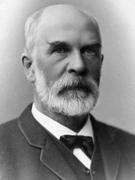
Cato Maximilian Guldberg was a son of Carl August Guldberg (1812-92) and Hanna Sophie Theresia Bull (1810-54). Carl August Guldberg had been born in Strömstad, Bohuslän, Sweden on 6 November 1812. He ran a bookshop in Christiania where he also had a printing press. Perhaps we should remark that Christiania adopted the spelling Kristiania in 1897 and was renamed Oslo, its present name, in 1925. He married Hanna Sophie Theresia Bull on 6 November 1835 in Halden, Østfold, Norway. Hanna had been born in Fredrikstad, Østfold, Norway on 28 July 1810. Carl August and Hanna Guldberg had ten children: Cato Maximilian Guldberg (1836-1902), the subject of this biography; Axel Sophus Guldberg (1838-1913); Cathinka Augusta Carlsdatter Guldberg (1840-1919); Marie Theresia Guldberg (1842-1844); Hans Riddervold Guldberg (1843-1896); Mathilde Sofie Guldberg (1845-1907); Carl Johan Carlsen Guldberg (1846-1906); Fredrik Oscar Guldberg (1848-1905); Fritkjof Guldberg (1851-1893); and Gustav Adolph Guldberg (1854-1908). Let us note that Hanna Guldberg died on 27 October 1854, the day that her son Gustav Adolph was born. We also note at this point that Carl August Guldberg remarried in 1857 and, following the death of his second wife in childbirth, remarried again in 1864. He had four further children with these two wives.Axel Sophus Guldberg, the second son of the family, also became a mathematician. He was awarded a doctorate in mathematics in 1867 and taught mathematics at the Norwegian Military Academy. Cathinka Augusta Guldberg became a nurse and was the first to establish Norway's first professional nursing programme. Mathilde Sofie Guldberg married the pharmacist Peter Waage in 1870; Waage became a close collaborator of Cato Maximilian Guldberg and we give details of this collaboration below.
Carl August Guldberg, along with Adam Dzwonkowski, founded Skilling-Magazin in 1834. He was an editor of the magazine until 1847. He had broad interests in literature, social affairs and science, and the children grew up in a home with ample access to magazines and books. Cato was educated at home in Christiania until he reached the age of eleven. The family moved to Nannestad in 1847 when Cato's father became the resident chaplain at Nannestad Church. Nannestad was about 65 km north of Christiania and was a wonderful rural setting which gave the young Cato a love of the countryside; he was often hunting and fishing. It was not, however, a good place to educate children and so, after a couple of years, Cato and his younger brother Axel were sent to live with their maternal grandmother in Fredrikstad. Cato's had decided that he would like to become a naval officer so his grandmother, who owned a shipping company, let him make a voyage to France on one of her ships. This seems to have put him off the idea of a naval career; he began attending a secondary school in Fredrikstad.
At this Latin School, Cato excelled in mathematics but the school did not grant admission certificates for a university. As a result, Cato went to Christiania in 1853 and spent one year studying at August Holth's private Latin school. This school was founded by Jens Christopher August Holth (1815-1879) after he left his teaching position at Christiania Cathedral School following a dispute. The school operated out of Holth's own house in the Kvadraturen district of Christiania. After a year at this school, Cato took the examen artium in 1854 and later that year matriculated at Christiania University. Let us note that he must have had a difficult start to his university studies since his mother died in October 1854 soon after he began his studies of mathematics and physics. Later, while studying at the university, he lived in the house of the bishop and statesman Hans Riddervold (1795-1876). Hans Riddervold's wife Ann Marie Bull was the sister of Cato's mother Hanna Sophie Theresia Bull.
Although Guldberg's main interest was in mathematics, he was also interested in a broad range of scientific subjects which he studied while at university. He aimed at a qualification as a secondary school teacher of natural sciences and, as a consequence, took courses across a range of topics such as mathematics, physics, chemistry, botany, and zoology. He was taught mathematics by, among others, Ole Jacob Broch. He was awarded the cand. real. degree in 1859 and, in the same year, was awarded the Crown Prince's Gold Medal for his thesis At udvikle Constructionen af en Cirkel der berører tre andre Cirkler Ⓣ. He published En elementaer Methode til Bestemmelsen af Maxima og Minima Ⓣ in Mathematisk Tidsskrift in 1859 and, in the same part of the journal, posed the following two problems in the "Problems to solve" section [12]:-
1. Given a straight line and two points, one on each side of the same; on the given line one must determine a point in such a way that the difference of the distances to the two given points is a maximum.While studying at university, he joined with some of his fellow students in creating a science society which proved important in developing his research interests [3]:-
2. On a given circle to find a point of such a nature that the sum of the squares of the distances from this point to two given points is a minimum.
The science program at the University of Christiania was new (established in 1851) and attracted good students in an enthusiastic environment. Guldberg particularly joined Peter Waage and Henrik Mohn. These three, together with the pharmacists Hans Hvoslef and Franz P Møller and Theodor Mohn, had a private "Physical-Chemical Society" in the years 1858-1860, with the purpose of "discussing matters of a physical-chemical nature". They met every Saturday and gave lectures to each other which were then discussed. The topics varied widely, from optics and astronomy to the factory production of aluminium; most of them lay in the border area between physics and chemistry. Guldberg contributed, among other things, a lecture on "mechanical heat theory" and several on how the melting point of metal alloys and other mixtures changes with the mixing ratio. The results of these last works were printed in the Proceedings of the Scientific Society of Christiania in 1860.After graduating in 1859, Guldberg taught mathematics at the Nissen School in Christiania. This school had been founded by Hartvig Nissen and his friend Ole Jacob Broch in 1843. Broch had taught at this school until 1847. At Nissen's Latin and Science School [2]:-
... three and four hours a week [of mathematics] were taught in the two upper forms. During the school's first few years, Ole Jacob Broch obviously led all the teaching of mathematics. When Broch left the school ... it was still in many ways [he] who ruled the teaching of mathematics. As professor of mathematics Broch not only taught future teachers ... [he] also determined the requirements for the 'examen artium'. Broch was known to be such a strict examiner and censor that many could not pass his requirements ...Ludwig Sylow had been the principal mathematics teacher at this school from 1856 to 1858 and Guldberg's appointment was to teach the higher classes after Sylow left. Sophus Lie was a pupil at the Nissen School 1857-1859; it is not clear whether he was taught by Guldberg.
As well as teaching at the Nissen School, Guldberg taught mathematics at the Christiania Military College. In 1861 he was awarded a scholarship which allowed him to spend a year studying applied mathematics and mechanics at various universities in France, Switzerland and Germany. Returning to Christiania in 1862 he was appointed to teach applied mathematics at the Christiania Military College.
On 30 June 1863 Guldberg married Bodil Mathea Riddervold in the Trinity Church in the Hammersborg district of central Christiania. Bodil was the daughter of Hans Riddervold, mentioned above, whose wife Ann Marie Bull was the sister of Guldberg's mother Hanna Sophie Theresia Bull. Guldberg therefore married his cousin. Cato and Bodil Guldberg had three daughters: Marie Sofie Guldberg (born 1865); Cathrine Margrethe Guldberg (born 1869); and Anna Emilie Guldberg (born 1870). When Guldberg married Bodil he became the brother-in-law of his friend and collaborator Peter Petersen Waage (1833-1900). Waage had married Johanne Christiane Tandberg Riddervold (1838-1869) on 31 January 1862. After Johanne died in 1869, Waage married Guldberg's sister Mathilde Sofie Guldberg on 2 October 1870. Guldberg and Waage then became brothers-in-law twice. Let us now look at the research carried out by Guldberg and Waage for which they are best remembered today [23]:-
Cato Guldberg was a mathematician and Peter Waage was a chemist. They were also brothers-in-law. Together they tried to find a way to express the "driving force" in chemical reactions mathematically. This was in the 1860s, at a time when it was thought that chemical forces acted when new substances were formed in a chemical reaction. Some explained reversibility, that is, the fact that chemical reactions can go both ways, as a balance between two opposing forces.We note that the chemist Augustus Vernon Harcourt and the mathematician William Esson, working at the University of Oxford in England, stated the law of mass action in 1865, one year after Guldberg and Waage stated it in their first paper. Today Guldberg and Waage are credited with the law since they included chemical equilibrium while Harcourt and Esson focused almost exclusively on the kinetics.
Building on the work of other researchers, Guldberg and Waage conducted about 300 experiments with reversible chemical reactions to explore the phenomenon further. Their strategy was to describe mathematically the forces acting in each of the opposing reactions, and then formulate a general law that said something about the relationship between them. They were also concerned with the conditions that affected the chemical forces acting in the reactions, such as temperature and solubility.
Guldberg and Waage eventually came to the conclusion that molecules of A and B react because they collide with sufficient force to cause them to react. How often they collide depends on the concentration of molecules A and B. Concentration was called "mass effect" by Guldberg and Waage. They called it mass effect because they argued that this was a factor that had to be taken into account in addition to affinity, the force that caused different substances to react with each other. In articles published in Norwegian, French and German in 1864, 1867 and 1879, they developed and refined their ideas towards what is today known as the law of mass action.
This work that Guldberg carried out up to 1867 was done without him having any university position. He taught mathematics at the Royal Military Academy from 1860, then from 1863 he taught military cadets advanced mechanics. In 1867, however, he was appointed as a university fellow in applied mathematics at the University of Christiania. At this time there were two professors of mathematics at the University of Christiania; Ole Jacob Broch was professor of pure mathematics and Carl Anton Bjerknes was professor of applied mathematics. Broch had a political career in parallel with his university professorship and had served on Christiania's city council from 1857. In 1869 he became a member of the government and left his university professorship. Bjerknes moved from the professorship of applied mathematics to the professorship of pure mathematics and Guldberg was appointed as professor of applied mathematics.
In addition to his university duties, Guldberg was active in other Norwegian organisations. The Polytechnic Society (Polyteknisk Forening) had been founded in 1852 and, in 1854, the society established it journal the Polyteknisk Tidsskrift Ⓣ; it later become Teknisk Ukeblad Ⓣ. Guldberg was an editor of the journal and served as chairmen of the Polytechnic Society for three terms (1866-1868, 1869-1872, 1874-1875). The Norwegian Academy of Science and Letters in Christiania had been founded in 1857 (it is now known as the Norske Videnskaps-Akademi, DNVA). Guldberg was a member from 1867 and served as President or vice-President from 1872 to 1895. The Royal Norwegian Society of Sciences and Letters in Trondheim (now nown as the DKNVS) had been founded in 1760; Guldberg was a member from 1870. He was a member of the board of the Norwegian Geographical Survey from 1872 to 1875. He also served on the board of the Norwegian State Railways being its director from 1878 to 1883.
There is another area of Guldberg's research that we must discuss. We mentioned above the "Physical-Chemical Society" which Guldberg started with his fellow students Peter Waage and Henrik Mohn. We have seen how he worked with Waage to come up with the law of mass action. He also worked on meteorology, the area in which Henrik Mohn (1835-1916) became an expert. Mohn's initial interest was in astronomy and, when Christopher Hansteen retired in 1861, Mohn was appointed as an observer at the University's Astronomical Observatory. Here he continued the meteorological observations that Christopher Hansteen had begun in 1837. This brought him into contact with meteorology, which was to become his main interest for the rest of his life. In 1863, Mohn published the paper Storms in Christiania from 1837 to 1863 in the Polyteknisk Tidsskrift. Guldberg used the data from that paper to understand low-pressure areas. He realised that air rotates around the low pressure in a spiral but it experiences a force, the Coriolis force, from the earth's rotation [3]:-
Wind direction and wind strength are determined by a balance between the pressure gradient, the Earth's rotation and the centrifugal forces in the vortex, and Guldberg set up equations for this balance. Using these equations, one can approximately calculate the wind from a map of the air pressure. He published the results in Polyteknisk Tidsskrift in 1872.Guldberg then undertook joint research with Henrik Mohn to produce a more reliable cyclone model. They published Études sur les Mouvements de l'Atmosphère Ⓣ in two parts (1876 and 1880); the Preface to the first part is as follows [14]:-
Since meteorological phenomena are highly complex, their mathematical study can only be approached by dealing with simple cases analogous to those found in nature. The equilibrium and movement of air constitute a still very underdeveloped branch of fluid mechanics, because there are too few observations for verifying numerical calculations. Encouraged by the excellent results obtained by Peslins, Reye, Colding, Ferrel, and Hann in this new application of analysis to meteorology, we have applied the principles of mechanics to atmospheric movements and have arrived at results that we believe are important for the development of meteorological science. First, we have found that one of the primary steps to ensure the success of meteorology is the establishment of meteorological stations at high altitudes: either on mountains or in balloons, and equipped, if possible, with recording instruments.Guldberg was also interested in factors that changed the freezing point and boiling point of a liquid. In 1890 he formulated Guldberg's rule which states that the normal boiling point of a liquid is approximately two-thirds of its critical temperature when both are measured on the absolute temperature scale. The critical temperature is the point above which a gas cannot be liquefied by pressure alone. The Swiss chemist Phillippe-Auguste Guye independently discovered this rule at about the same time and it is sometimes called the Guldberg-Guye rule.
Horizontal winds or air currents at the Earth's surface are intimately linked to vertical currents; but the origin and movement of the latter depend not only on the physical state of the air at the Earth's surface, but also on the physical state of the air in the upper layers. Furthermore, wind speed and direction are both highly influenced by the Earth's surface, while their values at a certain altitude would likely exhibit the regularity necessary to predict the course of meteorological phenomena.
We present here the first part of our studies, in which we have dealt with some simple cases of atmospheric mechanics. In treating atmospheric equilibrium, we introduced the virtual temperature, which is identical to the absolute temperature for dry air, but which depends on the amount of water vapor for humid air; the introduction of this quantity will simplify the formulas. We calculated the action of water vapor in the atmosphere, taking into account the variation of latent heat with temperature, which has been neglected in the usual formulas.
In studying horizontal currents under simple assumptions, we introduced friction along the Earth's surface, and we applied the theory to winds crossing the equator and vortices (C M Guldberg already, in 1872, developed part of this theory in the Norwegian Polytechnic Journal). The numerical calculations agree with the phenomena of nature within the limits that can be expected with the established hypotheses. It follows that the accurate observation of wind speed will be of great importance for meteorology.
Finally, we have also treated vertical currents in a special case to show the importance of meteorological observations at altitude.
We hope that the results derived from atmospheric mechanics will demonstrate the necessity of more extensive meteorological observations, especially in the tropics and in the upper layers of the atmosphere, and that the true path to progress in meteorology is founded on the development of atmospheric mechanics.
In January 1902 Guldberg died at the age of 65. Sadly although he had received many Norwegian honours, his contributions were little known outside Norway. This has certainly changed and today he is widely recognised for his important contributions.
References (show)
- Anon, Review: Opgaver i praktisk Regning (Tillæg til Samling af mathematiskeOpgaver), by C M Guldberg, Tidsskrift for mathematik 4 (2) (1868), 144.
- T A Bak, Cato Maximilian Guldberg, Danmarks Nationalleksikon (23 April 2023).
https://lex.dk/Cato_Maximilian_Guldberg - B Birkeland, K E Aubert and B Pedersen, Cato Maximilian Guldberg, Store norske leksikon (2026).
https://snl.no/Cato_Maximilian_Guldberg - Cato Maximilian Guldberg (1836-1902). Norwegian chemist, Oxford Reference (2003).
- Cato Maximilian Guldberg, ancestry.com (2026).
- Cato Maximilian Guldberg, Lernhelfer (2026).
https://www.lernhelfer.de/schuelerlexikon/chemie-abitur/artikel/cato-maximilian-guldberg - K Fasting, Teknikk og Samfunn, in Den Polytekniske Forening 1852-1952 (Oslo, 1952).
- R E Ferner and J K Aronson, Cato Guldberg and Peter Waage, the history of the Law of Mass Action, and its relevance to clinical pharmacology, British Journal of Clinical Pharmacology 81 (1) (2015), 52-55.
https://pmc.ncbi.nlm.nih.gov/articles/PMC4693570/ - H Goldschmidt, C M Guldberg, in Fordhandlinger Videnskabs-Selskabet Christiania 1 (1903), 1
- C M Guldberg, En elementar Methode til Bestemmelsen af Maxima og Minima, Mathematisk Tidsskrift 8 (September 1859), 113-115.
- C M Guldberg, Om Diagonaleres Beregning i rrgulaere Polygoner, Mathematisk Tidsskrift 12 (December 1863), 177-180.
- C M Guldberg, Opgaver til Losning, Mathematisk Tidsskrift 8 (September 1859), 127.
- C M Guldberg, Opgaver i praktisk Regning (Tillaeg til Sanding af mathematiske Opgaver) (Christiania, 1865).
- C M Guldberg and H Mohn, Études sur les Mouvements de l'Atmosphère. Première Partie (A W Brøgger, Christiania, 1876).
- Guldberg, Cato Maximilian, Scientists, Academic Dictionaries and Encyclopedias (2016).
https://scientists.en-academic.com/608/Guldberg_%2C_Cato_Maximilian - Guldberg, Cato Maximilian, Universalium, Academic Dictionaries and Encyclopedias (2016).
https://universalium.en-academic.com/270354/Guldberg%2C_Cato_Maximilian - J B Halvorsen, C M Guldberg, in Norsk Forfatter Lexikon, II (Christiania, 1888), 447.
- T Hiortdahl, Den Fysisk-Kemiske Forening, Tidsskr. Kemi, Farmaci og Terapi, in Pharmacia, 14 (1917), 240
- E Holst, C M Guldberg, in Nordisk Universitetstidsskrift 2 (1902), 321.
- E Holst, Mathematik, in Henrik Jaeger (ed.), Illustreret norsk Litteraturhistorie (Hjalmar Biglers Publishing, Kristiania, 1896).
https://runeberg.org/ilnolihi/4/0070.html - G B Kauffman, Guldberg, Cato Maximilian, encyclopedia.com (2026).
https://www.encyclopedia.com/science/dictionaries-thesauruses-pictures-and-press-releases/guldberg-cato-maximilian - C Krüger, Review: Laerebog i Meckanik, Tidsskrift for mathematik 1 (5) (1883), 94-96.
- A Lykknes and B Pedersen, Mass effect law, Store Norske Leksikon (12 February 2025).
https://snl.no/massevirkningsloven - A Stubhaug, The Mathematician Sophus Lie: It was the Audacity of My Thinking (Springer Science & Business Media, 2013).
- The Crown Prince's Gold Medal 1811-1870, Oslo University Museum (17 March 2021).
https://www.muv.uio.no/uios-historie/epoker/1811-1870/kronprinsen-kvist-010907.html - S Torup, C M Guldberg, in Norsk biografisk leksikonV (Oslo, 1931), 76
- N S Vaage, Cato M Guldberg, Arts and Gardens, University of Bergen (21 March 2012).
https://www.uib.no/en/arts-and-gardens/78214/cato-m-guldberg
Additional Resources (show)
Other websites about Cato Guldberg:
Written by J J O'Connor and E F Robertson
Last Update July 2026
Last Update July 2026