 MacTutor
György Hajós
Quick Info
Budapest, Austria-Hungary (now Hungary)
Budapest, Hungary

Biography
György Hajós was the son of Géza Hajós (1869-1951), a lawyer and a judge, and Clark Nelly (1889-1957). Géza Hajós, the son of Mór Hajós and Rozália Schwartz, was born on 5 July 1869. He married Nelly Clark in 1908. Nelly Clark was the daughter of Simon Clark and Irma Mária Mattmann. Simon Clark, born 1866, was the son of the Scottish engineer Adam Clark and his Hungarian wife Mária Áldásy. Adam Clark, born in Edinburgh, Scotland, in 1811, is famed as the engineer who built the Széchenyi Chain Bridge over the Danube River in Budapest. He also designed and built Buda Castle Tunnel. Géza and Nelly Hajós had three children: Maria Hajós (1910-1992), who became a nun; György Hajós (1912-1972), the subject of this biography; and Géza Hajós (1914-1975), who worked at the Hungarian National Bank.Hajós began his secondary education at the Kegyesrendi Gimnázium in Budapest. This was the Piarists Fathers' School in Pest which began operating in 1717. New buildings were erected just before World War I which provided space for the gymnasium, the convent, the provincial headquarters and the Kalazantinum theological institute. Hajós began to get interested in mathematics at the age of 13 and he was encouraged in this by reading the Középiskolai Matematikai és Fizikai Lapok [Mathematical and Physical Journal for Secondary Schools]. This journal has been published since 1894 and contained mathematics and physics problems. It also organised competitions for secondary school pupils. He was already solving the most difficult published problems in the journal when he was in the fifth grade and, in 1929, he won first prize in mathematics at the national secondary school mathematics competition. He graduated from the Gymnasium in 1929 but did not begin university studies at this time since he chose to enter a religious order and train as a teacher.
It is not surprising that Hajós decided to enter a religious order since he came from a religious family who had sent him to a religious school. Also his sister, who was two years older than Hajós, was training to become a nun. He applied to the Piarists Fathers' Teaching Order but during his novitiate period, in his free time, he intensively studied mathematics. In 1931, he enrolled in the Faculty of Humanities of the Pázmány Péter University in Budapest. The Pázmány Péter Catholic University had been founded in 1635 and was named after its founder, the Archbishop of Esztergom, Péter Pázmány. After having its name changed to the Royal Hungarian University of Science, it had regained the name of Pázmány Péter University in 1921. We should note that it was restructured in 1950 and the part separated from the Faculties of Medicine and Theology was named the Eötvös Loránd University.
Remarkably for someone who was an undergraduate, he gave a lecture to the Hungarian Academy of Sciences in 1932 entitled A determinant theorem and in 1934 he gave the lecture Covering of multidimensional space with a lattice to the Eötvös Loránd Mathematical and Physical Society. This Society had been founded by Loránd Eötvös in 1891 and it was named for its founder in 1921 following Eötvös' death in 1919. These invitations to lecture were the result of the results that Hajós was obtaining and publishing. He published three papers in 1934: A new proof of a theorem by Minkowski; A determinant theorem; and On Menger's graph theorem. The first and third were written in German (where his name appears as Georg Hajós) while the second was written in Hungarian. The first begins [6]:-
I will provide a proof of a theorem by Minkowski, which, to my knowledge, is simpler than the previously known proofs. The theorem states:In 1935 Hajós graduated from the Faculty of Arts of Pázmány Péter University having majored in mathematics and physics. He continued to study for his teaching certificate but, in 1935 he was appointed as an acting assistant professor at the József Nádor Technical University of Budapest.
If a convex region B, symmetric with respect to the origin O, in the plane of the rectangular coordinate system, has an area greater than 4, then B contains a lattice point other than O as an interior point.
The József Nádor Technical University traces its origins back to the Institutum Geometrico-Hydrotechnicum (Engineering Institute), founded by Joseph II, which began its work in 1782. In 1871 the independent Technical University was established. In 1934 re-structuring occurred, bringing about the József Nádor University of Technology and Economics. We note that today it is known as the Budapest University of Technology and Economics. In 1936 Hajós was awarded his teaching certificate and was appointed as an assistant professor at the József Nádor University. He also began undertaking research for his doctorate advised by Lipót Fejér. He submitted his thesis Covering of multidimensional spaces with a cube lattice and took the doctoral examination in mathematics in which he was examined by Lipót Fejér and the doctoral examination in experimental and theoretical physics examined by Charles Tangl and Rudolf Ortvay. He was awarded his doctorate in 1938.
Hajós is best remember today for his proof of Minkowski's famous 1896 conjecture. This proof appears in his 41-page paper Über einfache und mehrfache Bedeckung des n-dimensionalen Raumes mit einem Würfelgitter Ⓣ published in 1942. The paper begins [7]:-
About half a century ago, Minkowski's work "Geometry of Numbers" was published, in which he raised, among other things, a question that has been much discussed ever since. We intend to answer this question in the present work; it is related to the following theorem by Minkowski, proven in the aforementioned work:In fact the proof of Minkowski's conjecture can be found in two papers by Hajós written in Hungarian, one published in 1938 and the other in 1941. He lectured on his proof of Minkowski's conjecture to the Eötvös Loránd Mathematical and Physical Society in 1940.
If are homogeneous linear forms in the variables , with real coefficients and determinant 1, then there exist integers that do not all vanish and for which
.
In [7] he gives details of earlier work on the conjecture:-
Several authors have addressed this conjecture, but none have been able to provide a definitive answer. H Jansen (1909) proved its validity for n ≤ 6, Th Schmidt (1933) for n ≤ 7, and O-H Keller (1937) for n ≤ 8. However, regarding these works, see the critical remarks of O Perron (1940), who gave a clear proof for n ≤ 9 (1941). B Levi (1911), S L Van Oss (1915), and C L Siegel (1922) have dealt with the general conjecture, but their proofs contain gaps or are not fully developed. J F Koksma (1936) and L J Mordell (1936) gave reports on the state of the entire problem. In the present work, the validity of the conjecture is proven for every n.The authors of [2] write:-
The scientific work of Hajós culminated in his famous proof (1941) of Minkowski's conjecture (1896) concerning the lattice covering of the n-dimensional space with cubes. The proof rests on his theorem of the factorisation of Abelian groups the importance of which was later recognised in the international mathematical literature. Rédei called it the second fundamental theorem of the theory of Abelian groups.Hajós continued to work at the József Nádor Technical University of Budapest until 1949. He had broad mathematical interests; for example he published The foundations of error estimation (Hungarian) in 1942. It has the following summary [8]:-
After discussing the necessity, advantages, and principles of error estimation, the aim is to systematically present the well-known elements of error estimation and to supplement them in some places. Applications of probability theory are not touched upon. In the sense of approximation mathematics, only practical purposes are served.He was awarded his first major prize in 1942 when the Eötvös Loránd Mathematical and Physical Society awarded him their König Gyula Prize. Loránd Eötvös was president and Gyula König was vice-president when the Mathematical and Physical Society was founded on 5 November 1891. The Society was renamed the Eötvös Loránd Mathematical and Physical Society in 1921 and the König Gyula prize was first awarded in 1922 to Mihály Bauer who had been a student of König. In 1944, after losing its possessions, the Society ceased to exist. Hajós was presented with the König Gyula Prize by László Rédei, who gave the laureation. As a result, Rédei became involved in research on the topic and succeeded in simplifying Hajós's proof. Tibor Szele learnt about Hajós's proof through Rédei, and later published an even simpler proof of Hajós's theorem himself.
World War II began in September 1939 when Germany invaded Poland. Hungary joined Germany with military support from the summer of 1941. There was no military action in Hungary itself until 1944 and, except for conscriptions of some junior staff and students, university life went on much as normal. From December 1944 until February 1945 Budapest was under siege from Soviet and Romanian troops and was defended by German and Hungarian forces. Conditions in the city were horrendous and many of the inhabitants died of starvation or were killed by military action. After the war ended life in Budapest was difficult. There was hyperinflation with prices doubling every 15 hours. With the communists now in control, many changes in the educational system came about. Hajós became an invited lecturer in József Nádor Technical University in 1945 and, in the same year, an invited lecturer and mathematics department head of Eötvös College.
In 1945 he married Márta Vajda (1918-2012), the daughter of Ernő Vajda and Jolán Zmeskall, born in Gödöllő, Hungary on 2 August 1918. György and Márta Hajós had five children: György Hajós (18 February 1946-26 September 2019), Tamás Hajós (born 27 July 1947), Pál Hajós (born 17 December 1948), Katalin Hajós (born 15 March 1950), and Márta Hajós (born 28 June 1954). We note that the eldest son György Hajós became a chemist, a doctor of the Hungarian Academy of Sciences, and a research professor and director of the Institute of Organic Chemistry of the Natural Sciences Research Center of the Hungarian Academy of Sciences. The second son, Tamás Hajós, runs the Hajós database at https://hajos.iif.hu/rok/rok.php.
Quite understandably, the war had caused a break in Hajós's publications. In 1946 he gave the lecture Leibniz's life and work to the Eötvös Loránd Mathematical and Physical Society and in 1946-47 he gave a course of five lectures to the newly constituted Industrial Production Council on Mathematical statistics and monographs. His first publication following World War II was Sur la factorisation des groupes abéliens Ⓣ (see [9]) which continued to develop his work on Minkowski's conjecture. Robert Rankin writes [12]:-
The author considers various problems connected with the factorisation of abelian groups and the filling of space by congruent hypercubes. Let A and B be two subsets of a given group G; then we write AB = G if corresponding to any there exist unique elements , such that , and we say that G is divisible by A and by B. A subset S consisting of elements is called a series; when k is the order of a, S is a cyclic subgroup and is then said to be periodic. More generally, a subset A is called periodic if for some and A is then divisible by the cyclic subgroup generated by a. The Minkowski conjecture concerning homogeneous linear forms is equivalent to the author's theorem [1941] that if a finite abelian group is factorisable as where are series, then at least one is periodic. Various extensions of this result are discussed ...Hajós was an outstanding lecturer and was invited to give many popular lectures. For example in the years 1947-1949 he gave the lectures: Art in mathematics; Symmetry in thinking; Continuing education course for educators (3 lectures); Mathematical aesthetics; and How can we calculate with figures?
In 1949 Hajós left the József Nádor Technical University when he was appointed as professor of geometry at the Pázmány Péter University. On 15 September 1950 the Pázmány Péter University was restructured, the Faculties of Medicine and Theology were split off, and the remaining part was named Eötvös Loránd University. At this time a Faculty of Science was created in the Eötvös Loránd University and Hajós became Head of the Department of Geometry in the new Faculty of Science. Hajós immediately became dean of the new Faculty of Science and served in this role in 1950-51. Hajós, who had been elected to the Hungarian Academy of Sciences in 1948, became Head of the Department of Numerical and Graphical Methods in the Institute of Applied Mathematics of the Hungarian Academy of Sciences in 1950. We note that the Institute for Applied Mathematics was founded by a government decree in 1950. Its first director was Alfréd Rényi, who headed the Institute till his early death in 1970. It was then named the Alfréd Rényi Institute of Mathematics.
Hajós continued his research on abelian groups and published Sur le probleme de factorisation des groupes cycliques Ⓣ in 1950. A counterexample to a conjecture that he made in this paper was given by Arthur Sands in [15]. This is only one example of papers which were written developing further ideas or answering questions in papers by Hajós. In fact (in 2025) MathSciNet gives about 100 papers published between 1949 and 2025 which refer to Hajós in their title. Among these are papers on "the Minkowski-Hajós theorem", on "a group theory theorem of Hajós", on "a conjecture of Hajós", on "the chromaticity criterion of Hajós", on "the Hajós-Rédei theorem", on "the Hajós graph-colouring conjecture", on "Hajós' theorem for hypergraphs", on "the graph-colouring theorem of Hajós", on "the tree-like Hajós calculus", on "the Hajós n-property", on "the Hajós polyhedra", on "Hajós graphs", on "Hajós constructions", on "the Hajós sum", and several others.
In [3] his research contributions are summarised as follows:-
His name is associated with the proof of a famous conjecture by H Minkowski, which resisted the attempts of the greatest for many years; his theorem is cited everywhere as the Minkowski-Hajós theorem. In connection with the proof of the Minkowski conjecture, he expanded the classical theory of finite abelian groups with a breakthrough discovery. With this work he gained international fame. He achieved valuable results in the fields of discrete geometry, lattice point geometry, Bolyai-Lobachevsky geometry, the theory of geometric constructions, graph theory, nomography, and numerical analysis.At Eötvös Loránd University he taught the courses 'Introduction to geometry', 'Differential geometry', 'Numerical and graphical methods I' and 'Numerical and graphical methods II'. The authors of [2] write:-
Hajós was also an excellent teacher, his lectures had a country-wide fame. He was able to present the matter very clearly, very interesting and, at the same time, with highest logical precision. His book, "Introduction to Geometry" (1960) was published four times in Hungarian and translated into German (1970).He also actively supported Hungarian mathematics in other ways. He was Head of the Department of Numerical and Graphical Methods in the Institute of Applied Mathematics of the Hungarian Academy of Sciences (1949-1965) and Head of the Department of Geometry in the Institute of Applied Mathematics of the Hungarian Academy of Sciences (1962-1965). He was the editor-in-chief of the Acta Mathematica Academiae Scientiarum Hungaricae for ten years and also was president of the János Bolyai Mathematical Society for ten years (1963-1972).
We mentioned above awards and honours that Hajós received before he became a professor at Eötvös Loránd University. Later awards include: Order of Merit of the Hungarian People's Republic, 5th class (1951); Kossuth Prize, 2nd class (1951); Outstanding Worker of Higher Education (1953); Order of Merit for Labour (1954); Order of Merit for Labour (1960); Kossuth Prize, 2nd class degree (1961); elected a Corresponding Member of the Romanian Academy of Sciences (1965); elected a Member of the German Academy of Natural Sciences Leopoldina (1967); Commander of the Order of the Finnish Lion (1969); Budapest University of Technology, Royal Guard, 1st degree (1970); and Order of Merit for Labour, gold degree (1972).
Following his death in 1972, Hajós has been honoured with the Hajós György National Mathematics Competition being named for him. This competition was first held for students of technical institutions in 1979 and has been organised by an institution every year since then. Initially, only technical colleges were allowed to participate. The number of invitees has increased, however, so now not only colleges, but also university faculties of engineering, economics and information technology are invited to enter one team per faculty.
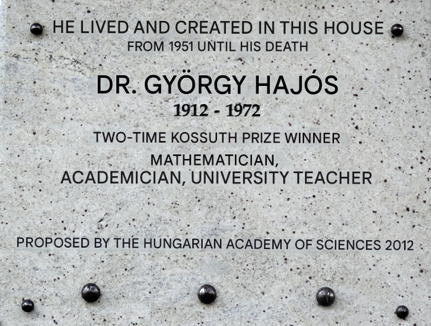
He has also been honoured with a memorial plaque being placed on his last residence, at 15-17 Margit Boulevard, Budapest, in 2012 by the Hungarian Academy of Sciences.
An English version of the plaque which is written in Hungarian is at THIS LINK.
The authors of [2] end with this tribute:-
Hajós loved his country profoundly. After many visits at foreign universities and congresses, he enjoyed to return to his pupils and tried to enrich and to improve the Hungarian mathematical life. He left a great lack behind him and we shall always cherish his memory.
References (show)
- György Hajós, Mathematics Genealogy Project (2025).
https://www.genealogy.math.ndsu.nodak.edu/id.php?id=157120 - György Hajós, Acta Mathematica Acaderniae Scientiarum Hungaricae 22 (1971), 267-268.
- Hajós György, Hungarian Biographical Encyclopaedia 1000-1990 (2025).
http://mek.oszk.hu/00300/00355/html/ABC05727/05821.htm - Hajós György, Nemzeti Névtér (2025).
https://magyarnemzetinevter.hu/person/652884/ - Hajós György (matematikus), A Wikipédiából, a szabad enciklopédiából (2025)
https://hu.wikipedia.org/wiki/Haj%C3%B3s_Gy%C3%B6rgy_(matematikus) - G Hajós, Ein neuer Beweis eines Satzes von Minkowski, Acta Litterarum ac Scientiarum, Szeged 6 (1934), 224-225.
- G Hajós, Über einfache und mehrfache Bedeckung des n-dimensionalen Raumes mit einem Würfelgitter, Mathematische Zeitschrift 47 (1942), 427-467.
- G Hajós, The foundations of error estimation (Hungarian), Matematikai és Fizikai Lapok 49 (1942), 84-122.
- G Hajós, Československá Akademie Věd. Časopis Pro Pěstování Matematiky 74 (1949), 157-162.
- Hajós György, Tudósportál (2025).
https://www.tudosportal.hu/egy.php?id=6499 - J Horvath (ed.), Hajós György, in A Panorama of Hungarian Mathematics in the Twentieth Century (Springer, 2006), 579.
- J Horvath (ed.), Molnár Ferenc, in A Panorama of Hungarian Mathematics in the Twentieth Century (Springer, 2006), 589.
- R A Rankin, Review: Sur la factorisation des groupes abéliens, by G Hajós, Mathematical Reviews MR0045727 (13,623a).
- L Rédei, On the fiftieth birthday of György Hajós (Hungarian), Matematikai Lapok. Bolyai János Matematikai Társulat 13 (1962), 217-227.
- A D Sands, On a conjecture of G Hajós, Glasgow Mathematical Journal 15 (1) (1974), 88-89.
- M Schwitzer, My First Thirty Years (1987).
https://www.schw.it/zer/ - W Schwitzer, Person Index for Mat Schwitzer's My First Thirty Years (March 2022).
https://www.schw.it/zer/mftyD.pdf - György Hajós (Hungarian), A Magyar Tudományos Akadémia Matematikai és Fizikai Tudományok Osztályának Közleményei 22 (1974), 2.
Additional Resources (show)
Other websites about György Hajós:
Cross-references (show)
Written by J J O'Connor and E F Robertson
Last Update March 2026
Last Update March 2026