 MacTutor
Fredrik Carl Mulertz Størmer
Quick Info
Skien, Norway
Oslo, Norway
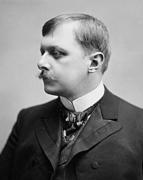
Biography
Carl Størmer's parents were Elisabeth Amalie Johanne Henriette Mülertz (1844-1916) (known as Henriette) and Georg Ludvig Størmer (1842-1930). Georg Størmer had been born in Trondheim where he attended the Latin High School before beginning an apprenticeship at a pharmacy in 1858. He took formal pharmacy examinations while working at this, and another, Trondheim pharmacy before moving to Kristiania (known as Oslo since 1925) where he passed his final pharmacy examination. After three years in Kristiania he moved to Skien and obtained permission to operate his own pharmacy in October 1871. Henriette Mülertz's family owned Skien's Pharmacy & Chemistry Shop which Georg Størmer purchased on 31 October 1871 just before marrying Henriette.Carl Størmer, born in Skien in 1874, was his parents' only child. He began his schooling at the Skien primary school in September 1881 and, two years later, entered Skien's Latin School. It was a happy childhood, with long summer trips with his parents to many different locations in Norway, but especially to the west coast fjords where his mother had relations. Carl's parents were very keen that their son should have the best educational possibilities and in November 1885 Georg Størmer sold his Skien pharmacy so that the family could move to Kristiania for the sake of Carl's education. They arrived in Kristiania in June 1886 and that summer Carl received private tutoring in mathematics from Heloise Lund. He studied at a Kristiania Middle School 1886-1887 graduating in July 1887 with good (but not outstanding) grades. In August 1887 he entered the Kristiania Katedralskolen, considered the best school in Kristiania. It was at this school that his interest in pure mathematics increased greatly [9]:-
From his childhood he showed a deep interest in the natural sciences, astronomy, physics, chemistry, meteorology, geology and in particular botany. At the age of about sixteen his interest turned exclusively to pure mathematics.Carl himself wrote in 1917 [12]:-
Before moving from Skien, I largely took care of myself and enjoyed science, particularly botany and astronomy. Every evening, when the weather was clear, I had the star map in front of me and learned to recognise different stars and planets from the map. I plotted their positions, sitting for several hours on the platform with paper, pen and a flash-light in hand. My only regret was that my father told me to become an astronomer I had to learn mathematics, which would be very difficult. That frightened me. Later, however, I came to a different understanding about learning mathematics.Elling Bolt Holst was an Associate Professor of Mathematics at the University of Kristiania when Carl Størmer's uncle, the engineer Fredrik Størmer, introduced Carl to Holst. During the winter of 1891-92 they met once a week to discuss mathematics. In March 1892 Holst invited Størmer to give a lecture at the University so, when still a high school pupil, he gave the lecture Summation of some trigonometric series. He graduated from the Kristiania Katedralskolen on 7 July 1892 with the overall grade "excellent" although his grades in Norwegian, English, French and Religion were not the highest.
Størmer entered the Royal Frederik University (as the University of Oslo was then called) on 2 September 1892. He lived at home during his university studies which were fully funded by his well-off parents. He chose to major in mathematics but he continued his interest in botany which he had since he was a child. It is unusual for anyone to publish a paper in the year they enter university as an undergraduate, but this is exactly what Størmer did with a paper on the summation of trigonometric series based on the lecture he had given at the University while still at the Kristiania Katedralskolen. At the Royal Frederik University he attended a few lectures by Cato Maximilian Guldberg (1836-1902), the mathematics professor, but in general missed lectures and read up the notes taken by his fellow students. He took botany courses, mechanics courses given by Axel Thue and astronomy courses by Hans Geelmuyden (1844-1920) but the only lecturer he described as "inspiring" was Elling Holst. By 1896, still a year before the award of his candidates degree, he had not only written seven mathematical papers but they were already in print by this time. Even more unusual is the fact that by this time he had also published a number of short notes on botany.
If one puts "Carl Størmer" into Google (in 2026), the greatest number of hits appear to be on articles on photography. For example Małgorzata Dwornik writes in [13]:-
Walking the streets of the capital, he observed people's expressions, behaviours, and clothes. He wondered how to preserve these scenes. Cameras at the time were large and static, yet Carl wanted to capture a specific moment, a smile, or a movement - especially of one young lady he admired. His youthful love, however, was no match for his shyness, which he couldn't overcome, especially since he did not know the lady personally. He simply wanted her photograph. Easier said than done, but he had access to the latest inventions and his own genius. ... Carl invested in a spy camera, the CP Stirn.He explained how it worked in a 1942 interview:-
I was a young 19 year-old student at the time and had got hold of a funny detective camera. It was a round flat canister hidden under my vest with the lens sticking out through a buttonhole. Under my clothes I had a string down through a hole in my trouser pocket, and when I pulled the string the camera took a photo. I strolled down Carl Johan, found myself a victim, greeted them, got a gentle smile and then I pulled the string. I took six images at a time and then I went home to change the plate.You can see examples of the photographs that he took at, for example, [1], [7], [8], [10], [13], [20], [22], [27]. We say more below about how his photography eventually became part of his academic studies.
Størmer studied at the Royal Frederik University until 1898 and in that year he obtained the candidates degree (about equivalent to a doctorate but without the accompanying title). He was awarded a scholarship from the Danish Hjelmstjerne Rosenkrone Foundation which enabled him to continue his studies abroad; he decided to study in Paris. Leaving Norway with his parents on 26 August 1898, he travelled to Paris via Denmark and Germany. His parents spent a month with him in Paris, then returned to Norway. Størmer spent the academic year, 1898-1899, at the Sorbonne studying with Émile Picard, Henri Poincaré, Paul Painlevé, Camille Jordan, Gaston Darboux, and Édouard Goursat. We know a lot about his time in Paris since he wrote long letters to his mother which have survived. They are fascinating so let us give an extract from a letter he wrote on 2 December 1898 (we use the translation from [12]):-
I just finished a new paper which I feel should be published as soon as possible. When I went to Societé Mathématique for the first time, I was well prepared and having written a short summary for oral presentation in French. Meetings always start with the president asking for "une communication à faire" or whether anyone has a work he wishes to present. One never announces a presentation beforehand. I informed him at once that I had a contribution. When called, I went to the board and started my presentation. I was told beforehand that I should not write long and complicated mathematical equations, but try to use simple forms. The audience is not supposed to applaud or clap hands. During this meeting 15 mathematicians were present. They and I were in formal evening dress.While in Paris, Størmer received a letter stating that from April 1899 he would have the position of research assistant in mathematics at the University in Kristiania. He left Paris in June 1899 and returned to Kristiania. On 25 September 1899 he invited 22 friends to a party at his parent's home. A special invitation was to Adelaide Clauson, whom he always called Ada, asking her to be his dinner partner. They had first met at a concert shortly after Størmer returned from Paris. She had been born in Naples, Italy, on 27 February 1877, the daughter of Consul-general Conrad Clauson and his wife Paula Rudolphine Nørregaard, and had spent the first twelve years of her life in Italy. Carl and Ada were formally engaged on 7 December 1899 and they were married at Uranienborg Church, near the University in Kristiania, on 27 February 1900. Note that they were married on Ada's 23rd birthday. They spent their honeymoon in Paris, travelling there by train and spending over fifteen weeks there. This, however, was a working honeymoon since Carl continued his studies at the Sorbonne while Ada took language courses. Returning to Kristiania, they moved into a furnished apartment at 14 Holtegaten on 18 October 1900. As their family increased they moved to larger apartments. They had five children, Henriette Adelaide Størmer (30 May 1902 - 16 November 1988), Leif Størmer (1 July 1905 - 15 May 1979), Per Størmer (13 June 1907 - 1991), Eva Størmer (4 April 1912 - 10 November 1986) and Christian Fredrik Mülertz Størmer (12 October 1915 - 26 December 2001).
I started my presentation with contempt for death. I felt it was better to jump in than to crawl. However, the printed version is more important. I tried to speak slowly and distinctly, as my French is far from fluent. However, I splashed a lot of chalk dust onto my evening dress, so by the time I finished it was almost white, but I did not notice this before I sat down. I finished with an apology for my French, but the President responded that he experienced no difficulty understanding my talk. On the way back to my seat I passed the secretary and handed him my manuscript. During my presentation I brought a book with notes to help with the presentation, but forgot to take it back with me. The first thing the next speaker did was to hand it to me, with a kindly smile. I promised myself that this would never happen again, because it clearly showed that I was very nervous. Next time, I promise not to be nervous, spill chalk dust or forget my notes.
After the presentations, we had an informal gathering at which I was asked a few questions regarding my work. On the way back to my apartment, I walked most of the way with the secretary of Societé Mathématique.
Størmer went abroad again in the autumn of 1902 to spend a semester at Göttingen in Germany. He greatly enjoyed Felix Klein's seminar but was not so happy with the courses he attended. It was a difficult time for him away from his wife and daughter. He missed his friends and the social life of Kristiania so he was happy to return to Norway shortly after Christmas.
His output of mathematical papers continued with twelve papers on series, number theory, and the theory of functions between 1896 and 1902. Let us note that he published a paper in Comptes Rendus in 1896 generalising formulas by James Gregory and John Machin which led to rapidly converging series for π. He also wrote papers on Pell's equation (for example [23]) and on logarithms of algebraic numbers. In fact in his 1897 paper on Pell's equation he proved that the equation
only has integer solutions for if is a power of 2.
He worked with Sylow and Holst to produce the two volumes to celebrate the centenary of Abel's birth in 1902. One volume was in Norwegian, the other a translation into French with the title Niels Henrik Abel; memorial publié à l'occasion du centenaire de sa naissance Ⓣ. In the same year he also published papers by Abel which he had left unpublished at his death, giving both Norwegian and French versions. Yet another work which came out in 1902 was the posthumous paper Über Integralinvarianten und Differentialgleichungen Ⓣ by Sophus Lie, edited by Størmer and Alf Guldberg and published in Christiania Videnskabsselskabs Skrifter Ⓣ.
Given this remarkable output of important mathematical works, he was a strong candidate to be appointed as professor of pure mathematics at the University of Kristiania when the position became vacant with the death of Cato Maximilian Guldberg in 1902. Størmer had to compete for the post against Alf Victor Emanuel Guldberg (1866-1936) who was also a strong candidate. Guldberg had been appointed to the University of Kristiania as a docent in 1892 and had a publication record as good as Størmer's. A committee was set up to make the selection consisting of Georg Zeuthen, Felix Klein and Émile Picard with Ludwig Sylow as chairman. The committee was impressed with both candidates, saying that they did not wish to distinguish between them. The Faculty was left to make the final decision and in August 1903 they appointed Størmer.
It was a post that Størmer held until 1946 yet, although he did continue to publish the occasional pure mathematics paper during this period, his interests were diverted by a different topic. Before looking at his new interest, however, we should comment briefly on his other work in pure mathematics. After his appointment as professor, he published, as he had earlier, a number of historical documents and some historical articles. He also published Methode d'intégrales numerérique des equations différentielles Ⓣ in 1921 and some elegant papers on number theory, including Sur une généralisation de la constante d'Euler Ⓣ (1940) published in a Russian memorial volume to Dmitry Aleksandrovich Grave, which were highly praised by Mordell.
Kristian Birkeland (1867-1917), one of Størmer's colleagues, had put forward a theory in 1896 that auroras were caused by electrons emitted by the sun which interacted with the earth's magnetic field. Poincaré had, in the same year, solved the differential equations resulting from the motion of a charged particle in the field of a single pole. This, of course, was not the situation for an aurora since the magnetic field of the earth is a dipole. This then was the problem that Størmer attacked [9]:-
Over many years [Størmer] made or organised such calculations, finding a great variety of orbits. His papers on this subject constitute a major part of his life's work; they number at least 48. Many are short, and in several cases he published brief accounts of the same work in different languages and journals. But many of the papers are very substantial in length and content.In 1931 Størmer published Über die Probleme des Polarlichtes Ⓣ which was reviewed by H D Harradon [16]:-
The ingenious corpuscular theory of polar lights, first experimentally studied by Birkeland in 1896 and later developed mathematically by Størmer and very recently illustrated by the refined experiments on periodic electron paths by Brüche, remains our most important attempt to explain the origin and nature of auroras and many apparently related geophysical phenomena. A large part of the article is properly devoted to these important studies in the development of which the author has had no small part. The latter portion of the article contains a good exposition of the present status of this work.A summary of all of this work appeared in Størmer's book The polar aurora published in 1955. However, this was not simply a theoretical investigation. As Størmer explained in the Preface to the work, he [9]:-
On the whole this paper may be characterised as a review of the special work to which Størmer has devoted many years of study. Its perusal discloses the many problems common to different fields of terrestrial and cosmical physics, possibly susceptible of elucidation through investigation of polar-light phenomena. That some light indeed may be shed on these in the near future the present activity in auroral study affords much hope.
... found it necessary to obtain more facts about the aurora in order to compare theory and observation. A photographic method designed to determine, among other things, the height and position of aurora was therefore developed and successfully applied. The chief results obtained from the analysis of a vast number of parallactic photographs are discussed in this book.Vicenzo Consolato Antonino Ferraro writes in the review [14]:-
Several monographs and articles on the Aurora have appeared in recent years: it is especially gratifying that the latest book on one of the most impressive of natural phenomena should be written by the man who more than any other has enriched the subject - Carl Størmer. As he tells us in the Preface, he began his career as a Pure Mathematician but the chance demonstration by his colleague Kristian Birkeland of the beautiful experiments on cathode rays moving in the presence of a magnetic field changed his whole future. Henceforth his whole interest was directed to the study and observation of the aurora and the author has here collected in book form the whole of his researches on the aurora.Certainly Størmer was not the first to photograph an aurora. This was first achieved in 1892. However he was the first to undertake a systematic scientific photographic investigation which he began in 1909 and continued throughout his career. The author of the review [19] of Størmer's book notes this contribution:-
The book is divided into two parts: the first gives an account of the observation, position and classification of aurorae. The second part is an account of Størmer's researches on the motion of a charged particle in the field of a magnetic dipole begun in 1903 and continued almost uninterrupted to the present day. The variety of orbits possible (amply illustrated by the many beautiful plates) is testimony of the great mathematical difficulty of the problem and also of the infinite patience of the man who pursued this laborious task. It is gratifying that this part of his theoretical researches has found a permanent place in the theory of cosmic rays. Its bearing on auroral theory is less certain though some features of it may be incorporated in an eventual theory. The typography of the book is excellent as was to be expected of a production from the Clarendon Press.
Many fine photographs by Størmer and his colleagues illustrate this part of the book. To Størmer the photographer we owe the development of the parallactic method of determining auroral heights.As we described above, it was not his interest in aurora which led him towards photography, rather his interest in photography came from his youth. As he wrote in the Preface of The polar aurora:-
It might be a source of interest to many to observe, in the development of my photographic work, what may result when a pure mathematician happens to be an enthusiastic amateur photographer.Størmer's interest in photography had started in his student days when he secretly photographed people near the university. He also published two works in 1942 and 1943 giving an illustrated account of his 'snapshots of famous people of the last fifty years'.
Viggo Brun was a student of Størmer's and writes in [3]:-
His lectures were of great importance to all us young students. They excelled in French elegance combined with clarity and simplicity. Particularly, Størmer's seminar was of great importance to all who were interested in mathematics. For graduate students, Størmer concentrated on Sophus Lie's transformation groups, gamma functions and elliptic functions. All acknowledged and appreciated his deep insights into these theoretical constructs.During his years as Professor of Pure Mathematics Størmer held other important positions in the university. These included serving as dean of the Mathematics and Natural Sciences Faculty from 1 September 1917 to the summer of 1923 and as deputy chairman of the Academic Collegium from 1921 to 1940. During World War II Germany invaded Norway in April 1940 and controlled the country from June 1940 until May 1945. Størmer should have retired in 1944 but, because of the German occupation, he continued in his post until he became emeritus on 1 January 1946. He continued to undertake research and came to the university almost every day.
Sydney Chapman, who knew Størmer for nearly 40 years, describes him in [9] as:-
... a rather large and bulky slow-moving man. ... He liked the pleasures of the table, good food and wine; he liked the theatre and the opera, and took with him opera glasses the better to observe the action and the danseuses.Størmer was honoured in many ways. He received the Fridtjof Nansen Prize in 1910 and, in the same year, he was awarded a gold medal for auroral research. He was elected to several Scandinavian academies, the Royal Society of London, the Ukrainian Academy of Sciences and the Paris Academy of Sciences. He was given honorary degrees by the universities of Oxford, Copenhagen and the Sorbonne. The Paris Academy of Sciences awarded him their Janssen Medal in 1922. He was invited to give a one-hour lecture on Modern Norwegian Researches on the Aurora Borealis to the International Congress of Mathematicians in Toronto in 1924 and he was president of the International Congress of Mathematicians in Oslo in 1936 and gave the first lecture on Tuesday 14 July with title Program for the quantitative discussion of electron orbits in the field of a magnetic dipole, with application to cosmic rays and kindred phenomena. In 1951 he was invited to address the Conference on Auroral Physics held at the University of Western Ontario, Canada. At this conference he received a gift from Sydney Chapman who gave a speech in homage to Størmer. We end our biography by quoting this speech:-
Dear Professor Størmer,
Members of this Colloquium on Auroral Physics have invited me to say to you, on their behalf, how pleased we have all been that you found it possible to come from Norway to be present with us at our Conference. We recognise in you the world authority in this field, in which you have been a pioneer and leader for very many years. We see combined in you gifts rarely found together, those of a pure mathematician and those of a national philosopher, theoretical and observational. You have enriched the literature of auroral physics with your mathematical papers on charged particles moving in a magnetic dipole field, as suggested by Birkeland's classical experiments. You have been the pioneer in auroral stereo-photography, for the determination of the height and geographic location of aurorae, and most of our knowledge of this subject is due to you. You have obtained, with the aid of many colleagues whom you have inspired, an enormous number of pairs of photographic plates of aurorae; you have measured and discussed them individually and statistically, and there remain a great quantity still to be discussed by you and others. One of the fruits of this work is the fascinating discovery of the remarkable sunlit aurorae. You have contributed to the study of the auroral spectrum, and your classification of auroral forms has been the basis of the International Auroral Atlas, which has been of great value to many other auroral observers, and has just been reissued for another period of fruitful life
But auroral studies have not fully absorbed your powers. You have used your auroral organisation also for the study of other interesting natural phenomena, such as the luminous night clouds, the mother-of-pearl clouds, and meteor trails. And your work and interest have extended beyond the bounds of physical science into botany and zoology. I need only refer to your practical skill in the production and discipline of unruly mice! (He made his handkerchief behave like a rat - to the great amusement for the participants.)
You have come from far to attend and add distinction and fruitfulness to our meetings. You have thus also given, to those of us who have long known you, the pleasure of renewed companionship, and to those who have hitherto known you only through your writings, the satisfaction of meeting you personally. You have made valued contributions to our lectures and discussions, and we hope that you will carry back with you some additions to your great store of auroral knowledge, which may enhance the value of the book of aurorae you are now writing, to whose appearance we are all looking forward.
We have unitedly felt that we should like you to take back with you some small memento of your time with us. I have much pleasure in asking you, in the name of us all to accept this little gift of a lighter, as a mark of our affectionate esteem, with our good wishes to you for a safe journey home, and a long continuance of your work in auroral physics.
References (show)
- A Norwegian Student Used an Early Spy Camera to Take Candid Street Scenes of Oslo in the 1890s, Rare Historical Photos (2026).
https://rarehistoricalphotos.com/carl-stormer-candid-photos/ - J A Anderson, The Work of Prof Carl Störmer on Birkeland's Theory of the Aurora Borealis, The Monthly Weather Review 36 (5) (1908), 129-131.
- V Brun, Carl Störmer in memoriam, Acta Mathematica 100 (1-2) (1958), i-vii.
- V Brun, Carl Störmer in memoriam, Nordisk Matematisk Tidskrift 5 (1957), 169-175; 213.
- Carl Störmer, NASA IMAGE Education Center (2026).
https://web.archive.org/web/20110512185904/http://image.gsfc.nasa.gov/poetry/tour/bioStorm.html - Carl Störmer, Encyclopaedia Britannica (2026).
http://www.britannica.com/biography/Fredrik-Stormer - Carl Størmer & his 1890s Hidden Camera, Photo Taking Spree. In Oslo Norway, London Luke Living History Page (2026).
https://www.youtube.com/watch?v=YyCMz5ynw-w - Carl Størmer Captured Candid Expressions With His Victorian Era Spy Camera, Racing Nellie Bly (24 March 2029).
https://racingnelliebly.com/weirdscience/carl-stormer-victorian-era-spy-camera/ - S Chapman, Fredrik Carl Mulertz Stormer, 1874-1957, Biographical Memoirs of Fellows of the Royal Society 4 (1958), 257-279.
- J Cheng, The Missing Photographer, Carl Størmer, Discover Photographers (2026).
https://www.youtube.com/watch?v=0OjfxTkPDr8 - A Egeland, Fredrik Carl Mülertz Størmer, Institute of Physics, University of Oslo (2 December 2005).
http://www.fys.uio.no/plasma/historie/stormer/ - A Egeland and W J Burke, Carl Størmer: Auroral Pioneer (Springer Nature, 2013).
- M Dwornik, Fredrik Carl Mülertz Størmer. Story of the first paparazzo in the world, Weekly Online Magazine, Reporterzy.info: media and the journalism (17 June 2024).
https://reporterzy.info/en/4671,fredrik-carl-mlertz-strmer-story-of-the-first-paparazzo-in-the-world - V C A Ferraro, Review: The Polar Aurora, by Carl Størmer, The Mathematical Gazette 40 (332) (1956), 141.
- O Grøn, Carl Størmer, Norsk biografisk leksikon (2026).
https://nbl.snl.no/Carl_St%C3%B8rmer - H D Harradon, Review: Über die Probleme des Polarlichtes, Geographical Review 22 (2) (1932), 344-345.
- J F Heard, Review: The Polar Aurora, by Carl Størmer, Journal of the Royal Astronomical Society of Canada 51 (1957), 117-118.
- P G Nutting, Störmer's work on the physics of the aurora, Terrestrial Magnetism and Atmospheric Electricity 13 (1) (1908), 23-24.
- M W O, Review: The Polar Aurora, by Carl Størmer, Science Progress (1933-) 44 (176) (1956), 717-718.
- Serie fotografert av professor Carl Størmer (Fredrik Carl Mülertz Størmer) (1874-1957), Norsk Folkemuseum (9 April 2014).
https://digitaltmuseum.no/011013321284/serie-fotografert-av-professor-carl-stormer-fredrik-carl-mulertz-stormer - R Siegmund-Schultze, Two contrasting and complementary views of Göttingen: letters from the first female Norwegian Ph.D. in mathematics, Elizabeth Stephansen, to her compatriot Carl Størmer in the winter semester of 1902/3, British Journal for the History of Mathematics 39 (2) (2024), 77-100.
- Størmer, Fredrik Carl Mülertz (1874 - 1957), Digitalt Museum (9 March 2026).
https://digitaltmuseum.no/021036008834/stormer-fredrik-carl-mulertz-1874-1957 - C Størmer, Om en egenskab ved løsningerne af den Pellske ligning Nyt tidsskrift for matematik 7 (B) (1896), 49-52.
- C Størmer, Measurements of Luminous Night Clouds in Norway, 1933 and 1934, Asrtophysica Norvegica 1 (3) (1935), 87-114.
- C Størmer, The polar aurora (Oxford Clarendon Press, 1955).
- C F Talman, Review: Luminous night clouds by Carl Størmer, Bulletin of the American Meteorological Society 16 (2) (1935), 50-51.
- Vintage: Street Shots of Oslo by Carl Størmer (1890s), Monovisions (12 April 2028).
https://monovisions.com/vintage-street-shots-of-oslo-by-carl-stormer-1890s/
Additional Resources (show)
Other websites about Carl Størmer:
Honours (show)
Honours awarded to Carl Størmer
Cross-references (show)
Written by J J O'Connor and E F Robertson
Last Update July 2026
Last Update July 2026