 MacTutor
Raghavan Narasimhan
Quick Info
Madras (now Chennai), India
Chicago, Illinois, USA
Biography
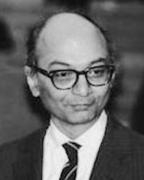
Raghavan Narasimhan was the son of Thillaisthanam Narasimhan Srirangam Raghavan (known as T N S Raghavan) and his artistic wife Kanakavalli. T N S Raghavan, who was born in 1901, was an Indian Civil Service officer who served as the District Collector of Madras in 1953 and then Chief Secretary of Madras State (now known as Tamil Nadu) in 1960. His family were from Thillaisthanam, a village in the Thanjavur district of Madras State. Raghavan Narasimhan had three siblings, all sisters. His most famous sibling was Raghavan Chudamani (1931-2010) who was born and grew up in Madras. She had a physical disability and was schooled at home. She became a famous author of short stories, plays and novels, writing in Tamil, and receiving many awards.It was in Madras that Narasimhan was brought up and educated. He finished his schooling in Town Higher Secondary School and joined Loyola College in Madras in 1952. The first two years at Loyola College involved in taking the "Intermediate", a preparation to enter a three year honours course. At first the subject that Narasimhan found most interesting was chemistry. He set up his own chemical laboratory at home and began conducting experiments. One of the chemistry books he read used the calculus in places and since he had never come across this before, he began to study the book Differential and Integral Calculus by Richard Courant. He was fascinated by the mathematics he learnt from this book and decided that he would give up his idea of a chemistry degree and study mathematics.
After completing the "Intermediate", he joined the mathematics honours course in 1954. He was greatly influenced by Father Charles Racine who was the head of mathematics at the College. He was also taught by Tirukkannapuram Vijayaraghavan who had been a student of G H Hardy and had become Director of the Ramanujan Institute of Mathematics when it was founded in 1950. Narasimhan's passion for mathematics was increased by Racine and Vijayaraghavan but it was given a special boost when he met Samuel Eilenberg in December 1956. Eilenberg had come to India to give a series of lectures at the Tata Institute of Fundamental Research but it was Eilenberg's interest in collecting Southeast Asian antiquities that brought him into contact with Narasimhan. He looked to buy rare bronzes and artefacts and had dealings with Narasimhan's maternal grandfather in Madras.
While he was an undergraduate at Loyola College, Narasimhan had embarked on a programme of studying advanced mathematical texts on his own. Many of these texts were in French or German and Narasimhan translated German texts into English with the help of dictionaries and language self-instruction books. In doing so he not only learnt advanced mathematics but also learnt German. He made carbon copies of his hand-written translations which he gave to his friend and fellow student C P Ramanujam. To give one example, he translated over 600 pages of Topologie Ⓣ by P S Aleksandrov and Heinz Hopf in less than a month while waiting for his B.A. (Honours) results in the summer of 1957.
In July 1957 Narasimhan was interviewed for the post of "Research Assistant" at the Tata Institute of Fundamental Research (TIFR) [25]:-
At the interview for the selection to the post (which was apparently of a record short duration), when asked if he could give a proof of the "Prime Number Theorem" Narasimhan responded with "Which proof do you want?"! There were two proofs of the theorem known at that time one using complex analysis, the other without; both proofs are difficult and the latter was less than a decade old as yet and by no means common knowledge even among experts in number theory.Narasimhan was accepted and began working for his Ph.D. advised by K Chandrasekharan. He wrote in [16]:-
When I joined the school of mathematics at TIFR in 1957, the atmosphere there was heady. Nothing seemed as important or as exciting as mathematics. New subjects were being talked about constantly and trying to learn them was a challenge. Listening to a colleague try out his ideas and attempting to understand and improve on them was the best instruction one could have. And then there was the excitement of working on problems oneself.Bernard Malgrange was invited to lecture at the TIFR and he gave a course of lectures in 1957-58 on functions of several complex variables. Narasimhan was asked to make notes from the lectures which he did sometimes adding his own insights after discussions with Malgrange. The lectures were published as the book Lectures on the theory of functions of several complex variables (1958). This led to Narasimhan undertaking research on functions of several complex variables and his first work in this area was the important paper Imbedding of open Riemann surfaces (1960). George Springer writes in the review [28]:-
One quality of the greatest importance in a leader of such a group is the ability to recognise significant mathematics and important problems even in fields far removed from his own areas of specialisation. In my opinion, Chandrasekharan had this quality to an extraordinary degree; otherwise the Institute would have been very different.
The author proves that every open Riemann surface has a one-to-one, regular, proper holomorphic embedding in . He uses a modified version of the Behnke-Stein approximation theorem and a special covering of the surface.The International Colloquium "Contributions to Function Theory" was held in January 1960 at TIFR and Narasimhan gave the talk Imbedding of open Riemann surfaces that was published later in 1960 in the Proceedings of the Colloquium. Narasimhan also began a collaboration with his thesis advisor Chandrasekharan and they began publishing a series of paper the first few being: Sur l'ordre moyen de quelques fonctions arithmétiques Ⓣ (1960); Hecke's functional equation and the average order of arithmetical functions (1960); On Hecke's functional equation (1961); Hecke's functional equation and arithmetical identities (1961); and Functional equations with multiple gamma factors and the average order of arithmetical functions (1962).
M S Raghunathan writes in [25]:-
When I joined TIFR in August 1960, [Narasimhan's] work on the imbedding of Riemann Surfaces had already been done. He was well ahead of his fellow students in their pursuit of a mathematical career. His colleagues certainly admired him greatly, but he himself seemed completely free of any feelings of superiority; and the admiration not withstanding, the interaction of his colleagues with him was informal and was by no means strained in any way. The most striking thing about him was his transparent enthusiasm for mathematics. He would get hold of one of his colleagues and start talking about some theorem or other that had excited him.In addition to his joint work with Chandrasekharan, Narasimhan studied the Levi problem (named after Eugenio Elia Levi). The original problem had been solved by K Oka in 1953 but Narasimhan was able to generalise this and published The Levi problem for complex spaces (1960-61). He continued this work and published The Levi problem for complex spaces II (1962). This led to him being invited to lecture at the International Congress of Mathematicians held in Stockholm from 15 to 22 August 1962. He gave a Half-Hour Address in the Analysis Section of the Congress with title The Levi problem in the theory of functions of several complex variables. One of the One-Hour Addresses at the Congress was by Hans Grauert who delivered the lecture Die Bedeutung des Levischen Problems für die analytische und algebraische Geometrie Ⓣ. Grauert quoted several results by Narasimhan in his talk. Narasimhan began his talk referring to Grauert's lecture:-
The history of the Levi problem is described in the lecture of H Grauert in this Congress and I shall not repeat it. We shall rather analyse the work of Oka on this problem, and see how the underlying ideas are susceptible of generalisation.In 1963 Narasimhan was awarded a Ph.D. by the University of Bombay and, in the same year, became an Associate Professor. In 1964 he became a full professor at TIFR, remarkably only two years after the award of his Ph.D.
In 1964-65 Narasimhan gave the course of lectures Topics in Analysis at TIFR, and the notes were published in the TIFR Lecture Notes Series as Lectures on topics in analysis (1965). He used the material from these lectures as the basis for his book Analysis on real and complex manifolds (1968). He also gave a course of lectures on Complex Analytic Sets at TIFR in 1965. He wrote the lectures up as he delivered them so that by the time he completed the course he had a manuscript ready to send to the publisher (Springer Verlag). The book was published as Introduction to the theory of analytic spaces (1966).
For more information about these three books by Narasimhan, see THIS LINK.
Things changed markedly at TIFR shortly after Narasimhan delivered these courses. He writes in [16]:-
Chandrasekharan left India for Switzerland in September, 1965 ... Shortly after his departure, Bhabha (the theoretical physicist who was the founder and first director of TIFR) died in a plane crash in January, 1966. It is my belief that the Tata Institute has been unable to absorb the loss of its two most visionary members, and that this has changed the atmosphere.Although Narasimhan does not say so in this quote, it was clear that he was unhappy with the director appointed to succeed Homi Bhabha. He resigned from TIFR in 1966 and accepted a professorship at Geneva, Switzerland. Before taking up the position, however, he was a member of the School of Mathematics at the Institute for Advanced Study at Princeton from September 1966 to April 1967. After leaving the United States, Narasimhan took up his professorship in Geneva and remained there until 1969. The University of Geneva awarded Narasimhan an honorary doctorate in 1986. The citation gives details of his career and then states [31]:-
When he was a professor at the University of Geneva, he exerted a profound influence on the development of mathematics in Geneva and French-speaking Switzerland, for example, by taking a close interest in the training of future doctoral students.Narasimhan returned to the United States and was appointed as a professor at the University of Chicago in 1969. He attended the conference Several Complex Variables held at the University of Maryland in April 1970 and delivered the lecture Cohomology with bounds on complex spaces. He married Carolyn Fulton Colburn (known as Lynn) in Newark, Delaware on 15 August 1970. Lynn, born 16 December 1942, was the daughter of Allan Philip Colburn and Evelyn Safford. Carolyn C Narasimhan received her PhD in 1977 from Northwestern University for her thesis The Periodic Behavior of Morse-Smale Diffeomorphisms on Compact Surfaces. Her advisor was John Moore Franks. Her early research was in the field of dynamical systems. She became active in mathematics and science education and became director of the STEM Center and a professor of mathematics at DePaul University, Chicago. She received generous funding from national, state, and local external agencies to support this work.
By conferring the degree of Doctor Honoris Causa upon Professor Narasimhan, the Faculty of Science has a dual purpose: on the one hand, to express the University of Geneva's gratitude to a world-renowned scholar for the services he has rendered to our institution; on the other hand, to strengthen the ties that bind us to him, in order to continue the collaboration undertaken for many years.
During the 1970s Narasimhan continued his long collaboration with Chandrasekharan and they published four joint papers. In 1971 he published the book Several complex variables which was based on lecture courses he had given at the University of Chicago and the University of Geneva. Joji Kajiwara writes in the review that this book [8]:-
... is a concise, excellent and well-written introduction to the elementary theory of functions of several complex variables, which is of importance not only in various branches of mathematics but also in theoretical physics. ... Readers may enjoy novel proofs of classical theorems here and there.For more information on this book, see THIS LINK.
Narasimhan also continued his work on the Levi problem, writing The Levi problem and pseudo-convex domains: a survey (1978), (with John Erik Fornaess) The Levi problem on complex spaces with singularities (1980), and The Levi problem on algebraic manifolds (1990). In the 1990s he wrote six papers with Charles Fefferman. Madhav Nori writes [19]:-
In the 1990s, Charles Fefferman and Narasimhan wrote a series of joint papers on the borderline of analysis and real algebraic geometry. Their results answered questions arising in the work of A Parmeggiani on the symplectic geometry associated to the symbol of a pseudo differential operator. The phenomena are subtle and surprising and the proof is formidable and related to a remarkable collection of geometric and analytic ideas.It was as a professor at the University of Chicago that Narasimhan spent the rest of his career. He became a naturalised American citizen in 1977. He made many visits to deliver lectures, for example he was invited by Chandrasekharan to the Forschungsinstitut für Mathematik of the Eidgenössische Technische Hochschule in Zurich from November 1984 to February 1985 where he delivered the Nachdiplom Lectures. The ETH Nachdiplom Lectures are given by distinguished guest professors, and are designed for an audience on a graduate level or higher. K Chandrasekharan and Jürgen Moser encouraged him to write up the lectures for inclusion in the series Lectures in Mathematics ETH Zurich published by Birkhäuser. His lectures were published as the book Compact Riemann surfaces (1992). C Andreian Cazacu in the review [2] writes:-
This remarkable book is distinguished from other books treating the subject using methods of algebraic topology and several complex variables, by the contents which, besides the usual results, includes special theorems not presented in other monographs and by the choice of the proofs, as well as by the conciseness and elegance of the style.For further information about this book, see THIS LINK.
Narasimhan gave a course of lectures on the structure of pseudoconvex manifolds at the Institute of Mathematical Sciences, Chennai in the Spring of 2007. Murali Krishna Vemuri writes in [29]:-
During this course, a new proof of L Schwartz's perturbation theorem for operators on Fréchet spaces was outlined. The proof is easy in the setting of Hilbert spaces, but for Fréchet spaces (or even Banach spaces) the proofs in the literature are quite hard. However, the Fréchet space version is the one which is needed to give easy proofs of the finite dimensionality of various cohomology groups which occur in complex analysis (in particular, the easiest proof that there exists a meromorphic function on any compact Riemann surface).Narasimhan had discovered this new proof shortly after the second edition of his book Complex analysis in one variable (Second Edition) (2001) had been sent to the printers. He intended to put the new proof into a third edition of the book but died before this could happen. (Vemuri reproduces Narasimhan's proof in [29]).
His last published work was Bernhard Riemann: Remarks on his Life and Work (2010). Here is part of the Abstract:-
The first part contains a few facts about Riemann taken from correspondence (of Riemann and of Dedekind), and then describes Riemann's letter to Weierstrass concerning his paper on the distribution of primes. It is followed by a brief outline of the paper itself. The second part deals with his course of Wintersemester 1858/59 on the hypergeometric series, which anticipated by a decade important work of L Fuchs and H A Schwarz.His wide range of mathematical interests took him in his final couple of years to a study of the twin prime conjecture. It was the results on small gaps between consecutive primes by Yitang Zhang (Bounded gaps between primes (2014)) and by James Maynard (Small gaps between primes (2015)) that excited him and he spent many hours studying their results.
On 24 September 2015, Narasimhan suffered a heart attack and became unconscious. He was taken to Bernard Mitchell Hospital but died on 3 October having never regained consciousness. A memorial service took place on 5 December 2015 at the University of Chicago's Quadrangle Club.
Following his death Narasimhan received many tributes. Shmuel Weinberger, the Andrew MacLeish Professor and chair of Mathematics at the University of Chicago, said [10]:-
Narasimhan was an analyst's analyst. He was a top analyst whose work had technical virtuosity, breadth of vision and elegance that, in difficult technical fields like analysis, are hard for non-analysts to appreciate. ... We appreciated his unique view of the world and his exquisite and uncompromising taste in mathematics. Much of his work was in several complex variables, but he had a deep interest in analytic number theory as well.Madhav Nori writes [19]:-
Narasimhan had a truly astounding insight in Analysis. He often got to the heart of any problem in this field with such speed that dazzled onlookers. He maintained a deep interest in many areas in mathematics, and was very generous with his ideas.M S Raghunathan writes in [25]:-
He was a warm person but it took a while for one to realise it as he seemed to have an almost pathological aversion to use language that may even remotely suggest any sentimentality. He was generous in his dealings with people and was always ready to share his ideas in mathematics. He was severe in his judgement of mathematical work and it was inevitable that that would cause some hurt.Narasimhan's wife Lynn said [10]:-
...
One of his abiding interests was wines. He knew a great deal about them and of course hugely enjoyed drinking fancy ones. He was an expert at tasting wines and has won bets for identifying the vineyard from which a peculiar wine originated. He once went on a "pilgrimage" to Burgundy cajoling vineyard owners to part with some of the finest vines in their cellars. There is a story about a waiter in a restaurant hesitating to serve a particular wine that he had ordered as it was very expensive when Narasimhan summoned the head waiter and ordered a whole crate! He was certainly a bon-vivant!
He had an unusual memory for taste. He could drink a wine in, say, 1990, and 10 years later drink the same wine and describe how it had changed. He could do the same thing with food. ... during the last decade of his life, cooking became one of his chief hobbies, and he would try to recreate some of his mother's recipes.M S Raghunathan writes in [25]:-
He used to declare that he was not interested in - even, that he disliked - music of any kind while he could sing short pieces of film music tunefully but giving them a twist to make them sound comical. [After 1966] I found him deeply interested in Western Classical music and listening to it for long hours every day. He had acquired quite a collection of records, a collection competing with his mathematics book collection.Pavaman Murthy said [20]:-
Once I came to Chicago, my friendship with Narasimhan became even more cemented. I have a great admiration for his mathematics. His interest in wine, and whatever he did, was done with such passion that it was quite admirable. He was a kind person who helped me a lot, and if I had any problem, I used to go to him first. We used to discuss mathematics quite a bit. In fact, whenever I had questions about affine varieties, I used to ask Narasimhan if answers were known in the case of Stein manifolds. If I did something in mathematics, I would tell Narasimhan first.Shravan Jyoti writes [3]:-
Very very sad indeed to hear that Dr Raghavan Narasimhan is no more. He was very intelligent and smart in balancing the academics and administration of the department. Very kind and motivating. His smile will be etched in our hearts forever. So many students have been motivated and will miss him.
References (show)
- S Abbott, Review: Complex analysis in one variable (Second Edition), by Raghavan Narasimhan and Yves Nievergelt, The Mathematical Gazette 86 (505) (2002), 190.
- C Andreian Cazacu, Review: Compact Riemann surfaces, by Raghavan Narasimhan, zbMATH 0758.30002.
- Dr Raghavan Narasimhan's passing away, Jipmer community pays tribute, facebook (2 May 2024).
https://www.facebook.com/groups/thejipmernet/posts/7603413513077548/ - J Eells, Review: Lectures on topics in analysis, by Raghavan Narasimhan, Mathematical Reviews MR0212837 (35 #3702).
- Gaddeswarup, Raghavan Narasimhan 1937-2015, Gaddeswarup's Blog (4 April 2017).
https://gaddeswarup.blogspot.com/2017/04/raghavan-narasimhan-1937-2015.html - M Hervé, Review: Introduction to the theory of analytic spaces, by Raghavan Narasimhan, zbMATH 0168.06003.
- S Hitotumatu, Review: Several complex variables, by Raghavan Narasimhan, zbMATH 0223.32001.
- J Kajiwara, Review: Several complex variables, by Raghavan Narasimhan, Mathematical Reviews MR0342725 (49 #7470).
- W Kaup, Review: Introduction to the theory of analytic spaces, by Raghavan Narasimhan, Mathematical Reviews MR0217337 (36 #428).
- S Koppes, Raghavan Narasimhan, analytically deft mathematician, 1937-2015, University of Chicago News (15 October 2015).
https://news.uchicago.edu/story/raghavan-narasimhan-analytically-deft-mathematician-1937-2015 - P Lappan, Review: Complex analysis in one variable (Second Edition), by Raghavan Narasimhan and Yves Nievergelt, Mathematical Reviews MR1803086 (2002e:30001).
- R F Lax, Review: Compact Riemann surfaces, by Raghavan Narasimhan, Mathematical Reviews MR1172116 (93j:30049).
- J Lorenz, Review: Analysis on real and complex manifolds (Third Edition), by Raghavan Narasimhan, zbMATH 0583.58001.
- D Minda, Review: Complex analysis in one variable, by Raghavan Narasimhan, Mathematical Reviews MR0781130 (87h:30001).
- M S Narasimhan, Review: Lectures on topics in analysis, by Raghavan Narasimhan, zbMATH 0185.33601.
- R Narasimhan, The Coming of Age of Mathematics in India, Miscellanea Mathematica (1991), 235-258.
- R Narasimhan, The Coming of Age of Mathematics in India, Bhavana 1 (1) (2017), 37-51.
- J Naumann, Review: Complex analysis in one variable (Second Edition), by Raghavan Narasimhan and Yves Nievergelt, zbMATH 1009.30001.
- M Nori, Remembering Prof Raghavan Narasimhan, Mathematics Newsletter 26 (3) (2015), 94-95.
- Of maths, Marx, marathons and more: Pavaman Murthy in conversation with Purnaprajna Bangere, Bhavana 6 (4) (2022).
https://bhavana.org.in/of-maths-marx-marathons-and-more/ - D Pascali, Review: Analysis on real and complex manifolds, by Raghavan Narasimhan, zbMATH 0188.25803.
- Raghavan Narasimhan, Mathematics Genealogy Project (2026).
https://mathgenealogy.org/id.php?fChrono=1&id=40862 - Raghavan Narasimhan Family Tree, imeuswe (2026).
https://www.imeuswe.in/famous-families/Raghavan-Narasimhan - Raghavan Narasimhan, Institute for Advanced Study (2026).
https://www.ias.edu/scholars/raghavan-narasimhan - M S Raghunathan, Remembering Raghavan Narasimhan, Mathematics Newsletter 26 (3) (2015), 95-98.
- M S Raghunathan, A journey from chance to permanence, Bhavana 6 (2) (2022).
https://bhavana.org.in/a-journey-from-chance-to-permanence/ - J W Robbin, Review: Analysis on real and complex manifolds, by Raghavan Narasimhan, Mathematical Reviews MR0251745 (40 #4972).
- G Springer, Review: Imbedding of open Riemann surfaces, by Raghavan Narasimhan, Mathematical Reviews MR0124483 (23 #A1795).
- M K Vemuri, Raghavan Narasimhan's proof of L Schwartz's perturbation theorem, arxiv.org (10 June 2016).
https://arxiv.org/pdf/1606.03155 - M von Rentein, Review: Complex analysis in one variable, by Raghavan Narasimhan, zbMATH 0561.30001.
- M Raghavan Narasimhan: Docteur ès sciences honoris causa, University of Geneva (2026).
https://www.unige.ch/math/application/files/8716/3949/7780/Dr_HC_NARASIMHAN.pdf
Additional Resources (show)
Other pages about Raghavan Narasimhan:
Other websites about Raghavan Narasimhan:
Cross-references (show)
Written by J J O'Connor and E F Robertson
Last Update July 2026
Last Update July 2026