 MacTutor
Charles Racine
Quick Info
Tonnay-Charente, Charente-Maritime, France
Bangalore (now Bengaluru), India
Biography
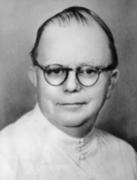
Charles Racine was born in Tonnay-Charente, a town in the south west of France on the right bank of the Charente River. Nothing seems to be known about his parents and upbringing. The first information available seems to be that he enlisted in the army in 1916 during World War I. This, however, left him with a life-changing injury. Not, as one might expect, through enemy action but he was kicked by Gallican artillery mule when near Noyon. Taken to a military hospital, where he spent his 20th birthday in 1917, his leg was saved by surgeons but he was left with a permanent leg injury. He spent the rest of his life walking with a severe limp and he had to suffer continual pain. It is probable that his wartime experiences led to him seek a religious life, for soon after being discharged, he entered the Congregation of the Most Holy Redeemer, commonly known as the Redemptorists. He soon decided that the Society of Jesus, widely known as the Jesuits, was more suited to him. On 25 October 1919 he entered the Jesuit novitiate in the Château de Mons in the Gers department of southwestern France. The château and estate at Caussens (near Condom) provided a training centre for new recruits and many prominent Jesuits who were trained there went on to undertake missionary work.Racine was passionate about mathematics and wanted to teach the subject. He taught for the year 1923-24 in Sarlat (now part of the town Sarlat-la-Canéda). He taught mathematics at the St Joseph College, Sarlat, which had been founded in 1850 and was run by the Jesuit Fathers. In 1924 he went to Paris and between 1924 and 1926, he studied for his Licence ès Sciences (the equivalent of a B.Sc.) in mathematics. After the award of his Licence ès Sciences, Racine studied theology in Innsbruck and Enghien from 1927 to 1930. He was ordained as a Jesuit priest in Enghien, Belgium, on 25 August 1929. After his studies of theology, he went to Paris to study for a doctorate in mathematics.
Racine undertook research for his Doctorate in Mathematical Sciences advised by Élie Cartan. He also worked with Jacques Hadamard and became friends with André Weil and Élie Cartan's son Henri Cartan. His mathematical interests were broad and while undertaking research for his doctorate he became familiar with the whole range of mathematical topics that were at the forefront of research at that time.
In 1934 he submitted two theses. His main thesis was Le problème des N corps dans la théorie de la relativité Ⓣ and his second thesis was Sur les courbes définies par une équation différentielle Ⓣ. The main thesis has the following Introduction:-
We have primarily addressed the problems raised by the application of the theories of Relativity from a local perspective. In the exact or approximate solutions we have formulated, we have always assumed that spacetime has a domain at infinity and that, within this domain, its metric is very close to the Euclidean metric. By specifying the nature of these conditions, we have been led to formulate others that allow us to pose the problem of Celestial Mechanics within the theory of Relativity with considerable generality. These conditions are such that if spacetime is regular everywhere, it is Euclidean, and conversely, if a gravitational field exists, there also necessarily exist singularities of this field. These singularities, if they satisfy certain conditions that we state in Chapter V, can be considered the physical cause of the field. By seeking to give them as simple a form as possible, we arrive at a schematisation which seems to generalise in Einstein's theory the notion of a material point (of non-negligible mass) from classical mechanics.This main thesis was 68 pages long and was examined by Élie Cartan, President, with Jean Chazy and Georges Darmois, Examiners. It was approved on 12 May 1934.
Later that year the Jesuits sent him to India to undertake missionary work. He was first in St Joseph's College, Tiruchirappalli. This college had been founded by European Jesuits in 1844 and is one of the oldest higher education colleges in India. It was affiliated to the University of Madras after it was founded in 1857. Racine taught for five years at St Joseph's College then, in 1939, he went to Loyola College, Madras. Let us note that Madras was renamed Chennai in 1996, an is known by that name today.
Loyola College was another Jesuit college but a much younger one than St Joseph's College, Tiruchirappalli for it had been founded in 1925. It taught a two-year Intermediate course but soon the honours course in mathematics started [10]:-
Within three years after the starting of the College, affiliation was obtained for the prestigious three-year Honours courses following the Intermediate. First year Honours in Mathematics and Economics commenced in July 1927. The enrolment went up to 503. ... Rev Fr Murphy, S.J., was Rector and Principal between 1937 - 42, a period of remarkable expansion for the College. The provision of three sections in Intermediate Science led to a great increase in the strength of the College. ... 1938-39 was the year of improvement. Lecture Halls for B.A. classes were built up.Racine became head of mathematics when he joined the college in 1939 taking over from Rev Fr Georges Vion, S.J. who had been Head of Mathematics from the founding of the college in 1925. He certainly had difficulties which were detailed in a letter by Father Jerome D'Souza, who had become Rector and Principal of Loyola College in 1942, written on 1 June 1946 (see [7]):-
My Reverend Father,The reason that Racine visited France was because his sister and brother-in-law had been killed in a road accident. He did return to India after this trip to France and inspired a number of students to become world-leading mathematicians including M S Narasimhan and C S Seshadri. Let us quote from these two famous mathematicians about their experiences of being taught by Racine. First we quote from M S Narasimhan who began his studies at Loyola College in 1952 [11]:-
Father de Grangeneuve asked me confidentially if I thought Father Racine should return to India after his upcoming visit to Europe. My Reverend Father, it is difficult for me to answer this question categorically. Father Racine had hoped to undertake a great apostolate - intellectual and religious - in India. He had formed an idea of India far exceeding reality. Hence, his profound disappointment. I believe he was unable to adapt to reality - he lacks optimism. He must certainly have sometimes thought about returning to Europe, provided he could find a suitable kind of ministry there.
One of the reasons why he hasn't been able to adapt here with complete satisfaction is that, in some respects, it seems to me, he doesn't understand Indian psychology. He looks at our students, practically speaking, as if they were young university students from Paris, and he expects them to react naturally within European circles. The remarks and criticisms he makes in their presence, the directives he sometimes gives them, do more harm than good - something Father Racine doesn't always realise.
If, in light of all this, and particularly in light of his family's situation, Father Racine himself seems inclined to remain in Europe, especially if Your Reverence believes he can do more good there, I believe he should not be hastened back here, but rather that this idea should be approved. If, on the other hand, Father Racine, examining the situation with hindsight, feels more reconciled to the conditions in India, more willing to be patient with people and circumstances, less harsh in his judgments about them, and consequently sincerely desirous of starting again, I believe he should be allowed to return. His great personal qualities and solid religious virtues would still ensure him a fine apostolate among us.
Fr Racine was a mentor not only for me and Seshadri, but also for almost all of that whole generation of mathematicians. He was a member of the Society of Jesus, or Jesuits as they are called, and Loyola College is run by them. He taught in Loyola College, and earlier in Tiruchirappalli too. And the amazing thing was that he was in touch with many of the modern developments in mathematics. He was also a close friend of many top French mathematicians of the day like Jean Leray. In fact, he was a PhD student of Élie Cartan himself.For more of M S Narasimhan's description of Racine's influence on him, see THIS LINK.
At that time, if at all, there was one subject that was taught well in mathematics in Indian universities, it was analysis. We had never even heard of modern algebra or anything else. Mostly, some bad textbooks in the British genre of applied mathematics were used. As a refreshing change, and for the first time, at least in south India, Racine introduced algebra - the so-called modern algebra of that time, and what you would now simply call algebra. And it was taught very well. The way it was taught was by insisting not only on computations, but also on concepts. This gave one a slightly different view of mathematics than what you would normally get. And also, somehow, he induced in motivated students, mainly by talking to them, a realisation and understanding of what was deep mathematics and what was not. In a sense, he cultivated some kind of a mathematical taste in his students. It's all very difficult to explain in precise terms what mathematical taste is. Without yourself being aware of it, you were actually moving into a different level of mathematical appreciation and knowledge, thanks to his mentoring.
He taught only the honours class, and never used to teach in the first year. However, he still wanted to get in touch with his students before teaching them. So on Monday mornings, there used to be a catechism class in Loyola College, which was meant for Catholics. The other students had something called a moral instruction class. Racine used to take the moral instruction class, the idea being to get to know the students whom he would teach mathematics. But the only thing he used to do was to come to the classroom and write letters, doing his own work, while the students were mostly just left alone. One day, I still remember, he came in with a serious face and said, "The Indian mathematician Pillai has died in an accident, and let us stand up in silence and pay our respects." Of course, we had never heard of S S Pillai at that stage.
I got to know him fairly well from then on. More seriously, I think that was the way in which I first got exposed to some kind of mathematics at a high level. I mentioned that algebra was introduced in our honours course curriculum. The book by van der Waerden, in my opinion the best book on the subject, was the book that was followed in our class. There was only a German edition of the book available then. Racine used to personally translate it into English, type it on his own like the French usually do, and distribute notes - because there was no good textbook in English at the time. Somehow, I came to know that there was an English edition that had just then become available in Higginbothams, the bookstore on Mount Road. I went there and ordered two volumes of the English translation, which was somewhat of a strain on our finances at the time. Anyway, I got them, and went to Racine and showed them to him.
"How did you get it?" he asked me. He didn't know there was an English translation because he didn't care. He had a German version and he could read German. In the first English edition, there were some wrong translations. So when I had some problems following it, I used to go and ask Racine. He would immediately consult his own copy of the book in German and would agree that I was right, and help me along too.
I wouldn't call him a very good teacher in the usual sense. I mean, in terms of teaching courses, he just used to give these notes, which were well-written; you just read it yourself. Importantly, if he found that some students were good at mathematics and interested in it, he used to meet them outside the class and talk to them personally, one on one, and that's how it really happened. One of the main things Racine did was to bring in new ideas which either he himself taught, or which some other good lecturer taught. He introduced to us new material like algebra, and thereby inculcated a completely new and different way of thinking. Direct contact with him in conversations outside the class also helped immensely.
C S Seshadri gives a similar account in [4]. Here is an extract:-
Fr Racine taught us a course in Algebra in Honours Mathematics following a book by Van der Waerden published in the 1930s, titled 'Modern Algebra'. This was a very influential and pioneering book. With the exception of F W Levi in Kolkata, Fr Racine was the only person in India to teach such a course at that time. I took the Honours Course during the academic years 1950-53. Fr Racine could not actually be called a great teacher in the usual sense. However, he had a knack of identifying and nurturing good students and keeping in touch with them even after they finished college. I remember that he gave me a textbook by Stefan Banach on Classical Mechanics to read. I don't think that I benefited much from it. He also lent me the book 'Introduction to Modern Algebra and Matrix Theory' by Otto Schreier and Emanuel Sperner to solve problems from the book. I was quite successful in this endeavour, and it gave me a lot of confidence.Let us give one further example of someone who may never have become a mathematician but for Racine, namely Gadde A Swarup. He became a student at Loyola College in 1956 but, because he did not attend classes, had his studies terminated [16]:-
The influence of Fr Racine therefore lay not in his direct teaching, but in creating an awareness of what is important, and later encouraging us to pursue it. I would say that in those days, undergraduate education was quite good in many colleges.
Fr Racine wrote to my father that I had potential and that I should come back to college. The next year I went to college again but the story repeated itself. It was during this time that I used to go to Racine's room in the Fathers' Quarters, chat about mathematics, and borrow books from him.Swarup completed his degree at another college and then Racine again asked him to come to Madras. In 1964 he went to TIFR to study for a Ph.D. advised by M S Narasimhan. He was awarded his Ph.D. in 1971 for his thesis Geometry of Manifolds. Near the end of 1974 he visited IHES in Bures sur Yvette, France [16]:-
Around the end of 1974, I visited France for a few months and before my visit, Fr Racine wrote to me asking me to say 'hello' to Henri Cartan. Henri Cartan was an institution in France and I duly ignored the advice. One day, I saw an old gentleman near one of the steps outside IHES in Bures sur Yvette, and the gentleman said "You must be Swarup, Racine wrote to me about you". It turned out to be Henri Cartan ...Swarup became a professor of mathematics at the University of Melbourne, Australia. He has made significant contributions to geometric topology, 3-manifolds, and geometric group theory with 47 papers listed in MathSciNet. It is hard to see how he would have become a mathematician had it not been for Racine.
Although Racine's main contributions are as an inspiring teacher at Loyola College, he also published several research papers on a wide variety of topics. MathSciNet lists 12 of his papers. These are: Le problème des N corps dans la théorie de la relativité Ⓣ (1934); Contribution to the relativistic problem of n bodies. I (1941); Contribution to the relativistic problem of n bodies. II (1941); The Riemann integration of sequences (1942/50); On Frullani integrals (1947); A note on the theory of the Riemann integral (1953); Contribution to the Galois theory; (1956); On the topological duals of a class of Banach spaces (1960); Le problème relativiste d'une masse en rotation Ⓣ (1965); The problem of two rotating bodies in the relativity theory (1966); Verification of Newton's law in the theory of relativity (1967); and Note on the Hahn-Banach theorem in normed spaces (1968).
Racine's contributions were recognised and he received several honours. In 1951 he was President of the 38th Indian Science Congress held in Bangalore. In 1962-63 he was made Chevalier de la Légion d'honneur, the highest civilian award made by the French government. The French Ambassador personally travelled to Loyola College in Madras to present him with this distinction. After his death, the Racine Research Centre was established in 1991 at Loyola College having been proposed four years earlier at the celebrations for the centenary of Racine's birth. It is now known as the Loyola - Racine Research Institute of Mathematics and Computer Sciences. Other tributes are noted in [2]:-
The Alumni from Loyola College working at TIFR got together in 1957 when they learnt that Fr Racine was turning 60. They instituted the Racine Prize to be awarded to a young mathematician with the best contribution to Mathematics. In 1987 a portrait of Fr Racine was unveiled a the Mathematics-Science Institute (Ramanujam Advanced Centre for the Study of Mathematics of the University of Madras), as one of ten eminent mathematicians.Although continuing to teach at Loyola College until he retired in 1968, Racine's health deteriorated. In addition to the pain from his leg injury, he began to suffer from a heart condition. During the summer, when the College was closed for the vacation, he would leave the extreme heat of Madras and live in Bangalore. This city is in the middle of India and has a moderate climate since it has a high elevation (900 metres). He was on his summer holiday in Bangalore in August 1976 when he died. His body was returned to Madras where his funeral was held on the Loyola College campus. He was buried on the Loyola College campus.
Fr Lawrence Murphy SJ, born in Liverpool, England, of Irish parents, was one of the first members of Loyola College's religious staff from June 1925. He became rector of the College in 1937 and also principal from 1938. He served in these roles until 1942 but continued on the staff of Loyola College as Head of the English Department. Let us quote Fr Murphy's description of Fr Racine from [5]:-
It is curious that those who lived with him longest knew him least. One thinks of Fr Racine as quiet, like a hermit in his cell, everlastingly thinking of the sublunary abstractions of number, infinitude and inescapably God; friends, a few and those intellectual; interest unknown … and how completely false! He was, like so many mathematicians, a lover of music, a keen conversationalist, witty, observant and interested in everything around him.For further details about Charles Racine, including another quote from Fr Murphy, see the obituaries at THIS LINK.
References (show)
- About Fr Charles Racine, Loyola College (2026).
https://www.loyolacollege.edu/mathematics/ - B D'Sami, Jesuits and Physical Sciences, JIVAN (July 2018), 20-21.
https://jivanmagazine.com/wp-content/uploads/2018/07/Jivan_july.pdf - Father Charles Racine, Mathematics Genealogy Project (2026).
https://www.genealogy.math.ndsu.nodak.edu/id.php?id=248506 - From Proofs to Transcendence, via Theorems and Rāgas: C S Seshadri in Conversation, Bhavana 2 (1) (2018).
https://bhavana.org.in/proofs-transcendence-cs-seshadri/ - Guest Authors, Some leading Jesuits of Madras, Madras Musings 26 (12) (2016).
https://madrasmusings.com/vol-26-no-12/some-leading-jesuits-of-madras/ - S Ignacimuthu, Contribution of Jesuits to Science in India (Gujarat Sahitya Prakash, 2021).
- M Katti, Two Jesuits who introduced modern education in India, Bhavana 6 (2) (2022).
- J Kozhamthadam, Jesuit Initiatives in Indian Higher Education (Christian World Imprints, 2022).
- Le Père Charles Racine (1897-1976), Maduré, Madagascar, revue trimestrielle (January 1977), 138-139.
- Loyola College: From 1925 to 1974, Loyola College (2026).
https://www.loyolacollege.edu/about/home - S Rao, A Versatile Ace at Bridge Building, Bhavana 2 (4) (2018).
https://bhavana.org.in/ms-narasimhan/ - C Racine, Le problème des N corps dans la théorie de la relativité (Ph.D. Thesis) (1934).
https://www.numdam.org/item/?id=THESE_1934__158__1_0 - M S Raghunathan, Artless innocents and ivory-tower sophisticates: Some personalities on the Indian mathematical scene, Current Science 85 (4) (2003), 526-536.
- K G Ramanathan, S Minakshisundaram (2026).
http://minakshisundaram.blogspot.com/p/sms-by-kg-ramanathan.html - R Ramaswamy, Going back (12 April 2013).
https://ramramaswamy.org/blog/tag/racine/ - G A Swarup, Remembering Fr Racine, Gaddeswarup's Blog (4 September 2008).
https://gaddeswarup.blogspot.com/2008/09/remembering-fr-racine.html - M Waldschmidt, History of Indo-French Scientific Partnership (8 October 2021).
https://webusers.imj-prg.fr/~michel.waldschmidt/articles/pdf/IndoFrenchCooperation.pdf - M Waldschmidt, Indo-French cooperation in Mathematics (22 March 2012).
https://webusers.imj-prg.fr/~michel.waldschmidt/articles/pdf/IndoFrenchCooperationMaths2012.pdf
Additional Resources (show)
Other pages about Charles Racine:
Other websites about Charles Racine:
Cross-references (show)
Written by J J O'Connor and E F Robertson
Last Update July 2026
Last Update July 2026