 MacTutor
Subbayya Sivasankaranarayana Pillai
Quick Info
Vallam near Courtallam, Tenkasi, Tamil Nadu, India
Near Itay El Barud, Egypt
Biography
S S Pillai was the son of Subbayya Pillai and Gomati Ammal who were both natives of Nagercoil on the southern tip if India. Subbayya Pillai was a contractor for the government but S S Pillai never knew his mother who died within a year of his birth. His first years were at the home of an aged relative who took care of the young boy. When he was five years old, his father arranged for a tutor to teach him reading, writing and arithmetic at his home. This arrangement continued until he reached the age of nine when his father arranged for him to attend the Middle School at Shencottah (known today as Sengottai).Around 1910, when Pillai joined the Middle School at Shencottah, there was a teacher at the school named Sastriar who quickly recognised the young boy's exceptional intellectual ability and huge potential for mathematics. He became Pillai's constant source of encouragement. After Middle School at Shencottah, Pillai moved to a local High School to complete his Matriculation course. At this time a second tragedy struck when his father suddenly died. Plunged into extreme poverty, Pillai thought that his only option was to terminate his school studies and find a job to support himself. Sastriar, however, stepped in with his own personal funds to pay for Pillai's schooling.
After completing his High School studies, Pillai won a scholarship to study for his Intermediate at the Scott Christian College in Nagercoil. The Intermediate was a two-year course which was designed as a foundation for a three-year honours course. The Scott Christian College in Nagercoil had its origins as a village school set up by missionaries from the London Missionary Society. It became a college affiliated to the University of Madras in 1893 and the Intermediate course had been introduced in 1904. The head of the College when Pillai studied there was the Rev George Parker. Pillai entered the College in 1922 having won a scholarship. This did not provide enough to support him during his studies but again Sastriar helped him out financially. He completed the Intermediate in 1924 and entered Maharaja's College in Trivandrum to study for a B.A. degree.
Maharaja's College in Trivandrum was founded in 1834 and in 1866 had become a College affiliated to the University of Madras. It began to offer courses for the B.A. degree in 1884. In 1924, the year that Pillai entered, the College had split in two colleges, H H The Maharaja's College of Science and H H The Maharaja's College of Arts. Pillai attended the Science College which from 1925 offered a B.A. Honours course in Mathematics. In 1927 he was awarded a B.A. and, in the same year, began research at the University of Madras funded with a research studentship. He quickly came under the influence of K Ananda Rau and R Vaidyanathaswamy.
K Ananda Rau (1893-1966) had studied at the University of Madras, then sailed to England where he studied the Mathematical tripos at King's College Cambridge. He was greatly influenced by G H Hardy and became a friend of Srinivasa Ramanujan who was working with Hardy at this time. Rau returned to India in 1919 and became a professor of mathematics at Presidency College. Ramaswamy S Vaidyanathaswamy (1894-1960) studied first in India, then travelled to Scotland to work for an M.A. at the University of St Andrews. At this time he worked with H W Turnbull of St Andrews, E T Whittaker of Edinburgh. He then went to Cambridge where he studied with Henry Baker. He was awarded a D.Sc. by the University of St Andrews and was elected a fellow of the Royal Society of Edinburgh in 1924. Returning to India in 1925, in 1927 he took charge of the newly formed Research Department of Mathematics of the University of Madras. Pillai was fortunate to come under the influence of two such excellent mathematicians.
Pillai began publishing papers, the first two being: A test for groups of primes; and On some empirical theorems of Scherk. Both were published in volume 17 (1927-28) of the Journal of the Indian Mathematical Society. His next two papers: On some functions connected with ; and On a function connected with were both published in volume 35 of the Bulletin of the American Mathematical Society. The first of these two AMS papers had the note:-
I take this opportunity to express my deep gratitude to K Ananda Rau for his invaluable guidance and encouragement.The second of the two papers has the note:-
This paper was read before the conference of the Indian Mathematical Society held in December 1928.
This problem was suggested by R Vaidyanathaswamy.Both these papers give Pillai's address as Annamalai University, Chidambaram, South India. In fact he was appointed as a lecturer in mathematics at Annamalai University in 1929 and continued to work there until 1941. In fact Annamalai University was founded on 1 January 1929 by the private philanthropist Rajah Sir Annamalai Chettiar. It is located just to the east of Chidambaram.
The paper [23] lists 76 papers by Pillai. Most are published by the Indian Mathematical Society, the London Mathematical Society or Annamalai University. Of these papers, only six are joint papers, five of the six being with Sarvadaman Chowla. Kaneenika Sinha describes how their collaboration began [17]:-
Based on existing records, it is quite probable that the interaction between Pillai and Chowla started through the posing and answering of questions in the Journal of the Indian Mathematical Society. They were both present at a conference of the Indian Mathematical Society in December 1928 and are standing next to each other in the group picture. The correspondence between Chowla and Pillai starts soon after. On the 3rd of January, 1929, Chowla writes to him, mentioning an observation of Hardy, that the smallest positive integer equal to a sum of two cubes in three different ways is 175,959,000. In fact,Pillai is most famous today for his outstanding contributions to Waring's Problem. Let us explain briefly what this problem is and give a little of its history..He also answers this question posed by Pillai, "Is it true that every prime factor of is congruent to ?", by providing a counterexample. He then asks Pillai a few other questions, and it is interesting to note that they are all about divisors of certain numbers. Chowla concludes the letter with the hope that they will soon begin to have a proper collaboration. Thus started a trail of frequent letters among them.
...
The letters from Chowla to Pillai reveal his characteristic enthusiasm, his admiration for Pillai, and how much the correspondence meant to him. Although these letters mostly contain mathematics, we also find references to other matters, such as travel plans, logistical arrangements, academic events and job searches.
In 1640, Fermat stated that every positive integer can be written as the sum of four squares. He said he had a proof but never gave it. Euler unsuccessfully attempted to prove this. In 1770, Lagrange proved that every positive integer can be expressed as the sum of 4 squares. In the same year of 1770, Edward Waring, in the second edition of his book Meditationes Algebraicae, made the following conjecture:
Every number is the sum of 4 squares; every number is the sum of 9 cubes; every number is the sum of 19 fourth powers; and so on.In his 1782 edition of the same book, Waring added that:
... similar laws may be affirmed for the correspondingly defined numbers of quantities of any like degree.This conjecture came to be known as Waring's problem. For every let be the smallest number so that every positive integer can be written as the sum of (or fewer) th powers of positive integers. Then Waring's 1770 conjecture is and . It is easy to check that 7 requires 4 squares, 23 requires 9 cubes and 79 requires 19 fourth powers, so and . Lagrange had proved that . Waring's added conjecture in 1782 is that is finite for every .
In 1909 David Hilbert proved the 1782 part of Waring's problem proving that is finite for every . In the same year Arthur Wieferich (1884-1954) made some progress and was able to prove . In 1920 Hardy and Littlewood worked on the problem and developed methods (the circle method suggested by Srinivasa Ramanujan) which were used by others. In the two papers On Waring's Problem (1936) and On Waring's Problem III (1936) Pillai found an exact formula for for most values of . Also in the same year Pillai published On Waring's Problem IV (1936) in which he proved . L E Dickson, independently, proved these same results in two papers also published in 1936. In 1940 Pillai published the paper On Waring's Problem , another remarkable achievement proving . If the reader is wondering which integer cannot be the sum of less than 73 sixth powers, then, as Pillai does, it is easy to check that 703 is such an integer.
so we have to make 703 by summing 1s and 64s. Then so so needs 73 6th powers.
We should note that Pillai's papers quoted above do have a few gaps where he has not included all the details. Brojomohan Padhy's paper [9] fills in the gaps in Pillai's two 1936 papers. Padhy writes [9]:-
On account of the importance of Pillai's formula for it was thought worthwhile to give a slightly simplified and more complete account of the proof ... Pillai's proofs of certain lemmas, especially those of lemmas 16 and 17, are incomplete.Not all of Pillai's gaps were filled as quickly. In 1939 he published On the number of representations of a number as the sum of the square of a prime and a squarefree integer. Mathematical Reviews started up in 1940 and their first reviews were of 1939 papers. Peter Scherk reviewed Pillai's paper and, after quoting Pillai's result, writes [16]:-
The paper contains inaccuracies.Because of this review, Pillai's result was ignored. Over 70 years later, however, M Ran Murty and R Thangadurai discussed this paper by Pillai in On a paper of S S Pillai (2012) and they write [14]:-
P Scherk stated: "The paper contains inaccuracies." There was no indication of what the inaccuracies were, nor whether they were major or minor. In this paper, the authors analyse Pillai's argument, and show that it is essentially correct.Pillai was awarded a D.Sc. by the University of Madras in 1933 becoming the first to be awarded a D.Sc. in Mathematics by this University. In 1941 Pillai left Annamalai University and joined the University of Travancore. This university, now known as the University of Kerala, was founded in 1937 in Thiruvananthapuram, Kerala. Pillai left after one year to join the University of Calcutta as a lecturer in 1942. The University of Calcutta had been founded by the East India Company in 1857 and was modelled on the University of London. It was F W Levi, who was the professor at the University of Calcutta at this time, who encouraged Pillai to move to Calcutta (now Kolkata).
Pillai had published On the number of numbers which contain a fixed number of prime factors in 1929 which announced an important breakthrough on Hardy's problem which arose from both Hardy and Ramanujan observing that round numbers, that is, natural numbers with many small prime factors, are rare. When Pillai arrived in the University of Calcutta he met Laxman Ganesh Sathe [2]:-
In Calcutta (now Kolkata) Pillai met the brilliant L G Sathe, who became his student. In 1943, Pillai suggested Hardy's problem to Sathe and put at Sathe's disposal all of his manuscripts on this problem. In the course of less than two years, L G Sathe produced a monumentally complex induction argument, that ran into 134 printed pages when published, and that did much more than solve Hardy's problem.Throughout the 1930s and 1940's Pillai worked on a problem on Diophantine equations concerning prime powers that has become known as Pillai's Conjecture. In particular he published the papers On the inequality (1931), On (1936); On (1944); and On the equation (1945). In the 1936 paper, Pillai conjectured that if is a non-zero integer, the equation has at most finitely many solutions in integers and exceeding unity. This is a generalisation of Catalan's Conjecture which is the case . In fact Catalan's Conjecture was essentially proved by R Tijdeman in 1976. Pillai's Conjecture remains open (we believe, in 2026). Special cases have been solved, some by Pillai himself. In both the 1931 and 1936 papers Pillai considered the case . With this condition, he proved in the 1936 paper that if is sufficiently large and gcd, the equation has at most one solution. Interestingly, although the proof works for sufficiently large, this is only an existence proof and there is no way to compute an actual number for "sufficiently large".
Despite the fact that all of Pillai's published papers were on number theory, he did study other mathematical problems. For example [20]:-
Apart from number theory, Pillai was also interested in tackling famous tough problems in other areas. In 1942, when he was a lecturer at Calcutta University, he was interested in the problem of whether a continuous, periodic function necessarily has a point of convergence.The International Congress of Mathematicians was to be held at Harvard University in Cambridge, Massachusetts, United States in September 1950. Pillai was invited to the Congress as a delegate of the University of Madras. He also received an invitation to spend the academic year 1950-51 at the Institute for Advanced Study at Princeton. Pillai boarded TWA Flight 903 which departed Bombay (now Mumbai) at 08:34 local time on 30 August 1950. The flight made its first stop in Cairo landing at 22:17 local time. After a crew change and refuelling, the flight left Cairo at 23:35, its next stop being Rome. Pillai was one of 48 passengers on board along with seven crew members. At a height of 3000 m the crew reported an engine fire and they attempted an emergency landing in the desert. The plane crashed near the village of Itay El Barud killing all 55 people on board.
M S Narasimhan was a pupil at Loyola College in 1950, having Charles Racine as his teacher. He told about the day the pupils were told of Pillai's death [15]:-
Racine used to take the moral instruction class, the idea being to get to know the students whom he would teach mathematics. But the only thing he used to do was to come to the classroom and write letters, doing his own work, while the students were mostly just left alone. One day, I still remember, he came in with a serious face and said, "The Indian mathematician Pillai has died in an accident, and let us stand up in silence and pay our respects." Of course, we had never heard of S S Pillai at that stage.Despite his outstanding research contributions, Pillai did not receive much recognition. He had never been elected to any academy although a letter has been found written by Sir C V Raman indicating that he would like to propose Pillai's name for a Fellowship to the Indian Academy of Sciences. The quality of his work was, however, much appreciated. The authors of [22] write:-
It has been mentioned by G H Hardy that after Ramanujan, the greatest Indian mathematician was Pillai.B Sury writes in [20]:-
Littlewood said in 1934 (before Pillai had gained fame for his work on Waring's problem), "Dr Pillai's work is fresh and original. I consider him as one of the very best of Indian mathematicians." T Vijayaraghavan said in 1937, "Since the time Ramanujan died, the work of no other Indian mathematician has brought to Indian mathematics greater credit than Dr Pillai's on Waring's problem."R Balasubramanian writes in [2]:-
Dr Subbayya Pillai Sivasankaranarayana Pillai, to give S S Pillai his full name, was, together with his friend and collaborator Sarvadaman Chowla, one of the two greatest Indian number theorists to emerge in the era immediately after Ramanujan; a mathematician whose contributions may well have been much greater were his life not repeatedly visited by misfortune.R Narasimhan writes in [8]:-
Pillai wrote many papers on the theory of numbers. Each of them shows analytic power and originality, but his work on Waring's problem remains his greatest achievement.We learn something of the character of Pillai in several of the papers listed in our References. For example, Thathamangalam Viswanathan Venkateswaran writes [26]:-
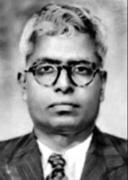
Although a doyen of mathematicians, Pillai was simple in his living and humane in approach to others. He was a man of honesty known for thrift and humbleness. He used to serve food in traditional South Indian style; food served on plantain leaves and the guest seated on the floor and using her or his hands to eat the filling, tasty, tangy South Indian food. He had strong views on public issues and opposed the atomic bomb as unethical and wanted nations to refrain from its first use. He also supported India coming out of Commonwealth even while English is retained as a link language. Once, an editor of a newspaper wanted to get his photograph. Shy of projecting himself, Pillai initially refused and could be persuaded only when the photographer lied that he had been tasked to take photograph by the Institute of Advanced Studies. Even then he refused to wear a coat saying that he wanted his picture to be "just as I am, with warts and all."
References (show)
- S Azizul Hoque, A remark on a Diophantine equation of S S Pillai, Czechoslovak Mathematical Journal 74 (149) (2024), 897-903.
- R Balasubramanian, Highly Composite, Proceedings of the International Congress of Mathematicians 2010 1 (Hyderabad, India, 2010), 176-209.
https://www.mathunion.org/fileadmin/ICM/Proceedings/ICM2010.1/ICM2010.1.pdf - R Balasubramanian and R Thangadurai (eds.), Collected works of S Sivasankaranarayana Pillai 1 (Ramanujan Mathematical Society, Mysore, 2010).
- R Balasubramanian and R Thangadurai (eds.), Collected works of S Sivasankaranarayana Pillai 2 (Ramanujan Mathematical Society, Mysore, 2010).
- K Chandrasekharan, Obituary: S S Pillai, Journal of the Indian Mathematical Society (N.S.) 15 (A) (1951), 1-10.
- Dakshinamurthy, Math After Ramanujan - S S Pillai, The Verandah Club (May 2025).
https://theverandahclub.com/article/math-after-ramanujan-ss-pillai-908 - R Narasimhan, The Coming of Age of Mathematics in India, Miscellanea Mathematica (1991), 235-258.
- R Narasimhan, The Coming of Age of Mathematics in India, Bhavana 1 (1) (2017), 37-51.
- B Padey, Pillai's exact formula for the number g(n) in Waring's problem, Proceedings of the Indian Academy of Sciences 3 (1936), 341-345.
- S S Pillai, Symposium on Waring's Problem, Chairman's address, Math. Student 7 (1939), 165-168.
- S Raghavan, An outstanding mathematician, The Hindu (Thursday, 10 May 2001).
https://web.archive.org/web/20070928161721/http://thehindujobs.com/thehindu/2001/05/10/stories/08100007.htm - M S Raghunathan, Artless innocents and ivory-tower sophisticates: Some personalities on the Indian mathematical scene, Current Science 85 (4) (2003), 526-536.
- K Ramachandra, S S Pillai remembered (05-04-1901 to 31-08-1950), Hardy-Ramanujan Journal 30 (2007), 71-72.
- M Ran Murty and R Thangadurai, On a paper of S S Pillai, Proceedings of the Indian Academy of Sciences 122 (1) (2012), 1-13.
- S Rao, A Versatile Ace at Bridge Building, Bhavana 2 (4) (2018).
https://bhavana.org.in/ms-narasimhan/ - P Scherk, Review: On the number of representations of a number as the sum of the square of a prime and a squarefree integer, by S S Pillai, Mathematical Reviews MR0000839 (1,135h).
- K Sinha, Sarvadaman Chowla: The Perpetual Ambassador for Number Theory, Bhavana 7 (2) (2023).
https://bhavana.org.in/sarvadaman-chowla-the-perpetual-ambassador-for-number-theory/ - R Sivaraman, Pillai another Ramanujan, but just not well known, The Times of India (7 September 2016).
https://timesofindia.indiatimes.com/blogs/tracking-indian-communities/pillai-another-ramanujan-but-just-not-well-known/ - Subbiah Sivasankara Narayana Pillai, Professor of Mathematics, Annamalai University - 1929, Annamalai University (5 September 2017).
https://annamalaiuniversity.ac.in/download/articles_acad_interest/profile_prof_subbiah_sivasankaranarayanapillai.pdf - B Sury, S S Pillai: 5 April 1901 - 31 August 1950, Resonance (June 2004), 1-2.
- B Sury and R Thangadurai, S Chowla and S S Pillai, Resonance (September 2012), 855-883.
- B Sury and R Thangadurai, The Story of Two Peerless Indian Mathematicians: S Chowla and S S Pillai, Nurture: Summer School in Mathematics to the memory of S S Pillai ( August 2016), 18-22.
https://nurture1729.in/other/Souvenir.pdf - R Thangadurai, S S Pillai Contributions, Nurture: Summer School in Mathematics to the memory of S S Pillai ( August 2016), 14-17.
https://nurture1729.in/other/Souvenir.pdf - R Thangadurai, An Outstanding Indian Number Theorist, Nurture: Summer School in Mathematics to the memory of S S Pillai ( August 2016), 8-13.
https://nurture1729.in/other/Souvenir.pdf - The Unsung Mathematician, Hindustan Times (31 August 2021).
https://www.hindustantimes.com/trending/the-unsung-mathematician-101630387331583.html - T V Venkateswaran, S Sivasankaranarayana Pillai, in Indian Scientists: The Saga of Inspired Minds (Vigyan Prasar, 2016), 142-146.
- M Waldschmidt, Perfect Powers: Pillai's works and their developments, in R Balasubramanian and R Thangadurai (eds.) Collected works of S Sivasankaranarayana Pillai 1 (Ramanujan Mathematical Society, Mysore, 2010), xxii-xlvii.
- M Webster, Master of the Integers: S S Pillai (Michael Webster, 2025).
- C S Yogananda, Waring's problem and the circle method, Resonance 9 (6) (2004), 51-55.
Additional Resources (show)
Other pages about S S Pillai:
Other websites about S S Pillai:
Cross-references (show)
Written by J J O'Connor and E F Robertson
Last Update July 2026
Last Update July 2026