 MacTutor
Tirukkannapuram Vijayaraghavan
Quick Info
Adoor Agaram, Kurinjipadi, India
Madras, (now Chennai) India
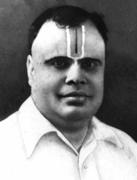
Biography
T Vijayaraghavan was the son of Tirukkannapuram Pattappa Swamy, a pandit and Tamil and Sanskrit scholar who raised his family in an environment steeped in classical Indian scholarship. Pattappa Swamy's deep mastery of traditional Sanskrit texts and classical Tamil literature profoundly shaped the intellectual orientation of his household. The attitudes and values of the household created a culture of precision, deep logical analysis, and pursuit of clarity which Vijayaraghavan carried with him throughout his life.We are unsure exactly when Vijayaraghavan married but we are told that he [25]:-
... had been married in early childhood, and his wife had come to live with his family while still a young girl, long before they were old enough to consummate the marriage; he congratulated himself on this arrangement having been followed.After an early education at home, Vijayaraghavan entered the Hindu Theological High School in Madras. This school had been founded in 1889 by Sivasankara Pandyaji with the aim of educating students within an Indian culture. Many of the schools in India at that time had been founded by Christian missionaries and they promoted a western culture. The purpose of the Hindu Theological High School was to emphasise Hindu culture. Vijayaraghavan did well at the school and graduated in 1918. He aimed to study for a university degree and to do this he would have to spend two years taking an Intermediate course and follow that with a three year honours course. He entered Pachaiyappa's College in 1918 to begin his study of the Intermediate course. Pachaiyappa's College had been founded as Pachaiyappa's Central Institution in 1842 and became the first educational institution in South India which was not founded by the British. It achieved college status in 1889 and, at the time when Vijayaraghavan studied there, it only admitted Hindu students.
At Pachaiyappa's College, Vijayaraghavan's educational difficulties began. He was now becoming interested in mathematics, studying it on his own well beyond what was being taught. He did not, however, find the material being taught at the college either interesting or exciting and spent little time on it. By the time he completed his two years at Pachaiyappa's College in 1920 he had shown little ability in the examinations he took and he had not performed well enough to allow him to continue to an Honours course. At this point he was saved by Ananda Rau who had studied at the University of Cambridge, where he had undertaken research advised by G H Hardy, and returned to India in 1919 to teach at Presidency College. M S Raghunathan writes [8]:-
Luckily for Vijayaraghavan, a real mathematician - Ananda Rau - who could recognise talent that the examination system was incapable of detecting, was at the helm of affairs and he could secure admission to the B.A. (Honours) course in the University.Although Ananda Rau managed to make it possible for Vijayaraghavan to enter Presidency College to study for a University of Madras Honours Degree in Mathematics, the same problems continued. Vijayaraghavan spent his time studying deep mathematics on his own and paid little attention to the college courses. Despite continued help from Ananda Rau who would meet with Vijayaraghavan and have deep mathematical discussions that both student and teacher would enjoy, Vijayaraghavan could not find the enthusiasm to study the formal material required for the examinations and so did not qualify for an Honours Degree. Both Ananda Rau and Vijayaraghavan were, of course, fully aware that Srinivasa Ramanujan had devoted his energies to his own researches and had not succeeded in the educational system. Both were also aware that Ramanujan was saved by sending his researches to G H Hardy at the University of Cambridge so Vijayaraghavan followed Ramanujan's example and sent material from his own researches to Hardy. By this time Hardy, unhappy at Cambridge because his anti-war beliefs put him at odds with his colleagues, had accepted an appointment as Savilian professor of geometry at Oxford. He still undertook joint research with J E Littlewood at Cambridge, so his links to Cambridge were not severed completely. He was impressed with the material Vijayaraghavan sent him and wrote to the University of Madras encouraging them to give Vijayaraghavan a scholarship to allow him to spent three years at New College, Oxford.
All this took some time to achieve so it was not until 1925 that Vijayaraghavan was able to sail to England and join Hardy at New College, Oxford. He was elected a member of the London Mathematical Society at the meeting on Thursday 10 December 1925 with president Arthur Lee Dixon in the chair. At the same meeting two of Vijayaraghavan's papers were communicated.
Papers he wrote while at Oxford include the six we have listed below as [15]-[20]. Let us quote some extracts from Harold Davenport concerning some of these papers [4]:-
The first two papers from the Oxford period related to Tauberian theorems. One of them [16] contained some curious results on unilateral and bilateral Tauberian conditions for series with infinite sums. ... The second paper [17] contained simpler proofs of theorems of R Schmidt on Abel and Borel summability; these proofs dispensed with the use of the theory of moments and applied instead an extension of Littlewood's principle of repeated differentiation. The analysis is delicate and intricate. A third paper [20] gave a generalisation of Mercer's theorem. ...After his productive years at Oxford with G H Hardy, Vijayaraghavan returned to India in 1929. He was fortunate that, in 1930, André Weil took up a position as Head of Mathematics in the Aligarh Muslim University. This university, established in 1920, evolved from the Mohammedan Anglo-Oriental founded in 1877. André Weil had asked Syed Masood, the Minister of Education for Hyderabad, if an appointment to a chair in French Civilisation at Aligarh University was possible. After first believing that he would get such a post, he received a letter from Masood saying that it was impossible to set up such a chair but the chair of mathematics was open. Weil accepted and his first task was to fill a vacant position of a lecturer in his department. A Scotsman, who was Pro-Vice-Chancellor of the university, told Weil that he would make a short list of the applicants. Weil said that was fine but, since he did not trust the Pro-Vice-Chancellor's judgement, he also wanted the full list of applicants. Weil explained how he made the appointment [25]:-
At the same time, Vijayaraghavan was working on quite a different subject: that of Diophantine approximation. His results [18] were concerned with the limitations inherent in Kronecker's theorem, and he showed that these limitations are much more severe in their nature for simultaneous inequalities than they are for a single inequality. In this discovery he had been partly anticipated by Blichfeldt. The theory was later developed systematically by Khinchin and others, and has now been largely absorbed in the subject of "transference theorems".
It took me no time at all to see that this list contained the name of only one mathematician, in the sense I ascribe to the word: this was a pupil of Hardy's by the name of Vijayaraghavan, who had to his credit several articles on approximation and Tauberian theorems, but no degree, and who was therefore not on the Scotsman's short list. I ran to the nearest telegraph office and told him to include Vijayaraghavan in the list. As soon as I saw him in Aligarh, I was positive that my choice was the right one. My only regret was not to have gotten rid of my Bengali reader, for Vijayaraghavan would have been perfectly qualified for that position. His impeccable Oxford English, which he spoke with a slight Madras lilt, and his no less impeccable turban of raw silk made him acceptable to everyone else as well.Vijayaraghavan's appointment was a great success. He was an extraordinary mathematician but he also impressed Weil with the way his Indian culture dominated his whole life. Weil wrote [35]:-
Vijayaraghavan had just arrived for the start of the academic year. As his name indicates, he was a brahmin from southern India. He came from one of those villages in the Tamil-speaking country where the traditional civilisation of India survives in what is probably its purest form. His father had been a widely-respected pandit. In comparison with his father's, Vijayaraghavan said, his own knowledge of Sanskrit was poor. His modesty notwithstanding, he was thoroughly familiar with the ancient literature in both Sanskrit and Tamil. Like me with my pocket Iliad, which I had even taken to Kashmir, Vijayaraghavan never parted with a Mahabharata printed in Tamil characters, which took up two large grey cloth-bound volumes. Having failed his examinations as a young student in Madras, he had left to study with Hardy at Oxford, and had just returned to India when I met him. He was a very sharp mathematician, doubtless overly influenced by Hardy; but having no diploma, he hardly stood a chance of obtaining a post in any Indian university, much less in a Muslim university like Aligarh, but for the happy accident of my presence there.
At the slightest prompting, and even totally unprompted, he would launch into tales from his beloved Mahabharata, or sometimes he would quote and comment on poems gnomic, erotic, or mystic, in Sanskrit or in Tamil. Ancient Indian culture is one of the richest in the world. It ranges from the most abstract refinements of logic, grammar, and metaphysics, through the steamiest sensuality, to the purest mysticism. Vijayaraghavan took me beyond the initiation I had received at the hands of my Parisian masters; it is to him that I owe my true immersion in these cultural riches.Weil and Vijayaraghavan became close friends and Weil was welcomed into Vijayaraghavan's family life [35]:-
Vijayaraghavan and I were fast friends. With some exaggeration I may say that I never left his side. Even his mother, the reigning matriarch of the family, took me under her wing after observing on my first visit that I not only tolerated but relished an extremely spicy dish which she had prepared, I am convinced, in the secret hope of scaring me away once and for all. I was the first European who had ever been admitted to her home. Even where her son's career was concerned, such a breach of the rules of caste must have been a source of some distress for her.Sadly, however, through no fault of either of the two, they were only colleagues at Aligarh Muslim University for two years. Weil had initially had a good relationship with Syed Masood but quite quickly the two disagreed about many aspects of what a university should be and how teaching should be done. In 1932 Weil decided to take a short holiday back in Europe where he also acquired books to add to the Aligarh University library. On his return to India, he was told that Masood had dismissed him. The dismissal had happened while Weil was in Europe and Masood had offered Vijayaraghavan the chair of mathematics at Aligarh University. Weil wrote [25]:-
Masood had spoken to Vijayaraghavan, telling him that he, Masood, had plans to get rid of me, and offering him my position. Vijayaraghavan was so horrified by this deceitful move, which I of course did not suspect in the least, that he took the first opportunity he could to flee with all possible haste.Shocked and saddened by Weil's dismissal which he considered as grossly unfair, Vijayaraghavan resigned and, by the time that Weil returned to India, Vijayaraghavan had already accepted a post at the University of Dacca (now known as Dhaka). This university had been established in 1921 and modelled on British universities. Although it was in India when Vijayaraghavan went there in 1932, after the partition of British India in 1947 it was in Pakistan but after Pakistan was partitioned in 1971 it was in Bangladesh. Weil, back in India without a job, contacted Vijayaraghavan who invited him to stay in Dacca with him and his family for as long as he wanted. Weil accepted and went to Dacca where he found Vijayaraghavan living with his wife and little daughter in a corner on the second floor of the main university building. Weil stayed with them, sleeping in a covered porch, until he returned to Paris.
In Dacca, Vijayaraghavan's career flourished. In 1934 he travelled to the United States, invited to visit G D Birkhoff at Harvard University in Massachusetts. It was Vijayaraghavan's paper Sur la croissance des fonctions définiés par les équations différentielles Ⓣ (1932) which had impressed G D Birkhoff. In this paper, published in Comptes Rendus of the Paris Academy of Sciences, he produced a counterexample to a conjecture of Émile Borel about the growth of solutions of non-linear ordinary differential equations. After visiting Harvard, Vijayaraghavan then travelled to Pittsburgh where he attended the 41st Annual (Winter) Meeting of the American Mathematical Society and delivered a talk entitled "A note on Tauberian theorems." At this meeting, following a recommendation by G D Birkhoff, he was honoured to be elected to a Visiting Lectureship of the American Mathematical Society for 1936 [10]:-
Upon recommendation of the Committee on the Visiting Lectureship of the Society, the Council voted to appoint Mr T Vijayaraghavan of the University of Dacca, Bengal, India, to this lectureship for 1936.In 1936 Vijayaraghavan spent six months in the United States. He travelled first to England where he stayed in London before going to Liverpool from where he sailed to Boston, leaving on the Samaria on 21 August 1936. He arrived in Boston on 29 August giving his American contact as his friend G D Birkhoff. His personal data, recorded on arrival, is as follows [24]:-
Complexion, Dark; Eye Colour, Dark; Hair Colour, Dark; Height, 5 ft 6 in.In 1939 Vijayaraghavan looked at an oddly constructed decimal in the paper [21]. The decimal is
0.2357111317192329...
where the sequence of digits is that of the primes in ascending order. Vijayaraghavan gives a short proof that this is irrational.
In 1940 Vijayaraghavan began the study for which he is best remembered today. He published the paper [22] which was reviewed by William Feller who writes [5]:-
This paper contains a proof due to the author and an alternative (somewhat simpler) proof due to A Weil for the following theorem: If θ > 1 is rational, then there are infinitely many points of accumulation of the fractional parts of , ...Vijayaraghavan made remarkable contributions to the study of the fractional parts of powers of numbers, most notably through the discovery of Pisot-Vijayaraghavan numbers. His research explored whether the sequence of fractional parts (for ) is dense, avoids certain values, or possesses specific limit points when is a real number greater than 1. It had previously been conjectured that might always be dense modulo 1, but Vijayaraghavan proved that there exist numbers where the sequence is not dense in [0, 1). The fractional parts can cluster near zero and actively avoid other intervals. He also proved that there are only countably many real numbers such that the sequence has only a finite number of limit points. In 1948, he established that for any real numbers and (where ), the set of numbers for which is not dense modulo 1 is an uncountable set.
Vijayaraghavan's work led to what today are called Pisot-Vijayaraghavan numbers. A Pisot-Vijayaraghavan number is a real algebraic integer strictly greater than 1 all of whose other conjugates have an absolute value strictly less than 1. Raphael Salem in the paper [9] proposed the name Pisot-Vijayaraghavan number, a term which is widely used today. If is a Pisot-Vijayaraghavan number, the sequence approaches 0 as approaches infinity. The most famous Pisot-Vijayaraghavan number is the golden ratio.
In 1946 Vijayaraghavan left the University of Dacca when he was appointed Professor of Mathematics at Andhra University which had been established in 1926 in Visakhapatnam, Andhra Pradesh. The number theorist Sarvadaman Chowla had worked at the University of Dacca in the 1930s but even before that he had become friends with Weil and Vijayaraghavan when they were working at the Aligarh Muslim University. Vijayaraghavan had begun a collaboration with Chowla in the early 1940s before he moved to Andhra University and the collaboration continued while he worked there. Their joint papers include: The complete factorization (mod p) of the cyclotomic polynomial of order (1944); Short proofs of theorems of Bose and Singer (1945); On the largest prime divisors of numbers (1947); and On complete residue sets (1948). It was during the three years that Vijayaraghavan spent at Andhra University that the British Parliament passed the Indian Independence Act in July 1947 which created two independent nations, India and Pakistan, at midnight on 14-15 August 1947. Andhra University remained in India but Chowla, who at this time was at Government College of Punjab University in Lahore, found himself in Pakistan and fled.
In 1949 Vijayaraghavan left Andhra University when he was appointed as Director of the newly created Ramanujan Institute in Madras. The Institute had been founded by businessman-educationist Alagappa Chettiar and formally inaugurated on 15 April 1950. R Narasimhan writes (see [6] or [7]):-
Based on some fairly extensive contacts with this institute since 1954, my impression was that it existed mainly as a place of work for Vijayaraghavan and his younger colleague, C T Rajagopal, at least till the latter's retirement in 1969. Vijayaraghavan would have liked having at his disposal the funds necessary to bring young researchers and outside scholars to the Ramanujan Institute. In this, he was disappointed. But he was very helpful and kind to the students who did go to him. Thus, for well over a year, up to the time of his death in 1955, Vijayaraghavan received C P Ramanujam and me [R Narasimhan] regularly. He helped us with the material we were trying to study, gave us a few lectures, and encouraged us to work on our own. I need hardly add that these activities were not part of his normal duties at the Institute.Vijayaraghavan played major roles in the Indian Mathematical Society. He was the Secretary from 1947 to 1951 and then President from 1951 to 1953; he also served as the Librarian of the Society for four years from 1950 to 1954.
He was elected into the fellowship of the Indian Academy of Sciences in 1934 under the Mathematical Sciences section. He would almost certainly have received further honours but for his early death. André Weil writes [25]:-
When I met him, he was already extremely corpulent. In the long run, his heart was unable to withstand the effort of moving such a weighty mass.He died of a heart attack at the young age of 52. K Chandrasekharan wrote (see [1] or [2]):-
No one who knew him intimately - as a working mathematician, as a genial host or as an affectionate father - could fail to say here was an intellectual of whom his country could be proud. Vijayaraghavan loved lecturing, and was a lucid, effective and sometimes brilliant lecturer, especially on mathematical topics which were of immediate interest to him. It was a pet saying of his that one could not claim that one knew a theorem, unless one could give not less than three different proofs of it, of which at least one proof was one's own.Harold Davenport wrote [4]:-
All Vijayaraghavan's work was of high quality, and his exposition was invariably precise and scholarly. His approach to mathematics was strongly influenced by Hardy, and most of the problems he attacked arose out of the work of Hardy and Littlewood. Like them, he was interested in theorems rather than in theories. His achievements might well have been greater if he had had the stimulus of regular association with mathematicians of sufficiently high calibre and strong personality; unfortunately this was vouchsafed to him only for brief intervals.
References (show)
- K Chandrasekharan, Prof Tirukannapuram Vijayaraghavan (1902-1955), Bull. Math. Assoc. India 14 (1-4) (1982), 8-12
- K Chandrasekharan, Obituary: T Vijayaraghavan, Mathematics Student 24 (1956), 251-267.
- S G Dani, India's Arrival on the Modern Mathematical Scene, Resonance (September 2012), 824-846.
- H Davenport, T Vijayaraghavan, Journal of the London Mathematical Society 33 (2) (1958), 252-255.
- W Feller, Review: On the fractional parts of the powers of a number. I, by T Vijayaraghavan, Mathematical Reviews MR0002326 (2,33e).
- R Narasimhan, The Coming of Age of Mathematics in India, Miscellanea Mathematica (1991), 235-258.
- R Narasimhan, The Coming of Age of Mathematics in India, Bhavana 1 (1) (2017), 37-51.
- M S Raghunathan, Artless innocents and ivory-tower sophisticates: Some personalities on the Indian mathematical scene, Current Science 85 (4) (2003), 526-536.
- R Salem, A remarkable class of algebraic integers. Proof of a conjecture of Vijayaraghavan, Duke Mathematical Journal 11 (1) (1944) , 103-108.
- The Annual Meeting in Pittsburgh, Bulletin of the American Mathematical Society 41 (3) (1935), 150-161.
- Thirjkkannapuram Vijayaraghavan, Institute of Advanced Study (2026).
https://www.ias.edu/scholars/thirjkkannapuram-vijayaraghavan - Tirukkannapuram Vijayaraghavan: The Forgotten Architect of a Mathematical Universe, reddit.com (2026).
https://www.reddit.com/r/IndicKnowledgeSystems/comments/1t03b20/tirukkannapuram_vijayaraghavan_the_forgotten/ - Tirukkannapuram Vijayaraghavan, Indian Academy of Sciences (2026).
https://fellows.ias.ac.in/profile/v/FL1934125 - T (Tirukkannapuram) Vijayaraghavan, Mathematics Genealogy Project (2026).
https://www.mathgenealogy.org/id.php?id=18536 - T Vijayaraghavan, A Tauberian Theorem, J. London Math. Soc. 1 (2) (1926), 113-120.
- T Vijayaraghavan, Converse Theorems on Summability, J. London Math. Soc. 2 (4) (1927), 215-222.
- T Vijayaraghavan, A Theorem Concerning the Summability of Series by Borel's Method, Proc. London Math. Soc. (2) 27 (4) (1927), 316-326.
- T Vijayaraghavan, A Note on Diophantine Approximation, J. London Math. Soc. 2 (1) (1927), 13-17.
- T Vijayaraghavan, Periodic Simple Continued Fractions, Proc. London Math. Soc. (2) 26 (1927), 403-414.
- T Vijayaraghavan, A Generalization of a Theorem of Mercer, J. London Math. Soc. 3 (2) (1928), 130-134.
- T Vijayaraghavan, On the irrationality of a certain decimal, Proc. Indian Acad. Sci., Sect. A. 10 (1939), 341.
- T Vijayaraghavan, On the fractional parts of the powers of a number. I, J. London Math. Soc. 15 (1940), 159-160.
- T Vijayaraghavan, On the fractional parts of the powers of a number. II, Proc. Cambridge Philos. Soc. 37 (1941), 349-357.
- T Vijayaraghavan, ancestry.com (2026).
- A Weil, The Apprenticeship of a Mathematician (Springer, 1992).
Additional Resources (show)
Other pages about T Vijayaraghavan:
Other websites about T Vijayaraghavan:
Cross-references (show)
Written by J J O'Connor and E F Robertson
Last Update July 2026
Last Update July 2026