 MacTutor
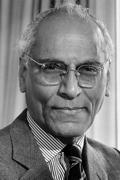
Komaravolu Chandrasekharan
Quick Info
Machilipatnam, Krishna District, Madras Presidency (now Andhra Pradesh), India
Zurich, Switzerland
Biography
K Chandrasekharan was the son of Sri Komaravolu Rajaiah and Padmakshamma. Komaravolu Rajaiah was a school teacher in Machilipatnam, Krishna District, but became the headmaster of the Bapatla Board High School in 1931. This school is in Bapatla, a town in the Guntur district of Andhra Pradesh.Chandrasekharan started his education at the District Board School in the Guntur District of Andhra Pradesh. He then studied at the Bapatla Board High School in Bapatla where his father was the headmaster. After graduating from the High School, Chandrasekharan went to Madras (now called Chennai) where he began his studies at Presidency College. This college had been founded in 1840 and, when the University of Madras was founded in 1857, the College was affiliated to the University. It was not clear to Chandrasekharan, however, which subject he should specialise in since he loved both mathematics and English literature. Krishnaswami Swaminathan was the professor of English at Presidency College and he was very impressed with Chandrasekharan abilities in English literature. He suggested, however, that India would soon become independent and that English literature may not be a favoured subject in an independent India. Chandrasekharan took his advice and concentrated on mathematics. He studied at Presidency College from 1937 to 1940, earning his B.A. (Hons) in Mathematics in 1940. Following his bachelor's degree, he began undertaking research at the University of Madras with Krishnaswamy Ananda Rau as his advisor.
K Ananda Rau (1893-1966) had been born in Madras and had studied at Presidency College. He graduated in 1914 and sailed to England where he entered King's College, University of Cambridge and studied the mathematical tripos. He completed the tripos in 1916 and began to undertake research advised by G H Hardy. Srinivasa Ramanujan was in Cambridge at this time and the two became friends. He was awarded the Smith's Prize in 1917 for his essay on the convergence and summability of Dirichlet's series, and became a fellow of King's College. He returned to India in 1919 and became a professor of mathematics at Presidency College. He continued to undertake research in summability of series, the theory of functions of a complex variable and number theory.
Chandrasekharan began his research career working in areas that K Ananda Rau had studied. He published eleven papers during the years 1941-1944: On Hadamard's factorization theorem (1941); The logic of intuitionistic mathematics (1941); The second theorem of consistency for absolutely summable series (1942); The absolute Bessel-summability of series (1942); Intuitionistic theory of linear order (1942); Bessel summation of series (1943); Bessel-summability of the product of two series (1943); The absolute summability of series of eigenfunctions (1943); On the canonical expression for a meromorphic function of finite order (1943); Partially ordered sets and symbolic logic (1944); and On Sturm-Liouville series (1944). During this time he obtained his M.A. in Mathematics from the University of Madras and began working as a part-time lecturer at the University of Madras in 1943 while continuing to undertake research for his Ph.D.
Chandrasekharan married Sarada Laxminarayan Rao in 1944; they had two sons.
Marshall Stone visited Madras in the spring of 1945, not for mathematical reasons but because of his interest in Indian music. He met Chandrasekharan there, and was impressed with the young man so he arranged for him to go to the Institute for Advanced Study in Princeton to work as Hermann Weyl's assistant. Chandrasekharan was awarded a Ph.D. by the University of Madras in 1945 for his thesis and, in the following year, arrived at the Institute for Advanced Study in Princeton. He was a member of the School of Mathematics at the IAS from December 1946 until May 1949. Ramaiyengar Sridhadan writes in [48] about Chandrasekharan's time as Weyl's assistant (note that he refers to Chandrasekharan as KC):-
... when he was at Princeton working as an assistant of Weyl, a person from the US Internal Revenue Service wanted to know what it meant to be an "Assistant", to which Weyl replied: "He is indeed my intellectual companion." KC wrote that he was moved by Weyl's generosity. On yet another occasion, KC, as assistant to Weyl, was filing a mass of reprints which Weyl used to have and KC was asked to comment on anything that struck him as unusual. It once happened that there was a reprint of Weyl's own lectures to the (future) US occupation forces in Germany. "This document," KC apparently told Weyl, "could be very useful to anyone in India interested in building a research centre." Weyl immediately said, "Take it and do what you like with it!" In KC's words, "The rest is history."In addition to Hermann Weyl, Chandrasekharan got to know Salomon Bochner, John von Neumann and Carl L Siegel. He learnt from them how mathematical research was organised in both Germany and in the United States. He began a fruitful cooperation with Bochner which led to seven papers and one book. Both Bochner and Chandrasekharan had written single authored papers on the summation of multiple Fourier series and their first joint paper was On the Localization Property for Multiple Fourier Series (1946). Their book, published by Princeton University Press, was Fourier Series (1949); for more information on this work, see THIS LINK.
Chandrasekharan was interested in music and, while at the Institute for Advanced Study in Princeton he had the letter [7] published:-
I, for one, do not think that when people say that music is a universal language they mean that there exists a definite type of music which evokes the same kind of response from all kinds of peoples. I think they mean that music in the abstract (which I would describe as audible tapas) is universal in its appeal, that even persons who may be illiterate are responsive to music. It is known that some animals, for instance snakes, are also responsive to music in a recognisable way. In this respect, music seems to me definitely to transcend language. That there are no dictionaries of music, as there are grammars of language, is therefore not a fact to be regretted. Greater stress should be laid on the word 'universal' than on the word 'language'.Homi Jehangir Bhabha (1909-1966) was an Indian nuclear theoretical physicist who had first studied the Mechanical Tripos at the University of Cambridge and had then studied the Mathematical Tripos. After undertaking research for his Ph.D. at the Cavendish Laboratory, he visited Niels Bohr's institute at Copenhagen, Wolfgang Pauli in Zurich and had spent three years working with Enrico Fermi at the Institute of Physics in Rome. He returned to India in 1939 and was appointed reader in physics at the Indian Institute of Science. In 1943, he wrote to Jehangir Ratanji Dadabhoy Tata proposing the establishment of an institute for fundamental research. Tata replied in positive terms suggesting that the Tata Trust would probably put up funding. In June 1945, with a grant from the Tata Trust, he established the Tata Institute of Fundamental Research (TIFR). Bhabha visited the United States with the aim of recruiting mathematicians and physicists for the TIFR and, when at the Institute for Advanced Study in Princeton, he met Chandrasekharan and, on the recommendation of Hermann Weyl and John von Neumann, offered him a position as reader at the TIFR. Chandrasekharan accepted having insisted that he must have a free hand in running the school of mathematics and took up the position in July 1949. He did return to Princeton as a Visitor to the School of Mathematics from August to October 1950.
When Chandrasekharan joined TIFR there were already two mathematicians employed there. Friedrich Wilhelm Daniel Levi (1888-1966) had fled from Nazi Germany in 1935 and in the following year was appointed to the Hardinge Chair of Higher Mathematics at the University of Calcutta. Bhabha had recruited him to TIFR in 1948 but he did not stay there long, returning to Germany in the early 1950s. Damodar Dharmananda Kosambi (1907-1966) was an Indian who had studied mathematics at Harvard under G D Birkhoff but had also been interested in many other subjects. He taught mathematics in India at a number of different colleges before Bhabha invited him to join TIFR. Although he was interested in differential geometry and statistics, he soon turned to his other interests becoming more of a Sanskrit scholar and a Marxist historian.
Once Chandrasekharan joined TIFR ran the School of Mathematics and he looked to invite mathematicians to spend time there. He had met Subbaramiah Minakshisundaram while they were both studying at the University of Madras, and they had both been at the Institute for Advanced Study at Princeton from 1946 to 1948. In 1951 Minakshisundaram was appointed as Head of the Department of Mathematical Physics at Andhra University and, in the same year, he participated in a summer seminar organised at the TIFR having been invited there by Chandrasekharan. This visit led to a collaboration between Chandrasekharan and Minakshisundaram, and they co-authored the book Typical Means which was published by Oxford University Press in 1952. For information about this book, see THIS LINK.
In 1951 Kollagunta Gopalaiyer Ramanathan was appointed to TIFR. Soon after this F W Levi left TIFR and returned to Germany leaving Mathematics at TIFR being led by Chandrasekharan, who became a full professor in 1952, with K G Ramanathan the only other permanent member of staff of Mathematics. Soon they were joined by some outstanding students who became Ph.D. students. In 1953 both M S Narasimhan and C S Seshadri were interviewed by Chandrasekharan and Ramanathan and offered places. Both accepted and Chandrasekharan became thesis advisor to both of them. He understood that the best way to develop a School of Mathematics in India undertaking leading research was to invite world-leading mathematicians to visit the school and give lecture courses. In 1953 Warren Ambrose visited TIFR and gave a course on Haar measure, the spectral theorem and other topics. In the following year Samuel Eilenberg visited and taught a course on algebraic topology. M S Narasimhan writes in [39] about Laurent Schwartz's visit during 1955:-
In the early fifties, Komaravolu Chandrasekharan initiated a programme for promoting mathematical research at the highest level at the Tata Institute of Fundamental Research in Bombay. At his invitation, Laurent Schwartz visited TIFR in 1955 for the first time and this was a landmark in the history of mathematical research in India. He gave a course on complex analytic manifolds. Starting from the definition of a differentiable manifold, the course covered - among other topics - currents, de Rham's theorem, elliptic partial differential equations, Hodge theory, Kähler manifolds and the Riemann-Roch theorem for compact Riemann surfaces. His inspiring lectures not only introduced young mathematicians at TIFR to important topics and techniques which were hardly studied in India at that time, but also introduced them to a whole new way of thinking about, and of doing, mathematics.R Narasimhan writes about the School of Mathematics that Chandrasekharan created at TIFR [40]:-
Members of the school were free to learn and to do research with no distractions (except of their own making). There were no restrictions on the field of work, no unfashionable subjects. This was specially important to people newly arrived from a restrictive university environment. These newcomers were given a stipend sufficient to cover necessities and encouraged to test their mettle. The older members (those who had been there longer) provided advice, information, and encouragement to the newer ones. Members of the school did not have to give lectures, nor did they have to undertake administrative duties, unless, of course, they wanted to. There was continuous contact with the best minds in mathematics. Outstanding mathematicians from all over the world, including the Soviet Union, came regularly to TIFR and lectured on the most diverse branches of the subject, presenting connected accounts of topics of current interest. These courses were written for publication by one or two members of the school. This often led to independent work by the "notes-takers", and sometimes, to collaborations with the lecturers. Material success and advancement in TIFR followed one's work; it was fair and rapid, based solely on the merits of the work done.The International Colloquium on Zeta-Functions was held at TIFR 14-21 February 1956. This was the first colloquium in a series initiated by Chandrasekharan which he organised and meticulously planned. Atle Selberg gave four talks in the 1956 colloquium and the famous "Selberg trace formula" figured in these talks. The series of four-yearly international colloquia on various topics in mathematics was co-sponsored by the International Mathematical Union (IMU).
One quality of the greatest importance in a leader of such a group is the ability to recognise significant mathematics and important problems even in fields far removed from his own areas of specialisation. In my opinion, Chandrasekharan had this quality to an extraordinary degree; otherwise the Institute would have been very different.
Chandrasekharan had become a member of the Executive Committee of the IMU a year before the first Colloquium. This committee consisted of nine voting members elected for four-year terms, namely the four officers (President, two Vice-Presidents, and Secretary General) and five Members-at-Large. He served in that capacity from 1955 to 1961. During this time he was appointed Deputy Director (Mathematics) of TIFR in 1960. In 1961 he became Secretary General of the IMU continuing in this role until 1966. In 1971 he was elected President of the IMU and held this position until 1974. During his time as President, he was assisted by Vice-President A A Albert from 1971 then, after A A Albert's death in 1972, by N Jacobson from 1972 to 1974. The five Members-at-Large were: M F Atiyah, Y Kawada (1916-2003), a Japanese mathematician known for his work in class field theory, harmonic analysis on topological groups, and algebra; N H Kuiper; M Nicolescu (1903-1975) a Romanian mathematician known for his foundational contributions to mathematical analysis; and E Vesentini (1928-2020) an Italian mathematician and politician known for his contributions to complex analysis, differential geometry, and functional analysis:-
The President is chair of the General Assembly and of the Executive Committee. The President is an ex-officio member of all Commissions of the IMU, however, in specific cases the President may delegate this responsibility to another Executive Committee member. The President appoints the chair of the Programme Committee, the Nominating Committee, and is an ex-officio member of the IMU Structure Committee.In [25] it notes that Chandrasekharan's:-
... initiatives over a long period of 24 years on the Executive Committee of the IMU were numerous and valued greatly.In fact, during his time as Secretary General of the IMU, Chandrasekharan left India and joined the Eidgenössische Technische Hochschule in Zurich, Switzerland. Seshadri suggests a possible reason for his move [47]:-
Chandrasekharan left TIFR towards the end of 1965 to join ETH in Zurich, Switzerland and remained there till his death. To many of us at TIFR, his decision to leave TIFR came as a surprise since it happened at a time when all his efforts were bearing fruit. Many possible reasons were given for his leaving but one thing that was clear was his rather strained relationship with Homi Bhabha. Though he admired Bhabha, he found faults with many things that Bhabha did. It is indeed sad that TIFR also lost Bhabha very soon in an air crash after Chandrasekharan left. Chandrasekharan was very upset by this event.Homi Bhabha, the founding director and professor of physics at TIFR, had been nominated for the Nobel Prize for Physics in 1951 and again in 1953-1956. He died in the crash of Air India Flight 101 on 24 January 1966, at the age of 56.
In fact Chandrasekharan had been in Zurich in the summer of 1964 and delivered a course of lectures on arithmetical functions at the Forschungsinstitut für Mathematik of the Swiss Federal Institute of Technology, Zurich. Beno Eckmann had been appointed as Head of this Mathematics Research Institute when it was founded in 1964 and he invited Chandrasekharan to deliver lectures on Arithmetical Functions. These lectures became the basis for Chandrasekharan's book Arithmetical Functions published in 1970. For information about this book, see THIS LINK.
At TIFR Chandrasekharan had been highly involved in administration and teaching so he had less time for research than he may have wished. At TIFR, Chandrasekharan was thesis advisor of three students: C S Seshadri (1958), M S Narasimhan (1960) and R Narasimhan (1963). He did not publish any joint papers with C S Seshadri or with M S Narasimhan but he published 14 joint papers with R Narasimhan about half published while he was at TIFR and half while he was in Zurich. During his time at Zurich, from 1965 to 1988, Chandrasekharan was thesis advisor for nine students.
While teaching in Zurich, Chandrasekharan gave several courses which formed the basis of books he published. These included: Introduction to Analytic Number Theory (1968); Elliptic Functions (1985); Classical Fourier Transforms (1989); A Course on Topological Groups (1996); and A Course on Integration Theory (1996). For information about these books, see THIS LINK.
Oliver Knill writes in [28] about Chandrasekharan as a lecturer:-
I had been fortunate to take an introductory number theory course from him as a sophomore student at ETH. As custom, there was no book for this course. The lectures were clear and sufficient. I remember the lectures vividly. "Chandra", (that is how we students would call him), obviously had a lot of fun giving the lectures. He could chuckle over even seemingly dry proofs and make us fall in love with the subject. He also made sure that we appreciated even seemingly simple facts in number theory and saw them in a historical context, where first attempts were often incomplete.Heath-Brown gives some details of Chandrasekharan's research in [23]. He are some extracts:-
...
I later took also a pro-seminar with him. Taking such seminars was mandatory and tough! I obtained the task to present a density theorem of George Polya on Dirichlet series. The assistant Albert Stadler (a PhD student of Chandra) had been in charge to make sure that we came prepared to the classes. Preparing for such seminars was a lot of work. Reading the article, putting together the necessary background and bringing down the proof to a 2 hour lecture was not easy.
Chandrasekharan's early research (1940-1955) focused on logic and analysis, and in summability theory and Fourier series in particular. His first works in number theory, written jointly with S Bochner in one case and S Mandelbrojt in others, can be viewed as extensions of Hamburger's theorem. ... The next group of articles, written by Chandrasekharan with his student R Narasimhan, are his most widely cited research papers. They consider the sum function for coefficients of generalised Dirichlet series satisfying suitable functional equations. Both ordinary sums and Riesz means are examined, and both O-estimates and Ω-theorems are given for the error terms that arise. In addition the mean square of the error term is also considered. Despite the generality of the setting for these theorems, they recapture many of the classical estimates for sums of arithmetic functions, and provide a number of new bounds.Chandrasekharan received three major awards: (i) the Padma Shri (1959), (ii) the Shanti Swarup Bhatnagar Award for Mathematical Sciences (1963), and (iii) the Srinivasa Ramanujan Medal (1966). Let us say a little about each of these awards.
Also highly influential was the paper [The approximate functional equation for a class of zeta-functions] on the approximate functional equation for generalised Dirichlet series, which again was written jointly with R Narasimhan. The result is quite complicated to state, as is not surprising given its remarkable degree of generality, but the paper convincingly shows how familiar properties of the Riemann zeta-function may often be extended to a much larger family of functions. In this way Chandrasekharan's work clearly foreshadowed our current viewpoint on the natural setting in which to view the Riemann zeta-function.
- The Padma Awards are one of the highest civilian honours of India announced annually on the eve of Republic Day. The Awards are given in three categories: Padma Vibhushan (for exceptional and distinguished service), Padma Bhushan (distinguished service of higher order) and Padma Shri (distinguished service). The award seeks to recognise works of distinction and is given for distinguished and exceptional achievements/service in all fields of activities/disciplines. The awards are presented by the President of India usually in the month of March/April every year where the awardees are presented a Sanad (certificate) signed by the President and a medallion. K Chandrasekharan received the Padma Shri award in 1959 in the field of Literature and Education.
- The Shanti Swarup Bhatnagar Prizes are named after the founder of the Indian Council of Scientific & Industrial Research, Shanti Swarup Bhatnagar, and is known as the 'Shanti Swarup Bhatnagar Prize for Science and Technology'. The Prize is given each year for outstanding Indian contributions to science and technology. The Mathematical Science prize was founded in 1959 and the first award was made to K Chandrasekharan in 1963.
- The Srinivasa Ramanujan Medal, established by the Indian National Science Academy in 1961, recognises outstanding contributions in the mathematical sciences and is open to scientists of Indian origin or those working in India. It is, of course, named for the remarkable Indian mathematician Srinivasa Ramanujan. It was first awarded in 1962 to Subrahmanyan Chandrasekhar and was awarded every second year so K Chandrasekharan was the third person to receive the award in 1966.
References (show)
- R G Bartle, Review: A Course on Integration Theory, by K Chandrasekharan, Mathematical Reviews MR1662921 (99k:28001).
- C Benedetti, Review: Arithmetical Functions, by K Chandrasekharan, Genus 27 (1/4) (1971), 426-428.
- M Berg, Review: A Course on Topological Groups, by K Chandrasekharan, Mathematical Association of America Reviews (5 April 2012).
- S Bochner and K Chandrasekharan, Fourier Transforms (Princeton University Press, 1949.
- Chandrasekharan, Komaravolu, Élites suisses (2026).
https://elitessuisses.unil.ch/p/77785 - Chandrasekharan, Komaravolu (1920-2017), IdRef - Identifiants et Référentiels pour l'ESR (2026).
https://www.idref.fr/031616399 - K Chandrasekharan, Minor Modes in Indian Music, ETC: A Review of General Semantics 5 (1) (1947), 75-76.
- K Chandrasekharan, Introduction to analytic number theory (Springer-Verlag, 1968).
- K Chandrasekharan, Arithmetical Functions (Grundlehren der Mathematischen Wissenschaften, Springer-Verlag, 1970).
- K Chandrasekharan, Elliptic Functions (Springer-Verlag, 1985).
- K Chandrasekharan, Classical Fourier transforms (Springer-Verlag, 1989).
- K Chandrasekharan, Course on topological groups (Hindustan Book Agency, 2011).
- K Chandrasekharan, Course on integration theory (Hindustan Book Agency, 2011).
- K Chandrasekharan and S Minakshisundaram, Typical means (Oxford University Press, 1952).
- S D Chatterji, Komaravolu Chandrasekharan, Historisches Lexikon of Swiss Academy of Humanities and Social Sciences (2026).
https://hls-dhs-dss.ch/de/articles/043108/2017-06-19/ - J L B Cooper, Review: Fourier Transforms, by S Bochner and K Chandrasekharan, The Mathematical Gazette 35 (312) (1951), 140-141.
- G P Curbera, Mathematicians of the world, unite! (A K Peters, Ltd, Wellesley, Massachusetts, 2009).
- H G Eggleston, Review: Typical Means, by K Chandrasekharan and S Minakshisundaram, The Mathematical Gazette 38 (323) (1954), 61-62.
- From Humayun Kabir: Science Bodies, The Nehru Archive (23 September 1963).
https://nehruarchive.in/documents/from-humayun-kabir-science-bodies-23-september-1963-ww235#fn-90-marker - C C Graham, Review: Classical Fourier Transforms, by K Chandrasekharan, Mathematical Reviews MR0978387 (90c:42001).
- D H Griffel, Review: Classical Fourier Transforms, by K Chandrasekharan, The Mathematical Gazette 74 (467) (1990), 88.
- L Guzzella and S Springman, Prof. Dr. Komaravolu Chandrasekharan, Eidgenössische Technische Hochschule Zürich (3 May 2017).
https://people.math.harvard.edu/~knill/history/chandra/index.html - D R Heath-Brown, Komaravolu Chandrasekharan (1920-2017), Acta Arithmetica 185 (2) (2018), 101-106.
- J Hunter, Review: Introduction to Analytic Number Theory, by K Chandrasekharan, Proceedings of the Edinburgh Mathematical Society 17 (1) (1970), 112.
- K Chandrasekharan, in Some famous scientists of modern India (Tata Institute of Fundamental Research, 14 November 2004), 12.
https://web.archive.org/web/20191101075058/https://www.tifr.res.in/~outreach/outreach/scientists.pdf - K Chandrasekharan on China's Scientific Base, The Nehru Archive (13 February 1963).
https://nehruarchive.in/documents/k-chandrasekharan-on-chinas-scientific-base-13-february-1963-2elq6 - K Chandrasekharan Biography, Maps of India (2026).
https://www.mapsofindia.com/who-is-who/science-technology/k-chandrasekharan.html - O Knill, Komaravolu Chandrasekharan (1920-2017), Department of Mathematics Harvard University (13 October 2017).
https://people.math.harvard.edu/~knill/history/chandra/index.html - M I Knopp, Review: Elliptic Functions, by K Chandrasekharan, Mathematical Reviews MR0808396 (87e:11058).
- Komaravolu Chandrasekharan, The Talented Indian (2026).
https://www.thetalentedindian.com/komaravolu-chandrasekharan/ - Komaravolu Chandrasekharan, Institute for Advanced Study (2026).
https://www.ias.edu/scholars/komaravolu-chandrasekharan - Komaravolu S Chandrasekharan, Mathematics Genealogy Project (2026).
https://www.mathgenealogy.org/id.php?id=79756 - L Kuipers, Review: Introduction to Analytic Number Theory, by K Chandrasekharan, Mathematical Reviews MR0249348 (40 #2593).
- L Kuipers, Review: Arithmetical Functions, by K Chandrasekharan, Mathematical Reviews MR0277490 (43 #3223).
- B Kuttner, Review: Typical Means, by K Chandrasekharan and S Minakshisundaram, Bulletin of the American Mathematical Society 60 (1) (1954), 85-88.
- S Mandelbrojt, Review: Typical Means, by K Chandrasekharan and S Minakshisundaram, Mathematical Reviews MR0055458 (14,1077c).
- T S N, Review: Typical Means, by K Chandrasekharan and S Minakshisundaram, Current Science 22 (6) (1953), 187.
- M S Narasimhan, K Chandrasekharan (1920-2017), Current Science 113 (1) (2017), 171-172.
- M S Narasimhan, Laurent Schwartz and Development of Mathematical Research in India, Bhavana 2 (2) (2018).
https://bhavana.org.in/laurent-schwartz-m-s-naraimshan/ - R Narasimhan, The Coming of Age of Mathematics in India, Miscellanea Mathematica (1991), 235-258.
- S S Pal, Komaravolu Chandrasekharan, The Talented Indian (21 November 2024).
https://www.thetalentedindian.com/komaravolu-chandrasekharan/ - H Pollard, Review: Fourier Transforms, by S Bochner and K Chandrasekharan, Mathematical Reviews MR0031582 (11,173d).
- M S Raghunathan, Forgotten genius, Frontline Magazine, The Hindu (7 June 2017).
https://frontline.thehindu.com/other/obituary/forgotten-genius/article9721253.ece - I E Segal, Review: Fourier Transforms, by S Bochner and K Chandrasekharan, Bulletin of the American Mathematical Society 56 (6) (1950), 526-528.
- C-O Selenius, Review: Introduction to Analytic Number Theory, by K Chandrasekharan, Nordisk Matematisk Tidskrift 19 (1/2) (1971), 40-41.
- C S Seshadri, K Chandrasekharan (1920-2017), Hardy-Ramanujan Journal 40 (2017), 47-51.
- C S Seshadri, K Chandrasekharan (1920-2017), Bhavana 1 (3) (July 2017).
- R Sridhadan, KC and I: My Fond Rememberance, Bhavana 2 (1) (January 2018).
https://bhavana.org.in/kc-and-i-my-fond-remembrance/ - H M Stark, Review: Introduction to Analytic Number Theory, by K Chandrasekharan, Bulletin of the American Mathematical Society 77 (6) (1971), 943-957.
- H M Stark, Review: Arithmetical Functions, by K Chandrasekharan, Bulletin of the American Mathematical Society 77 (6) (1971), 943-957.
- A Stenger, Review: Introduction to Analytic Number Theory, by K Chandrasekharan, Mathematical Association of America Reviews (4 August 2017).
- A Stenger, Review: Classical Fourier Transforms, by K Chandrasekharan, Mathematical Association of America Reviews (12 December 2017).
- A Stenger, Review: A Course on Integration Theory, by K Chandrasekharan, Mathematical Association of America Reviews (14 April 2012).
- The Infosys-Chandrasekharan Random Geometry Centre, Tata Institute of Fundamental Research (2026).
https://randomgeometry.in/ - J M Tosenblatt, Review: A Course on Topological Groups, by K Chandrasekharan, Mathematical Reviews MR1661135 (99k:22010).
Additional Resources (show)
Other pages about Komaravolu Chandrasekharan:
Other websites about Komaravolu Chandrasekharan:
Cross-references (show)
Written by J J O'Connor and E F Robertson
Last Update July 2026
Last Update July 2026