 MacTutor
Krishnaswamy Ananda Rau
Quick Info
Madras, now Chennai, India
Bombay, now Mumbai, India
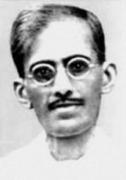
Biography
K Ananda Rau was a son of C Krishnaswami Rao (1867-1928) and his wife (whose name we have been unable to find). C Krishnaswami Rao had been born in 1867 at Saidapet, a neighbourhood of Madras. He had studied at Presidency College, Madras, where he attended the Law Lectures. After an apprenticeship at Madras he set up his own practice at Kurnool. In the year 1893 he was first appointed as a low-tier judge. He received the title 'Dewan Bahadur', rose to the position of District Judge and after a few years was made Judge of the High Court at Madras. He retired in 1923 and, after a short illness, died in 1928. He had three sons and two daughters, K Ananda Rau, being his second son.We should mention at this point a relative of Ananda Rau who was important in developing his interest in mathematics. This is R Ramachandra Rao (1871-1936) who entered the Civil Service in 1890 and became a highly influential Indian civil servant who served as the District Collector of Kurnool from 1901 to 1907 and, after being Registrar of Cooperative Societies, served as the District Collector of Nellore from 1910 to 1914. He was a founding member of the Indian Mathematical Society in 1907, secretary from 1910 to 1915 and served as its president from 1915 to 1917. He became a friend and supporter of Ramanujan.
Ananda Rau attended the Hindu High School in the Triplicane district of Madras. This school began as two small schools dating back to 1852 but it grew larger and the main building opened in 1897 with the school adopting the name Hindu High School in 1898. The school continued to flourish and, while Ananda Rau was studying there, a further twelve rooms were added to the main building in 1906. Ananda Rau was an excellent pupil at the school and at the end of his studies at the High School in 1909 he took the Matriculation examination of Madras University. He passed this examination, was awarded First Class, and was ranked fourth out of all the candidates. He then entered Presidency College to take the two year Intermediate course which was necessary before students began a three year honours course. Presidency College had been founded in 1840 and, when the University of Madras was founded in 1857, the College was affiliated to the University and brought its courses into line to qualify students for a University of Madras degree. After two years study, in 1911 Ananda Rau took the Intermediate examination of the University of Madras. He was awarded first class and ranked third. He then began his studies for a B.A. degree with Honours in Mathematics.
There is no doubt that R Ramachandra Rao had a strong influence on Ananda Rau throughout his education. In 1910 Ramachandra Rao, at that time the District Collector of Nellore and secretary of the Indian Mathematical Society, had met with Ramanujan and given him advice and financial support. Ananda Rau's family were well off and certainly did not need financial support but Ramachandra Rao's encouragement and enthusiasm for mathematics played an important role in the young student's development. While studying for his M.A., Ananda Rau learnt of the excitement among his professors about the young Ramanujan. E H Neville, a colleague of G H Hardy from Cambridge, visited Madras in early 1914 and lectured at the university. He made arrangements for Ramanujan to visit Cambridge and he sailed from India on 17 March 1914 to go to Cambridge, England. Ananda Rau was awarded a B.A. with First Class Honours in Mathematics and followed Ramanujan to Cambridge, sailing from India on 1 August 1914. Before leaving, Ananda Rau married his wife (whose name we cannot find); they had four daughters.
At the University of Cambridge, Ananda Rau studied at King's College. Shortly after he arrived he met Ramanujan and the two became close friends. At King's College he had lectures from Arthur Berry (1862-1929). Berry had been Senior Wrangler in the Mathematical Tripos of 1885, had become a Fellow of King's in 1886 and, after 1889, devoted himself to King's and to lecturing mathematics. Life at Cambridge was influenced by World War I (1914-1918) with many teaching staff called up for military service. Ananda Rau sat Part I of the Mathematical Tripos in 1915 and was awarded First Class. In 1916 he sat Part II of the Mathematical Tripos and again was First Class. He was awarded a mark of proficiency in the advanced pure mathematics of Schedule B. M S Rangachari writes in [16]:-
During his stay at Cambridge, Ananda Rau was first elected as an exhibitioner and then a scholar of King's College. His mathematical talent blossomed under the influence of G H Hardy who was then at Trinity College. Hardy wrote on 26 March 1918, "Mr K A Rau has spent the last year in mathematical research, undertaken in part under my advice. Some of his results are contained in an essay which obtained the Smith's Prize this year; and he has done other valuable work which will no doubt be published in due course."Even before he was awarded the Smith's Prize, Ananda Rau published A note on a theorem of Mr Hardy's which he submitted to the Proceedings of the London Mathematical Society in October 1917.
Although his Smith's Prize Essay was not published, Ananda Rau published the paper On the convergence and summability of Dirichlet's series (1932). In it he writes [20]:-
The contents of this paper form a slightly modified version of part of an essay for which a Smith's Prize was awarded in 1918 in the University of Cambridge.We quote from the Introduction to give an indication of the contents of Ananda Rau's Smith's Prize Essay [20]:-
1. In a paper published several years ago in these Proceedings Hardy and Littlewood proved a series of theorems of great generality, whose nature they have called Tauberian; and in the same paper they applied these theorems to the study of a variety of problems. The theorems were concerned, to put the matter roughly, with the relations connecting the behaviour of a function and of its derivatives of integral orders. Hardy and Littlewood foresaw that theorems similar to theirs can be proved involving Riemann-Liouville derivatives of non-integral orders. M Riesz has since proved some of these extensions by making use of an important mean value theorem.Although Ananda Rau did not publish this part of his Smith's Prize Essay until many years after he wrote the Essay, his first papers, submitted shortly after he left Cambridge, are clearly related to the Essay. He published On Lambert's series in the Proceedings of the London Mathematical Society in 1921. It was submitted on 1 April 1919 and has many references to Hardy's assistance. For example, he writes the following about the converse of one of his results [18]:-
2. Among the applications which Hardy and Littlewood made of their Tauberian theorems, there is one class with which the present paper is connected, namely the applications to questions of convergence and summability of Dirichlet's series. Hardy and Littlewood concerned themselves only with ordinary Dirichlet's series, that is, series of the type ; the methods of summation which they employed were those associated with the name of Cesàro, and the orders of summation were integral. But they foresaw not only that their theorems can be extended to non-integral orders of Cesàro summation, but also that the more general methods of summation by typical means introduced by Riesz can be employed and theorems of a similar character proved for Dirichlet's series of arbitrary type. Riesz, in the paper referred to, has proved some extensions of this nature.
3. The present paper deals with some of the generalisations suggested by Hardy and Littlewood and also some additional matter. The mean value theorem of Riesz and his extended forms of the Tauberian theorems of Hardy and Littlewood play an important part in the present paper.
The problem is then very much more difficult; Mr Hardy has kindly pointed out to me its close connection with the Prime Number Theory. He also tells me that he and Mr Littlewood have proved (on assuming the Prime Number Theorem) that, if a series is summable (L), then it is also summable (A). I understand that their paper on the subject is to be published in this volume of the Proceedings.At another point he notes [18]:-
This theorem was previously known to Messrs Hardy and Littlewood, and I am indebted to them for their permission to have it published here.His paper Note on a property of Dirichlet series was published in the same volume of the Proceedings. It extends work in a paper by G H Hardy and M Riesz.
M S Rangachari writes in [16] about Ananda Rau and Ramanujan together at Cambridge:-
Both often met at Cambridge. They talked to each other in homely Tamil. Ananda Rau never ceased to regret that he was then not mature enough mathematically to use his opportunities to gain an insight into a mind of remarkable originality. After all, there are mathematicians who believe that Hardy himself struggled hard to have such an insight but with no great success.After five years in England, Ananda Rau returned to India in 1919 and was appointed in Presidency College, the college at which he himself had studied, on 7 July 1919. He continued to undertake research and published excellent papers on topics such as summability of series in general and of general Dirichlet series in particular, functions of a complex variable, and representation of numbers as sums of an even number of squares. To give examples of some of his papers, let us list: On the boundary behaviour of elliptic modular functions (1929); An Example in the Theory of Summation of Series by Riesz's Typical Means (1930); On Hermite's doubly periodic functions of the third kind (1957); On the summation of singular series associated with certain quadratic forms (Part I, 1959, Part II, 1962).
Although Ananda Rau published a number of excellent research papers, his importance for Indian mathematics lies mainly in the influence he had on his students creating a number of world leading Indian mathematicians. He was quick to recognise talent at an early stage and make great efforts to see that such talents were fully developed. Let us quote from some who saw this flowering of mathematics under his leadership. M S Raghunathan writes [11]:-
He was from all accounts an inspiring teacher, held in great respect and affection by his students, many of whom went on to become fine mathematicians themselves; some among them were leaders on the Indian scene ... S S Pillai become a student of Ananda Rau for whom he cherished life-long affection and respect. ... Luckily for Vijayaraghavan, a real mathematician - Ananda Rau - who could recognise talent that the examination system was incapable of detecting, was at the helm of affairs and he could secure his admission to the B.A. (Honours) course in the University.Ananda Rau's contributions to number theory are discussed in detail by Purabi Mukherji in [23]. Here are a few of his comments:-
R Balasubramanian said, "If Ramanujan's influence in India is the tree … then K Ananda Rau is the root." ... Noted mathematician V Ganapathy Iyer was one of Ananda Rau's students. He commented: "As a student I used to feel that his exposition of any topic was so clear and impressive that I need not study the topic again." C T Rajagopal, a doctoral student of Prof Ananda Rau, said that Ananda Rau's way of working with research scholars was rather novel. He encouraged them and expected them to formulate their own problems. Later, he would discuss the problems with them. In this way, he brought out the best in them. Special emphasis is being given to this quality of Ananda Rau, because many of the stalwarts of the number theory school of South India were mentored by him. Starting from T Vijayaraghavan, S S Pillai, K Chandrasekharan to C T Rajagopal, all were his students. All of them made rich contributions in developing the school of research on number theory in India.R Narasimhan writes (see [8] or [9]):-
Ananda Rau's early work was done in Cambridge. He was a student of Hardy, and there is no mistaking the influence of Hardy and Littlewood on this work. Ananda Rau had a critical and independent mind and he was conscious of the vast extent of mathematics and the lack of interest in India in many of its branches. He knew Ramanujan in Cambridge and spoke of him with great admiration, but without a trace of the mysticism or romanticism of many others. On his return to India, he took up a position at Presidency College, where he remained until his retirement. He was in the Indian Educational Service, and was thus better off than most other mathematicians. (The IES was abolished shortly after his appointment.)C S Seshadri writes about K Chandrasekharan being advised by Ananda Rau beginning in 1940 (see [21] or [22]):-
Ananda Rau's first successes concerned summability by general Dirichlet series (including power series). He established very general "Tauberian theorems" which had resisted the efforts of some of the best analysts. One of the methods of summation to which he contributed some of his most original ideas, Lambert summability as it is called, is intimately connected with the distribution of prime numbers. In later years, Ananda Rau was occupied with modular functions and the representation of integers as sums of squares. It has always seemed to me a great pity that neither Ramanujan nor Ananda Rau ever came into contact with someone like Erich Hecke when they were young. Hecke was a master at combining hard analysis with the arithmetic behaviour of modular (and automorphic) functions, exactly the two topics central in the work of these two Indians.
Ananda Rau's work is of great depth and elegance. He had a strong influence on his students: Vijayaraghavan, S S Pillai, Ganapathy Iyer, Minakshisundaram, K Chandrasekharan and others. He taught them, besides mathematics, the value of intellectual independence.
K Chandrasekharan naturally took up mathematics and wrote his Ph.D. thesis with Ananda Rau as his thesis advisor. K Chandrasekharan's mathematical interests centred around analysis and analytic number theory. The most well-known and influential persons in mathematics in Madras at that time were Ananda Rau, R Vaidyanathaswamy (at the newly created mathematics department in the Madras University) and Fr Racine at Loyola College. ... Whereas Ananda Rau represented analytic number theory, the other two brought to K Chandrasekharan and other students the awareness of different disciplines.M S Rangachari writes (see [16] or [17]):-
Ananda Rau used to take very good interest in mathematics education. The author cannot forget his unfailing attendance in the monthly meetings arranged by the Madras Mathematics Club where teachers from colleges and the university mingled and listened to informal lectures. He used to say explicitly that our children are made to keep excessively long school hours, whereas all that may be needed to make good students of them (according to their bent) is no more than three hours of school per day. He also believed that every one who sits for a degree examination should be given a degree, since such a system alone would foster genuine scholarship and justify the ends of the university even if it be that it produced only a few men of outstanding ability. Consistent with these opinions was his argument that an employment agency, whether of the Government or not, should devise its own system of selecting candidates instead of leaving the selection to the university and its system of examinations.Despite his great successes for helping to create a strong Indian mathematical research school, the second half of Ananda Rau's life saw several major tragedies. His wife died in 1928 and one of his three daughters died in 1940. His final years are described by M S Rangachari in [16] and C T Rajagopal [12] in an identical paragraph:-
Ananda Rau's life, especially in its second half, had an undertone of silent suffering and dedicated studiousness, relieved though by his hobby of gardening pursued with more than amateur skill. Death very nearly claimed him after a kidney operation in November 1936, while it actually claimed two of his dear ones at different times. His wife (whom he had married before he left for Cambridge) passed away in 1928 and one of his daughters in 1940. So it was his mother who, till her death in 1958, became largely responsible for the care of his home and of his surviving three daughters (the first and the two last) as long as they needed it. In the closing years of his life, when he became blind of one eye and physical disabilities began to weigh upon him increasingly, a constant preoccupation with him was numbers expressible as specific sums of squares. During this period, his only personal contacts were with his family and with his pupils in the Ramanujan Institute and their own pupils. Many in the Ramanujan Institute will long remember his tall spare figure, worn away so thin as to seem but a vehicle of shining thought.One of his daughters married Oopalka Srinivasa Murthy who was a pioneering civil engineer in Indian Railways, and was widely celebrated for establishing the Integral Coach Factory in Perambur, Madras (now Chennai). Appointed as the first Engineer-in-Charge in 1951, he led the team that designed and constructed this premier coach-manufacturing facility. He later served as the General Manager of the Western Railway zone. Ananda Rau spent his final years living with his daughter and her husband O S Murthy, and he died in their home in Bombay (now Mumbai) at 6 a.m. on 22 January 1966.
References (show)
- V K Balachandran, C T Rajagopal and M S Rangachari (eds.), Ananda Rau Memorial Volume (Ramanujan Institute, 1969)
- R Balasubramanian, Highly Composite, Proceedings of the International Congress of Mathematicians 2010 1 (Hyderabad, India, 2010), 176-209.
https://www.mathunion.org/fileadmin/ICM/Proceedings/ICM2010.1/ICM2010.1.pdf - S G Dani, India's Arrival on the Modern Mathematical Scene, Resonance (September 2012), 824-846.
https://www.ias.ac.in/article/fulltext/reso/017/09/0824-0846 - J W Dauben and R Parikh, Beginnings of modern mathematics in India, Current Science 99 (3) (2010), 15-37.
- Dewan Bahadur C Krishnaswami Rao, Dakshini Marathi Khajana (2026).
https://www.dakshinimarathiadda.com/dewan-bahadur-c-krishnaswami-rao - K Ananda Rau, Mathematics Genealogy Project (2026).
https://mathgenealogy.org/id.php?id=91314 - K Ananda Rau, Indian Academy of Sciences (2026).
https://fellows.ias.ac.in/profile/v/FL1934080 - R Narasimhan, The Coming of Age of Mathematics in India, Miscellanea Mathematica (1991), 235-258.
- R Narasimhan, The Coming of Age of Mathematics in India, Bhavana 1 (1) (2017), 37-51.
- R Prasad, Ananda Rau - Teacher, Mathematician, Dakshinapatha (9 July 2020).
https://dakshinapatha.com/2020/07/09/k-ananda-rau-teacher-mathematician/ - M S Raghunathan, Artless innocents and ivory-tower sophisticates: Some personalities on the Indian mathematical scene, Current Science 85 (4) (2003), 526-536.
- C T Rajagopal, K Ananda Rau, Journal of the London Mathematical Society 44 (1) (1969), 1-6.
- C T Rajagopal, K Ananda Rau: A sketch, Publ. Ramanujan Inst. (1968/69), 1-10.
- R Ramachandran, Beyond Ramanujan, Frontline (24 September 2010).
https://frontline.thehindu.com/other/beyond-ramanujan/article30181892.ece - A Raman, Another who was mentored by G H Hardy, Archive Madras Musings 20 (3) (2010)
- M S Rangachari, K Ananda Rau (1893-1966), Biographical Memoirs of INSA Fellows (Indian National Science Academy, New Delhi, 1988), 107-117.
- M S Rangachari, K Ananda Rau (1893-1966), Bull. Math. Assoc. India 18 (1-4) (1986), 9-12.
- K Ananda Rau, On Lambert's series, Proceedings of the London Mathematical Society (2) 19 (1) (1920), 1-20.
- K Ananda Rau, Note on a property of Dirichlet series, Proceedings of the London Mathematical Society (2) 19 (1) (1920), 114-116.
- K Ananda Rau, On the convergence and summability of Dirichlet's series, Proceedings of the London Mathematical Society (2) 34 (6) (1932), 414-440.
- C S Seshadri, K Chandrasekharan (1920-2017), Hardy-Ramanujan Journal 40 (2017), 47-51.
- C S Seshadri, K Chandrasekharan (1920-2017), Bhavana 1 (3) (July 2017).
- P Mukherji, Research Schools on Number Theory in India (Springer, 2020).
Additional Resources (show)
Other pages about Krishnaswamy Ananda Rau:
Other websites about Krishnaswamy Ananda Rau:
Cross-references (show)
Written by J J O'Connor and E F Robertson
Last Update July 2026
Last Update July 2026