 MacTutor
Veeravalli Seshadri Varadarajan
Quick Info
Bangalore (now Bengaluru) India
Santa Monica, California, USA
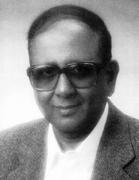
Biography
V S Varadarajan (known as Raja to his friends and colleagues) was the son of Seshadri who was an Inspector of Schools in India's Department of Education. His mother came from a family originating in Hosur, a town on the border of Tamil Nadu and Karnataka. Although Varadarajan was born in Bengalore he never lived there. It was where his mother's parents lived at the time and by tradition women went to their parent's home for the birth of their children. Her paternal uncle was Chakravarti Rajagopalachari a prominent Indian independence leader, statesman, and the last Governor-General of India. Seshadri and his wife had five children, Varadarajan and four girls, who were brought up in a traditional Tamil Brahmin household. It was a middle-class family who lived without luxuries. In the summer vacations, Varadarajan sometimes went to stay with his mother's elder sister in Shivamogga, a city on the banks of the Tunga River. Music was important in the household and Varadarajan became a singer, encouraged by the husband of his mother's elder sister who was a singer.Seshadri's work as an Inspector of Schools meant that he was transferred to different towns so Varadarajan attended several Jesuit schools mainly in Trichinopoly (now known as Tiruchirappalli) and Salem. In these schools he was taught in Tamil but he studied English particularly the works of Shakespeare and Wordsworth. The sport he enjoyed most was cricket and he was a better bowler than batsman. His first interest in mathematics was in the 10th grade when he was taught by O V Rajagopalan. He said [1]:-
Rajagopalan had a habit that, once a week, no word will be uttered in the class. If the proposition is drawn on the board, you had to indicate what the hypothesis was, and you had to argue using your hands, without speaking a word, to reach the conclusion. Only through hand movement. It was quite a challenge, but Rajagopalan was a great teacher.In fact he was taught geometry by O V Rajagopalan, having chosen this as his optional course.
Varadarajan graduated from high school in 1951 around the time that his father was posted to Madras (now known as Chennai). For university studies, the system in place at that time was to do a two-year Intermediate course and then progress to a three-year honours course. Varadarajan entered Loyola College for his Intermediate. Loyola College was a Jesuit College which had been founded in 1925. Up to that point his schooling had all been in the Tamil language but he had studied English as a foreign language so he had no problem with the teaching at Loyola College all being in English. He was taught mathematics by K A Adivarahan. He explained [1]:-
Adivarahan was the teacher who made the strongest impression. I remember the other teachers but they didn't make such a strong impression. Adivarahan was a legend in Loyola College and a very strict disciplinarian as well. A typical student would be scared to talk to him.After completing his Intermediate at Loyola College, Varadarajan entered Presidency College in 1953 to study for honours. This College was founded in 1840, before the University of Madras which was established in 1857. After the University came into existence, the Presidency College brought its courses into line to qualify students for a University of Madras degree. There were two honours courses involving mathematical sciences. One was the mathematics honours which consisted of courses in pure mathematics and applied mathematics. The second was statistics honours which consisted of the same pure mathematics courses as the mathematics honours but statistics courses instead of applied mathematics. Varadarajan chose the statistics honours because he felt this would put him a stronger position to get a job and, at the same time, let him study the pure mathematics courses which interested him.
While at Presidency College, Varadarajan attended two talks which had a large influence on his future research interests. The first was by P A M Dirac who visited Presidency College in 1954 and give a lecture. Varadarajan attended the lecture, failed to understand much of it, but nevertheless it inspired him to learn more about the connections between mathematics and physics. The second talk which influenced him greatly was given by C Radhakrishna Rao when Varadarajan was in his final year of study at Presidency College. C R Rao was head of the Research and Training School at the Indian Statistical Institute in Calcutta (now known as Kolkata). Varadarajan was very impressed by C R Rao's talk, and after he graduated in early 1956 he wrote to C R Rao asking whether he could work at the Indian Statistical Institute; he was accepted.
We should also mention another important life-changing event which happened while Varadarajan was at Presidency College. He met Veda (born 29 March 1936 in Coimbatore, Madras, India); they would marry in 1964.
Varadarajan began his studies at the Indian Statistical Institute in Calcutta in the summer of 1956 but life was difficult. Ria Fioresi writes in [13]:-
Raja also shared memories of his PhD years in Calcutta; he could not afford to either buy or xerox mathematics books. The only way to study them properly was to visit the university library and copy them by hand. When I expressed surprise at the amount of time this took, he explained that it actually helped him read more carefully and reflect deeply on the material - something that today's students, with their access to photocopiers and online downloads, might miss.In the article [43] Varadarajan gives the background to the Indian Statistical Institute in Calcutta becoming one of only two research institutes in India at that time and explains how he become one of the "famous four", Veeravalli S Varadarajan, Ramaswamy Ranga Rao, K R Parthasarathy and S R Srinivasa Varadhan. For an extract from that paper, see THIS LINK.
He began undertaking research advised by C R Rao and soon began publishing papers. The following seven papers were all in print by 1958: Weak convergence of measures on separable metric spaces; On the convergence of sample probability distributions; On a problem in measure-spaces; An existence theorem for probability spaces (Russian); A remark on strong measurability; (with R Ranga Rao) On a theorem in metric spaces; and A useful convergence theorem. In fact his research had led to results very quickly. For example, having only arrived at the Indian Statistical Institute in the summer of 1956, his paper On a problem in measure-spaces was received by the Annals of Mathematical Statistics on 12 November 1956. As to the other papers, two were received in October 1957, one in November 1957, and two in May 1958. In the first of these seven papers in our list he writes:-
... the writer wishes to thank Dr V K Balachandran of the Indian Statistical Institute for several useful discussions during the preparation of the paper.Early in 1960 Varadarajan was awarded a Ph.D. for his thesis Convergence of Stochastic Processes. The Indian Statistical Institute could not award Ph.D. degrees so his thesis had to be submitted to Calcutta University. They had to appoint an external examiner for the thesis and the university accepted Varadarajan's suggestion of Yuri Prokhorov. Yuri Vasilyevich Prokhorov (1929-2013) had been a student of Andrey Kolmogorov at Moscow State University, where he had obtained his Ph.D. in 1956.
Varadarajan had been awarded a postdoctoral fellowship by Princeton University in the United States and immediately he went there. He entered New York on 4 January 1960 having arrived on a flight from Paris. While at Princeton University he met Valentine Bargmann (1908-1989), a German Jew who had fled from Germany in 1933 after the Nazis came to power. Bargmann was an assistant of Albert Einstein at the Institute for Advanced Study at Princeton from 1937 to 1946, then spent the rest of his career at Princeton University. Bargmann advised Varadarajan to study the works of Harish-Chandra; this advice bore fruit since Varadarajan's later work was dominated by ideas from Harish-Chandra's results.
Although Varadarajan originally entered the United States intending to spend a year there, in fact after Princeton he went to the University of Washington in Seattle where he spent the academic year 1960-61. In December 1960, J L Doob communicated Varadarajan's paper Convergence of Stochastic Processes to the Bulletin of the American Mathematical Society. It has the following Introduction:-
Many problems in probability theory, when properly formulated, appear as problems in the theory of convergence of stochastic processes. The need for such a theory was demonstrated by the early results of Doob, Donsker and others. In their fundamental papers, Le Cam and Prohorov developed several aspects of such a theory. Their work was based on, and was a development of, the earlier work of A D Alexandrov and Kolmogorov. However, several questions which naturally arise were either not discussed or discussed only under unnecessary restrictions. The following remarks contain an outline of a general theory of measures on topological spaces. Only the statements and the appropriate formulations of the main results are given. The detailed proofs will be published elsewhere.The paper, announcing results from his thesis, has the following note:-
This work was done during 1958-1959 while the author was in the Indian Statistical Institute, Calcutta, but due to diverse reasons the announcement was delayed up to now.While at Princeton, Varadarajan had been advised to study the works of Harish-Chandra. He received the same advice from a rather different source at the University of Washington. Varadarajan [32]:-
... attended the seminars of G W Mackey at the University of Washington at Seattle on the mathematical foundations of quantum mechanics and group representations. Already in 1954 as a first year undergraduate student he had the opportunity of listening to a talk by the eminent physicist P A M Dirac at Madras University. In the course of his lecture Dirac made the statement 'the world is noncommutative'. It was just as 'loud as a heartbeat' but its full significance came to light during the Mackey seminars. It was a meeting point of fundamental laws of nature, group representations, Lie groups and Lie algebras and probability theory. Raja had several long discussions with Mackey during which he mentioned that a deeper understanding of group representations must be sought in the 'formidable Lie algebraic machinery of Harish-Chandra'.After the year at the University of Washington, Varadarajan spent a third academic year in the United States, being, for most of 1961-62, at New York University's Courant Institute. During this year he briefly met Harish-Chandra who was based at Columbia University, New York, but spent most of the year at the Institute for Advanced Study where he was a Sloan Fellow.
Varadarajan returned to the Indian Statistical Institute in Calcutta in the second half of 1962. He resumed his collaboration with R Ranga Rao (they already had two joint papers), and K R Parthasarathy. The three authors published two papers both with the title Representations of complex semisimple Lie groups and Lie algebras. The first is an announcement of the results (1966) and the second is a 47-page paper (1967) giving the results in full. The second paper begins as follows:-
The purpose of this paper is to study a class of irreducible Banach space representations of a complex semi-simple Lie group G through an analysis of the associated representations of the Lie algebra of G.Both papers have the following Acknowledgement (we have combined the two slightly differing texts):-
The work described in this paper was done during 1963-65 when the authors were at the Indian Statistical Institute, Calcutta. At an early stage of the work, the last named author [Varadarajan] had the opportunity of detailed and highly stimulating discussions with Dr S R S Varadhan currently of the Courant Institute of Mathematical Sciences, New York. He would like to express his indebtedness to Dr Varadhan for these discussions which determined our entire approach to the whole circle of questions studied in the present work.The PRV conjecture (the Parthasarathy-Ranga Rao-Varadarajan conjecture), concerning the decomposition of tensor products, comes out of this work. It was proved in 1988 by Shrawan Kumar. The importance of this conjecture can be seen by looking at MathSciNet where (in June 2026) 48 papers are listed with "PRV conjecture" either in the title of in the review.
In 1964-65 Varadarajan gave a course of lectures at the Indian Statistical Institute on the mathematical foundations of quantum mechanics. This became the basis for his two-volume book Geometry of quantum theory (1968). He writes in the Preface:-
The present work is the first volume of a substantially enlarged version of the mimeographed notes of a course of lectures first given by me in the Indian Statistical Institute, Calcutta, India, during 1964-65. When it was suggested that these lectures be developed into a book, I readily agreed and took the opportunity to extend the scope of the material covered.For more information about this book, and other books written by Varadarajan, see THIS LINK.
Varadarajan wrote about his years 1963-65 at the Indian Statistical Institute, Calcutta in [38]:-
This period, 1963-65, was one of the most wonderful in my career. Calcutta was a very difficult place to live, with recurring power outages, rationing of essentials like rice and sugar, and other disruptions of daily life. The war in Vietnam was heating up and Calcutta, one of the most politicised centres in India, was in an uproar over this. The only constant was our work. We would work nonstop every day. We would read statements by Robert McNamara that it was only a matter of time before the war would end since half of Hanoi's electrical capacity was destroyed. We would laugh at this since we were always working in Calcutta much below capacity and yet the city and the people carried on heroically.Varadarajan was offered a position as Associate Professor of Mathematics at the University of California at Los Angeles. In 1965 he arrived in the United States with his wife Veda. They were admitted for permanent residence on 6 July 1966 and 7 July 1966 respectively. They both became naturalised American citizens on 23 February 1973 and both had as witnesses Thomas S Ferguson, professor of mathematics and statistics at UCLA, and Alfred W Hales, professor of mathematics at UCLA.
Although based at UCLA, Varadarajan spent time with research visits to other institutions. He was a member of the School of Mathematics at the Institute for Advanced Study from September 1968 to December 1968 and again from January 1976 to June 1976. In the 1970s and in 1984 he was a visiting professor at the Institut des Hautes Études Scientifiques near Paris, France. In 1976 he spent time in Japan. He made three research visits to Trondheim, Norway, in the 1990s. The first was in 1991 when he lectured on the foundations of quantum mechanics. The influences on his work from research visits is illustrated in the following extract from the Preface to his book Supersymmetry for mathematicians: an introduction (2004):-
These notes are essentially the contents of a minicourse I gave at the Courant Institute in the fall of 2002. ... I have profited greatly from the lectures that Professor S Ferrara gave at UCLA as well as from many extended conversations with him, both at UCLA and at CERN, where I spent a month in 2001. ... I also gave a course in UCLA and a miniworkshop on supersymmetry in 2000 in Genoa, Italy, in the Istituto Nazionale di Fisica Nucleare.For more information about this book, see THIS LINK.
Varadarajan's contributions at UCLA are summarised in [22]:-
At UCLA, with balanced emphasis upon research, exposition, teaching and mentoring he was a superb colleague who inspired respect and devotion among those lucky enough to work with him. He did sustained and significant work in at least five areas over his long career. ... At UCLA Raja found Richard Arens, Donald Babbitt, and Robert Blattner to be colleagues with sympathetic interests. Indeed, by that time Raja's primary interest was turning to the theory of semisimple Lie groups and their representations, and especially the transformative theory of Harish-Chandra who became a friend. Over the next 25 years, he and his collaborators T J Enright, J J Duistermaat, R Gangolli, J A C Kolk and P C Trombi, made diverse important contributions to this developing theory. Raja also wrote a number of excellent expository articles on Harish-Chandra's work. ... Inspired by problems arising from Harish-Chandra's theory, Raja collaborated with UCLA colleague Don Babbitt, from 1983 until 1991, in basic research on the theory of meromorphic differential equations with irregular singular points. They published six articles, and an Asterisque monograph in 1989 on the topic. This work brought him for the first time, as an active user, into contact with Grothendieck's theory of schemes and it had a lasting impact on his perspective. Around this time, Raja's concerns returned (they had never really left!) to quantum theory. He became interested in the new theory of quantum groups, in problems of quantisation, and in novel topics such as arithmetic, including non-archimedian, physics. He published numerous research and expository articles on all these topics, and hit high points with his 2004 exposition 'Supersymmetry for Mathematicians: an introduction', which became an AMS 'bestseller', and his 2006 collaborative paper which defined and developed the notion of a unitary representation of a Lie supergroup.For more details about Varadarajan's research, you can read extracts from the Prefaces and reviews of his books, particularly Geometry of quantum theory (1968), Lie groups, Lie algebras, and their representations (1974), Harmonic analysis on real reductive groups (1977), Harmonic analysis of spherical functions on real reductive groups (1988), An Introduction to Harmonic Analysis on Semisimple Lie Groups (1989), Supersymmetry for mathematicians: an introduction (2004), and Reflections on Quanta, Symmetries, and Supersymmetries (2011) at THIS LINK.
Varadarajan was also interested in the history of mathematics and MathSciNet lists 24 publications by him with a history classification. These include the article Mathematics In and Out of Indian Universities which you can read at THIS LINK.
Of the 24 publications, two are the books Algebra in Ancient and Modern Times (1998) and Euler Through Time: A New Look at Old Themes (2006). You can read the Prefaces and extracts from some reviews of these books at THIS LINK.
When he arrived at UCLA in 1965 he became second advisor to a Ph.D. student. Two further students graduated with a Ph.D. in the 1970s, one with Varadarajan as advisor, the other having him as second advisor. Not a single student was awarded a Ph.D. in the 1980s with him as advisor. There was certainly some truth in his joke that he "scared them away" by requiring any student to read Harish-Chandra's work on representations of semisimple Lie groups before he would consider being their advisor. He changed his approach towards the end of the 1980s when he decided to spend less time on research and more time on supporting students on reading courses which would bring them to the level required for research. Rita Fioresi, who graduated with a Ph.D. in 1997 with her thesis Quantum Homogeneous Projective Varieties, writes [13]:-
During this period, he supervised many graduate students, including myself. We would meet weekly for seminars on topics such as meromorphic differential equations, Lie algebras and their representations, quantum groups, and supersymmetry (SUSY). The series of seminars on SUSY was a collaborative effort with his long-time friend, Sergio Ferrara, from the physics department at UCLA. At that time, I was expecting my first child, Elia, and Raja humorously told me that my unborn child would already know mathematics simply by listening to our seminars. According to Hindu tradition, even unborn children can learn from their parents. Indeed, Elia did end up graduating in mathematics. Raja enjoyed spending time with his graduate students outside of work as well. His wife, Veda, would invite us to Thanksgiving dinners at the Varadarajans' home in Pacific Palisades, where we would relax in their beautiful garden, discuss mathematics, and, of course, enjoy their traditional Thanksgiving feast, featuring a huge turkey for the 20+ people in attendance. At these social gatherings, students had the chance to interact with other UCLA professors, such as his good friends Don Blasius and Robert Steinberg, in a casual atmosphere. Visiting professors from other universities would also join, creating a friendly environment that fostered valuable networking opportunities for students' future careers.The work of Harish-Chandra played a very large role on Varadarajan's research career. Following Harish-Chandra's death in 1983 at the age of 60, Varadarajan edited four volumes of Harish-Chandra, Collected papers, published in 1984. He also wrote several obituaries of Harish-Chandra, for example for the Dictionary of Scientific Biography, for the Mathematical Intelligencer, for the Journal of the Indian Mathematical Society, and several others. Harish-Chandra left a lot of unpublished material when he died and for years Varadarajan wanted to see if it could be put into a form for publication. Around 2010 he decided to collaborate with Ramesh Gangolli on this task. The book Harish-Chandra Collected Papers V (Posthumous) was published in 2018. The publisher writes:-
This volume is to be regarded as the fifth in the series of Harish-Chandra's collected papers, continuing the four volumes already published by Springer-Verlag. Because of manifold illnesses in the last ten years of his life, a large part of Harish-Chandra's work remained unpublished. The present volume deals with those unpublished manuscripts involving real groups, and includes only those pertaining to the theorems which Harish-Chandra had announced without proofs.Varadarajan received a number of honours for his outstanding mathematical contributions. He was an invited speaker in Section 10 - Operator Algebras, Harmonic Analysis and Representation of Groups of the International Congress of Mathematicians in Vancouver, Canada in August 1974. He delivered the lecture Harmonic Analysis on Real Semisimple Lie Groups. Other honours include an honorary doctorate in physics from the University of Genova, and the Lars Onsager medal from the Norwegian University of Science and Technology.
In the autumn of 1992 Varadarajan had his first major health problem when, following a heart attack, he had to undergo heart surgery with a quintuple bypass. His friend S R S Varadhan spent a few days with him while he was recovering and advised him that from then on he should simply do what gave him pleasure. Varadarajan followed that advice.
Ramesh Gangolli tells us something of Varadarajan's interests outside mathematics in [15]:-
Raja and I shared many hours laughing and chatting. He had wide interests. For some years he took up the study of the clarinet, and enjoyed trying to play some snatches of Mozart's clarinet pieces, especially his Clarinet concerto K622. Shakespeare, The Mahabharata, Mozart, Bach, Wodehouse, Tin Tin, and the fortunes of the Los Angeles Lakers in the basketball championships were his unfailing passions.Don Blasius writes in [7]:-
Conversation with Raja was a unique delight. As all his friends witness, he had a remarkable memory of the vast range of his experiences. He also had a strong interest in the lives of mathematicians and he knew many stories and quotes. ... For two decades he and Veda have been a prime source of recommendations for mysteries, especially classic British crime fiction, including those on television. Once, to start the conversation, I mentioned that I had seen an episode of the British series 'Midsomer Murders' the night before. He perfectly recalled the plot of the episode, which he had seen years before, and even corrected me on a point.In 2014 Varadarajan retired from ULCA and became a Distinguish Research Professor. From 2016, although he continued to make outstanding contributions to mathematics, his health steadily deteriorated. He suffered from diabetes which led to him having increasing heart and kidney problems. In March 2019 Varadarajan and his wife Veda made a $1 million donation to UCLA [31]:-
UCLA has received $1 million from mathematics professor emeritus V S Varadarajan and his wife, Veda, to establish the Ramanujan Visiting Professorship in his home department. The new position honours renowned Indian mathematician Srinivasa Ramanujan, who made substantial contributions to mathematics in the early 1900s. The post will help UCLA attract visiting faculty members in Varadarajan's specialisations of automorphic forms, an important concept in number theory, and representation theory, which has been linked to elementary particles and quantum physics.One month later, on 24 April 2019, Varadarajan died peacefully.
References (show)
- C S Aravinda, Reflections on a Long Innings: V S Varadarajan in Conversation with C S Aravinda, Bhavava 3 (2) (2019).
https://bhavana.org.in/reflections-on-a-long-innings/ - C S Aravinda, Reflections on a Long Innings: V S Varadarajan in Conversation with C S Aravinda, The Wire (6 July 2019).
https://thewire.in/the-sciences/v-s-varadarajan-reflections-on-a-long-innings - D G Babbitt, Varadarajan and Differential Equations, in Donald G Babbitt, Ramesh Gangolli, and K R Parthasarathy (eds.), Selected works of V S Varadarajan. Vol. 2. Differential equations. Representation theory (Hindustan Book Agency, 2013), 3-12.
- D Barbasch, Review: Harmonic analysis of spherical functions on real reductive groups, by Ramesh Gangolli and Veeravalli S Varadarajan, Bulletin of the American Mathematical Society (N.S.) 23 (2) (1990), 598-604.
- D Beltita, Review: Selected works of V S Varadarajan. Vol. 3. Physics. Analysis and Probability. Reflections and Reviews, by Veeravalli S Varadarajan, Mathematical Reviews MR3157468.
- E G Beltrametti and G Cassinelli, Varadarajan and the Department of Physics of the University of Genoa, in Enrico G Beltrametti , Gianni Cassinelli, Rita Fioresi , Anatoly N Kochubei, and K R Parthasarathy (eds.), Selected works of V S Varadarajan. Vol. 3. Physics. Analysis and Probability. Reflections and Reviews (Hindustan Book Agency, 2013), 3-10.
- D Blasius, T Digernes, R Fioresi, R Gangolli, M Rapoport and S R S Varadhan, Recollections of V S Varadarajan, Notices of the American Mathematical Society 67 (9) (2020), 1365-1373.
- H E Brandt, Review: Reflections on Quanta, Symmetries, and Supersymmetries, by Veeravalli S Varadarajan, Mathematical Reviews MR2808564 (2012g:81002).
- B L Cox, Review: Supersymmetry for mathematicians: an introduction, by Veeravalli S Varadarajan, Mathematical Reviews MR2069561 (2005g:58011).
- W G Faris, Review: Reflections on Quanta, Symmetries, and Supersymmetries, by Veeravalli S Varadarajan, SIAM Review 54 (1) (2012), 186-190.
- A Fellouris, Review: Selected works of V S Varadarajan. Vol. 2. Differential equations. Representation theory, by Veeravalli S Varadarajan, Mathematical Reviews MR3157467.
- R Fioresi, V S Varadarajan and Supersymmetry, in Enrico G Beltrametti , Gianni Cassinelli, Rita Fioresi , Anatoly N Kochubei, and K R Parthasarathy (eds.), Selected works of V S Varadarajan. Vol. 3. Physics. Analysis and Probability. Reflections and Reviews (Hindustan Book Agency, 2013), 155-159.
- R Fioresi, V S Varadarajan (1937-2019), Expositiones Mathematicae 43 (2) (2025), 1-6.
- R Gangolli, V S Varadarajan and Representation Theory, in Donald G Babbitt, Ramesh Gangolli, and K R Parthasarathy (eds.), Selected works of V S Varadarajan. Vol. 2. Differential equations. Representation theory (Hindustan Book Agency, 2013), 483-495.
- R Gangolli, In Memoriam - R Gangolli, Resonance (September 2019), 947-962.
- S P Gudder, Review: Geometry of quantum theory Vol I, by Veeravalli S Varadarajan, Mathematical Reviews MR0471674 (57 #11399).
- S P Gudder, Review: Geometry of quantum theory Vol II, by Veeravalli S Varadarajan, Mathematical Reviews MR0471675 (57 #11400).
- S P Gudder, Review: Geometry of quantum theory (Second edition), by Veeravalli S Varadarajan, Mathematical Reviews MR0805158 (87a:81009).
- R A Herb, Review: Harmonic analysis on real reductive groups, by Veeravalli S Varadarajan, Bulletin of the American Mathematical Society (N.S.) 1 (2) (1977), 398-401.
- R A Herb, Review: The selected works of V S Varadarajan, by Veeravalli S Varadarajan, Mathematical Reviews MR1647109 (99j:01030).
- R L Hudson, Review: Geometry of quantum theory (Second edition), by Veeravalli S Varadarajan, The Mathematical Gazette 70 (454) (1986), 332-333.
- In Memoriam: Veeravalli Seshadri Varadarajan, UCLA Mathematics (30 April 2019).
https://ww3.math.ucla.edu/in-memoriam-veeravalli-seshadri-varadarajan/ - D M Jesseph, Review: Euler Through Time: A New Look at Old Themes, by Veeravalli S Varadarajan, Mathematical Reviews MR2219954 (2007h:01009).
- V J Katz, Review: Algebra in Ancient and Modern Times, by Veeravalli S Varadarajan, Mathematical Reviews MR1621032 (99d:01007).
- T Kawazoe, Review: An Introduction to Harmonic Analysis on Semisimple Lie Groups, by Veeravalli S Varadarajan, Mathematical Reviews MR1071183 (91m:22018).
- A U Klimyk, Review: Harmonic analysis on real reductive groups, by Veeravalli S Varadarajan, Mathematical Reviews MR0473111 (57 #12789).
- A N Kochubei, V S Varadarajan and p-Adic Mathematical Physics, in Enrico G Beltrametti , Gianni Cassinelli, Rita Fioresi , Anatoly N Kochubei, and K R Parthasarathy (eds.), Selected works of V S Varadarajan. Vol. 3. Physics. Analysis and Probability. Reflections and Reviews (Hindustan Book Agency, 2013), 277-282.
- List of Fellows of the American Mathematical Society, American Mathematical Society (2026).
https://www.ams.org/cgi-bin/fellows/fellows.cgi - R J Miatello, Review: Harmonic analysis of spherical functions on real reductive groups, by Ramesh Gangolli and Veeravalli S Varadarajan, Mathematical Reviews MR0954385 (89m:22015).
- S Murakami, Review: Lie groups, Lie algebras, and their representations, by Veeravalli S Varadarajan, Mathematical Reviews MR0376938 (51 #13113).
- A Okamoto, Professor emeritus gives $1 million to bring visiting mathematics faculty to UCLA, University of California Los Angeles (6 March 2019).
- K R Parthasarathy, V S Varadarajan at the Indian Statistical Institute, Calcutta, Resonance (September 2019), 941-946.
- K R Parthasarathy, Review: An Introduction to Harmonic Analysis on Semisimple Lie Groups (Corrected reprint of the 1989 edition), by Veeravalli S Varadarajan, Mathematical Reviews MR1725738 (2000m:22011).
- Professor emeritus V S Varadarajan establishes the Ramanujan Visiting Professorship, UCLA Mathematics (7 March 2019).
https://ww3.math.ucla.edu/professor-emeritus-v-s-varadarajan-establishes-the-ramanujan-visiting-professorship/ - J V Rauff, Review: Algebra in Ancient and Modern Times, by Veeravalli S Varadarajan, The Mathematics Teacher 92 (5) (1999), 454.
- P Roy, Review: Euler Through Time: A New Look at Old Themes, by Veeravalli S Varadarajan, The American Mathematical Monthly 115 (5) (2008), 469-473.
- A Staff Reporter, American Mathematical Society Honors 23 Indians, IndiaWest (19 December 2012).
https://web.archive.org/web/20121223063220/http://www.indiawest.com/news/8170-american-mathematical-society-honors-23-indians.html - B Sury, Veeravalli S Varadarajan: 18th May 1937 - 27th April 2019, Resonance (September 2019), 937-940.
- The Impact of Giving: Veeravalli Seshadri Varadarajan 1937-2019, We are Mathematics UCLA (Fall 209), 12-13.
https://www.math.ucla.edu/sites/default/files/newsletter/nl2019.pdf - The Lars Onsager Professorship, Norwegian University of Science and Technology (2026).
https://www.ntnu.edu/onsager/professorship - V S Varadarajan, The papers in Analysis/Probability, in Enrico G Beltrametti , Gianni Cassinelli, Rita Fioresi , Anatoly N Kochubei, and K R Parthasarathy (eds.), Selected works of V S Varadarajan. Vol. 3. Physics. Analysis and Probability. Reflections and Reviews (Hindustan Book Agency, 2013), 365-368.
- V S Varadarajan, Mathematics In and Out of Indian Universities, The Mathematical Intelligencer 5 (1) (1983), 38-42.
- V S Varadarajan, Some mathematical reminiscences, Methods and Applications of Analysis 9 (3) (2002), v-xviii.
https://link.intlpress.com/JDetail/1806623584179167239 - Veeravalli S Varadarajan, Mathematics Genealogy Project (2026).
https://www.genealogy.math.ndsu.nodak.edu/id.php?fChrono=1&id=36691 - Veeravalli S Varadarajan, Institute for Advanced Study (2026).
https://www.ias.edu/scholars/veeravalli-s-varadarajan - Veeravalli S Varadarajan: Professor of Mathematics, UCLA Mathematics (2026).
https://www.math.ucla.edu/~vsv/ - Veeravalli S Varadarajan, Men & Women of Science. A biographical dictionary of today's leaders in physical, biological and related sciences (33rd Edition) (Cengage Learning, Detroit, 2015).
- Veeravalli Seshadri Varadarajan, Federal Naturalization Records, California, US (23 February 1973).
- P Winternitz, Review: Geometry of quantum theory Vol I, by Veeravalli S Varadarajan, The Mathematical Gazette 54 (388) (1970), 202-203.
- J A Wolf, Review: An Introduction to Harmonic Analysis on Semisimple Lie Groups, by Veeravalli S Varadarajan, Bulletin of the American Mathematical Society (N.S.) 28 (2) (1993), 367-370.
- Indian American Couple gives $1 million to UCLA to Establish Ramanujan Visiting Mathematics Faculty, The Indian Panorama (Friday 8 March 2019), 4.
https://www.theindianpanorama.news/wp-content/uploads/2019/03/TIP-March-8-NYC.pdf
Additional Resources (show)
Other pages about V S Varadarajan:
Other websites about V S Varadarajan:
Cross-references (show)
Written by J J O'Connor and E F Robertson
Last Update October 2026
Last Update October 2026