 MacTutor
The Kenneth O May Prize
Following the death of Kenneth O May in 1977, the International Commission on the History of Mathematics wished to honour his memory. He was instrumental in creating a unified international community of historians of mathematics through his tireless efforts in founding in 1971 the International Commission on the History of Mathematics and in 1974 the International Commission on the History of Mathematics' journal, Historia Mathematica. The Commission decided to inaugurate the Kenneth O May Prize which would be presented for outstanding contributions to the history of mathematics every four years. It was first awarded in 1989 on the occasion of the 18th International Congress of History of Science in Hamburg and Munich.
In 1993, the International Commission on the History of Mathematics commissioned the Canadian sculptor, Salius Jaskus, to design in bronze the Kenneth O May Medal and this Medal is now part of the Kenneth O May Prize.
See THIS LINK.
We list below the winners of the Kenneth O May Prize.
Click on a link below to go to the citations for that year
In 1993, the International Commission on the History of Mathematics commissioned the Canadian sculptor, Salius Jaskus, to design in bronze the Kenneth O May Medal and this Medal is now part of the Kenneth O May Prize.
See THIS LINK.
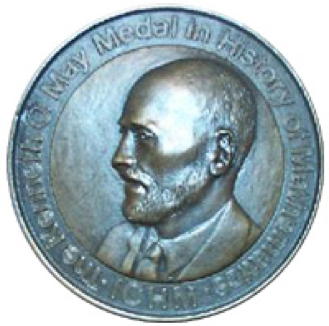
We list below the winners of the Kenneth O May Prize.
Click on a link below to go to the citations for that year
- 1989 Dirk J Struik and Adolf P Yushkevich
- 1993 Christoph J Scriba and Hans Wussing
- 1997 René Taton
- 2001 Ubiratan D'Ambrosio and Lam Lay Yong
- 2005 Henk Bos
- 2009 Ivor Grattan-Guinness and Rhada Charan Gupta
- 2013 Menso Folkerts and Jens Høyrup
- 2017 Eberhard Knobloch and Roshdi Rashed
- 2021 Sonja Brentjes and Christine Proust
- 2025 Jan Hogendijk and David Rowe
1989
The Kenneth O May prize for 1989 was presented to Dirk J Struik (United States) and Adolf P Yushkevich (Soviet Union) at the 18th International Congress of History of Science in Hamburg and Munich, Germany in 1989. The presentation was by Joseph Dauben.
Report in the Bulletin of the International Mathematical Union 31 (1990).
The XVIII th International Congress of History of Science, which was held in Hamburg/Munich, August 1-9, 1989, was the first opportunity that the International Commission on History of Mathematics has had to meet at an International Congress since becoming a joint Commission of the International Mathematical Union and International Union of History and Philosophy of Science two years ago. The next opportunity will come in Kyoto and Tokyo this summer, 1990. During the Hamburg/Munich Congress, the Commission's first Kenneth O May Prize was awarded for outstanding contributions to the History of Mathematics. The first May Prize, jointly sponsored by the Commission and the Institute for History and Philosophy of Science at the University of Toronto, was awarded to A P Youschkevitch and to Dirk J Struik, both of whom were present in Hamburg to receive their awards.
Dirk Jan Struik
30 September 1894
Rotterdam, Netherlands
21 October 2000
Belmont, Massachusetts, USA
See the MacTutor biography of Dirk Jan Struik.
Adolph Pavlovich Yushkevich
15 July 1906
Odessa, Ukraine
17 July 1993
Moscow, Russia
See the MacTutor biography of Adolph Pavlovich Yushkevich.
1993
Report in the Bulletin of the International Mathematical Union 31 (1990).
The XVIII th International Congress of History of Science, which was held in Hamburg/Munich, August 1-9, 1989, was the first opportunity that the International Commission on History of Mathematics has had to meet at an International Congress since becoming a joint Commission of the International Mathematical Union and International Union of History and Philosophy of Science two years ago. The next opportunity will come in Kyoto and Tokyo this summer, 1990. During the Hamburg/Munich Congress, the Commission's first Kenneth O May Prize was awarded for outstanding contributions to the History of Mathematics. The first May Prize, jointly sponsored by the Commission and the Institute for History and Philosophy of Science at the University of Toronto, was awarded to A P Youschkevitch and to Dirk J Struik, both of whom were present in Hamburg to receive their awards.
Dirk Jan Struik
30 September 1894
Rotterdam, Netherlands
21 October 2000
Belmont, Massachusetts, USA
See the MacTutor biography of Dirk Jan Struik.
Adolph Pavlovich Yushkevich
15 July 1906
Odessa, Ukraine
17 July 1993
Moscow, Russia
See the MacTutor biography of Adolph Pavlovich Yushkevich.
The Kenneth O May prize and medal for 1993 were presented to Christoph J Scriba (Germany) and Hans Wussing (Germany) at the 19th International Congress of History of Science in Zaragoza, Spain on Thursday 26 August 1993. Both Professors Scriba and Wussing are well-known to historians of mathematics for their many publications and scholarly contributions to the international community of historians of mathematics, and the Commission was pleased to congratulate them both warmly on the announcement of 1993 award. The Medal was presented by Joseph Dauben.
Christoph Joachim Scriba
6 October 1929
Darmstadt, Germany
26 July 2013
Hamburg, Germany
See the MacTutor biography of Christoph Joachim Scriba.
Hans Wussing
15 October 1927
Waldheim, Germany
26 April 2011
Leipzig, Germany
See the MacTutor biography of Hans Wussing.
1997
Christoph Joachim Scriba
6 October 1929
Darmstadt, Germany
26 July 2013
Hamburg, Germany
See the MacTutor biography of Christoph Joachim Scriba.
Hans Wussing
15 October 1927
Waldheim, Germany
26 April 2011
Leipzig, Germany
See the MacTutor biography of Hans Wussing.
The Kenneth O May prize and medal for 1997 were presented to René Taton (France) at the 20th International Congress of History of Science in Liege, Belgium in 1997.
René Taton
4 April 1915
L'Échelle, France
9 August 2004
Ajaccio, Corsica
See the MacTutor biography of René Taton.
2001
René Taton
4 April 1915
L'Échelle, France
9 August 2004
Ajaccio, Corsica
See the MacTutor biography of René Taton.
The Kenneth O May prize and medal for 2001 were presented to Ubiratan D'Ambrosio (Brazil) and Lam Lay Yong (Singapore). Ubiratn D'Ambrosio received the prize and medal at the 21st International Congress of History of Science and Technology in Mexico City, Mexico in 2001. Lam Lay Yong received the prize and medal at the International Congress of Mathematics in Beijing, China in 2002. The presentation to Lam Lay Yong was by Joseph Dauben.
The two scholars were awarded the Kenneth O May Prize because they have contributed significantly to enlarge history of mathematics by opening new research fields which actually also soon found their ways into textbooks. Thus today no serious historian of mathematics would write a general book on the history of mathematics without including ethnomathematics and Chinese mathematics. This is partly due to the inspiring contributions by professor D'Ambrosio and professor Lam.
Ubiratan D'Ambrosio
8 December 1932
São Paulo, Brazil
12 May 2021
São Paulo, Brazil
After the award of his doctorate from the University of São Paulo in 1963, Ubiratan D'Ambrosio spent the years 1964 to 1972 in the United States, first at Brown University, then at SUNY Buffalo. In 1972 he returned to Brazil becoming head of mathematics at the State University of Campinas in São Paulo. He is known for being the originator of the term "ethnomathematics". He was a founding member of the International Study Group on Ethnomathematics in 1985, serving as its president from 1996 to 2000.
Citation for the 2001 Kenneth O May Prize and Medal.
Study of D'Ambrosio's curriculum vitae leaves one almost breathless, how can one scholar have done so much, having at the time of the Mexico Congress not yet reached seventy? Here follows an extremely abbreviated version. D'Ambrosio earned his doctorate from the University of São Paulo, Brazil in 1963. He retired as a professor of mathematics from the State University of Campinas, São Paulo, Brazil in 1993 having behind him an impressive career as teacher, administrator, council member of many societies, including Pugwash, and writer, and he also found time to serve the International Commission on the History of Mathematics for five years. He is still very active and member of numerous learned societies, even founding member of several, including the International Group of Ethnomathematics and the Brazilian Society for History of Mathematics.
The International Commission on the History of Mathematics has awarded the May Medal to D'Ambrosio for his never ending efforts through writing and lectures to promote Ethnomathematics and thereby contributing intensely to make the field established. Recognition has come from many sides, for instance the first May Medalist, Dirk Struik, was very impressed by the work by D'Ambrosio; a better recommendation is hard to find. On my request professor D'Ambrosio has selected the following publications from his long list of writings on ethnomathematics:
Ethnomathematics and Its Place in History and Pedagogy of Mathematics, in For the Learning of Mathematics 5 (FLM Publishing Association, Canada, 1985).
Ethnomathematics. Challenging Eurocentrism, in Arthur B Powell and Marilyn Frankenstein (eds.), Mathematics Education (State University of New York Press, Albany, 1997), 13-24.
Historiographical Proposal for Non-Western Mathematics, in Helaine Selin (ed.), Mathematics Across Cultures. The History of Non-Western Mathematics (Kluwer Academic Publishers, Dordrecht, 2000), 79-92.
A matemàtica na época das grandes navegações e início da colonização, Revista Brasileira de História da Matemática 1 (1) (2001), 3-20.
Etnomatematica (Pitagora Editrice, Bologna, 2002).
M Rosa and D C Orey, D'Ambrosio's Role in the Development of Ethnomathematics.
This extract is from Journal of Humanistic Mathematics 11 (2) (2021), 441-443.
D'Ambrosio's remarkable journey was permeated by a diversity of experiences that led him to create the Program Ethnomathematics movement in the mid-1970s. In 1976, D'Ambrosio organised and chaired the section entitled Why Teach Mathematics? within the Topic Group: Objectives and Goals of Mathematics Education during the Third International Congress of Mathematics Education (ICME-3) in Karlsruhe, Germany. In this section, he brought up the discussion about the cultural roots of mathematics in the context of mathematics education.
It was first in 1977 that the term ethnomathematics was first used, in a lecture Ubi gave at the Annual Meeting of the American Association for the Advancement of Science, in Denver, USA. In 1984, the term ethnomathematics was consolidated in an opening lecture entitled "Sociocultural Bases of Mathematics Education" given by D'Ambrosio at ICME-5, in Adelaide, Australia. This is important, as this is when he officially instituted the Program Ethnomathematics as a field of research.
In 1985, D'Ambrosio's article entitled "Ethnomathematics and its Place in the History and Pedagogy of Mathematics" was published in the journal For the Learning of Mathematics. According to A B Powell and M Frankenstein this article represents the first comprehensive and theoretical treatise, in English, on Ethnomathematics as a program. It is where Ubi's ideas about ethnomathematics truly began to stimulate the development of this research field.
In 2004, Carpenter, Dossey, and Koehler selected D'Ambrosio's "Ethnomathematics and its place in the history and pedagogy of mathematics" to compose part of the National Council of Teachers of Mathematics (NCTM) book entitled Classics in Mathematics Education Research. This article was selected for its positive influence on international investigations in mathematics education. This book was collated as a response to a request from the Educational Materials Committee (EMC) of NCTM to develop a compilation of articles reflecting the history of research and the important international influences that directly impacted mathematics education. It remains a solid reference to this day.
With the international expansion of the ethnomathematics movement, in 1985, the International Study Group on Ethnomathematics (ISGEm) was officially created, which fully launched the Program Ethnomathematics internationally. The Program Ethnomathematics is not limited to understanding the mathematical knowledge (knowing and doing) of peripheral cultures. It seeks to understand the cycle of generation of both the intellectual and social organisation and dissemination of this knowledge. Naturally, when cultures encounter one another, there is an important dynamic adaptation and reformulation accompanying this entire cycle, including the cultural dynamic between encounters of individuals and groups. It is clear that through his work encompassing the social, political, and cultural arenas, D'Ambrosio established a deep relationship between mathematics, anthropology, and society.
D'Ambrosio offered mentorship, encouragement, leadership, and dissemination of innovative ideas, concepts, and perspectives involving ethnomathematics around the world and its applications in mathematics education. He was without a doubt the primary leader of the field. His broader view of ethnomathematics accounts for the dialogical transformation of knowledge within and among communities and societies. His epistemology is consistent with Freire's approach; his views of mathematical knowledge are cooperative, dynamic, interactive, and collaborative because he sees mathematics as the result of human activity; and as such, mathematics is not and cannot be static nor ordained.
In 1983, D'Ambrosio was honoured with the title of Fellow of the American Association for the Advancement of Science (AAAS) for his imaginative and effective leadership in the evolution of Mathematics Education in Latin America and also for his efforts aimed at the development of international cooperation.
Gerdes, as well as Powell and Frankenstein, stated that D'Ambrosio was considered the intellectual Father of the Program Ethnomathematics. In the study conducted by Shirley, D'Ambrosio was elected as one of the most important mathematicians of the 20th century, mainly, in relation to social, political, cultural, and anthropological issues through the development of the Program Ethnomathematics.
In 2001, D'Ambrosio was awarded, by the International Committee of History of Mathematics (ICHM), the Kenneth O May Award for his important contributions to the History of Mathematics. The award announcement stated that the ICHM awarded this medal to him for his never-ending efforts through writing and lectures that promote ethnomathematics and thereby contributing intensely to the establishment of this research field.
Lam Lay Yong
12 February 1936
Singapore
After graduating from the University of Malaya (now the University of Singapore) in 1957, she studied at the University of Cambridge before being awarded a Ph.D. in 1966 from the University of Singapore. She taught at the University of Singapore being promoted to professor in 1988. She is renowned for her research into the history of Chinese mathematics
Citation for the 2001 Kenneth O May Prize and Medal.
Professor Lam Lay Yong's curriculum vitae is also long and notable, and again I extract a very brief version. Lam Lay Yong graduated from National University of Singapore in 1966. She had taught mathematics there since 1960 and was a full professor from 1988. She retired in 1996 after having worked at the Department of Mathematics for 35 years. During this period, she also served the International Commission on the History of Mathematics as associate editor of Historia Mathematica from 1974 to 1990. She is member of the Académie internationale d'histoire des sciences.
The International Commission on the History of Mathematics has awarded Lam Lay Yong the Kenneth O May Medal for her profound scholarship on Chinese mathematics, and for making the richness of Chinese mathematics accessible to Western readers, as for instance in her first book from 1977: A Critical Study of the Yang Hui Suan Fa, a Thirteenth-Century Mathematical Treatise. The number of papers she has published in international peer-reviewed journals is just extraordinary, they are internationally highly respected and some of her ideas have given rise to vivid academic discussions. On my request professor Lam has selected the three following publications among her valuable contributions to Chinese mathematics.
Jiu Zhang Suanshu (Nine Chapters on the Mathematical Art): An Overview, Archive for History of Exact Sciences 47 (1994), 1-51.
Zhang Qiujian Suanjing (The Mathematical Classic of Zhang Qiujian): An Overview, Archive for History of Exact Sciences 50 (1997), 201-240.
(with Ang Tian Se) Fleeting Footsteps. Tracing the Conception of Arithmetic and Algebra in Ancient China (Revised Edition) (World Scientific, Singapore, 2004).
Lam Lay Yong. Singapore Women's Hall of Fame.
Internationally renowned for her research into the history of Chinese mathematics, Lam Lay Yong is the first woman, and the first person from Asia, to have won the prestigious Kenneth O May prize for her contribution to mathematics. After 30 years of research, she laid to rest the long held belief that the Arabs and Indians invented the numeral system used today. She offered evidence that it was the Chinese who discovered it, using simple bamboo rods.
The granddaughter of Tan Kah Kee and niece of Lee Kong Chian, both prominent Chinese businessmen and philanthropists, Lay Yong graduated from the National University of Singapore (NUS) with First Class Honours in Mathematics in 1957.
She was then awarded a Queen's scholarship to study at Cambridge University, after which she returned to Singapore where she began lecturing at her alma mater in 1960. In 1966 Lay Yong completed her PhD at NUS, and she became a full professor in 1988.
Over the years, Lay Yong has written extensively about the history of Chinese mathematics. In so doing, she has brought the many accomplishments of Chinese mathematicians to the attention of global audiences, especially those who do not read or speak Chinese.
For this work, in 2001, Lay Yong was awarded the Kenneth O May medal, the highest honour given by the International Commission on the History of Mathematics (ICHM), and bestowed only once every four years.
One of her most remarkable discoveries concerns the development of the numeral system used today. Lay Yong says it was actually invented by the Chinese (not the Indians and the Arabs as commonly believed), who were adding, subtracting, multiplying and dividing at least 1,000 years before anyone else, using bamboo rods. In fact, Lay Yong says the Arabs and the Indians only came up with the written symbols for the numeral system.
Between 1974 and 1990 Lay Yong also served the ICHM as associate editor of Historia Mathematica. She is a member of the Académie Internationale d'Histoire des Sciences, and past President of the Singapore Mathematical Society.
Lay Yong retired from NUS in 1996, after having worked at the Department of Mathematics for 35 years. In 2005 Lay Yong also won the Outstanding Science Alumni Award from NUS. One of her most notable books, Fleeting Footsteps: Tracing the Conception of Arithmetic and Algebra in Ancient China, was published in 2004.
2005
The two scholars were awarded the Kenneth O May Prize because they have contributed significantly to enlarge history of mathematics by opening new research fields which actually also soon found their ways into textbooks. Thus today no serious historian of mathematics would write a general book on the history of mathematics without including ethnomathematics and Chinese mathematics. This is partly due to the inspiring contributions by professor D'Ambrosio and professor Lam.
Ubiratan D'Ambrosio
8 December 1932
São Paulo, Brazil
12 May 2021
São Paulo, Brazil
After the award of his doctorate from the University of São Paulo in 1963, Ubiratan D'Ambrosio spent the years 1964 to 1972 in the United States, first at Brown University, then at SUNY Buffalo. In 1972 he returned to Brazil becoming head of mathematics at the State University of Campinas in São Paulo. He is known for being the originator of the term "ethnomathematics". He was a founding member of the International Study Group on Ethnomathematics in 1985, serving as its president from 1996 to 2000.
Citation for the 2001 Kenneth O May Prize and Medal.
Study of D'Ambrosio's curriculum vitae leaves one almost breathless, how can one scholar have done so much, having at the time of the Mexico Congress not yet reached seventy? Here follows an extremely abbreviated version. D'Ambrosio earned his doctorate from the University of São Paulo, Brazil in 1963. He retired as a professor of mathematics from the State University of Campinas, São Paulo, Brazil in 1993 having behind him an impressive career as teacher, administrator, council member of many societies, including Pugwash, and writer, and he also found time to serve the International Commission on the History of Mathematics for five years. He is still very active and member of numerous learned societies, even founding member of several, including the International Group of Ethnomathematics and the Brazilian Society for History of Mathematics.
The International Commission on the History of Mathematics has awarded the May Medal to D'Ambrosio for his never ending efforts through writing and lectures to promote Ethnomathematics and thereby contributing intensely to make the field established. Recognition has come from many sides, for instance the first May Medalist, Dirk Struik, was very impressed by the work by D'Ambrosio; a better recommendation is hard to find. On my request professor D'Ambrosio has selected the following publications from his long list of writings on ethnomathematics:
Ethnomathematics and Its Place in History and Pedagogy of Mathematics, in For the Learning of Mathematics 5 (FLM Publishing Association, Canada, 1985).
Ethnomathematics. Challenging Eurocentrism, in Arthur B Powell and Marilyn Frankenstein (eds.), Mathematics Education (State University of New York Press, Albany, 1997), 13-24.
Historiographical Proposal for Non-Western Mathematics, in Helaine Selin (ed.), Mathematics Across Cultures. The History of Non-Western Mathematics (Kluwer Academic Publishers, Dordrecht, 2000), 79-92.
A matemàtica na época das grandes navegações e início da colonização, Revista Brasileira de História da Matemática 1 (1) (2001), 3-20.
Etnomatematica (Pitagora Editrice, Bologna, 2002).
M Rosa and D C Orey, D'Ambrosio's Role in the Development of Ethnomathematics.
This extract is from Journal of Humanistic Mathematics 11 (2) (2021), 441-443.
D'Ambrosio's remarkable journey was permeated by a diversity of experiences that led him to create the Program Ethnomathematics movement in the mid-1970s. In 1976, D'Ambrosio organised and chaired the section entitled Why Teach Mathematics? within the Topic Group: Objectives and Goals of Mathematics Education during the Third International Congress of Mathematics Education (ICME-3) in Karlsruhe, Germany. In this section, he brought up the discussion about the cultural roots of mathematics in the context of mathematics education.
It was first in 1977 that the term ethnomathematics was first used, in a lecture Ubi gave at the Annual Meeting of the American Association for the Advancement of Science, in Denver, USA. In 1984, the term ethnomathematics was consolidated in an opening lecture entitled "Sociocultural Bases of Mathematics Education" given by D'Ambrosio at ICME-5, in Adelaide, Australia. This is important, as this is when he officially instituted the Program Ethnomathematics as a field of research.
In 1985, D'Ambrosio's article entitled "Ethnomathematics and its Place in the History and Pedagogy of Mathematics" was published in the journal For the Learning of Mathematics. According to A B Powell and M Frankenstein this article represents the first comprehensive and theoretical treatise, in English, on Ethnomathematics as a program. It is where Ubi's ideas about ethnomathematics truly began to stimulate the development of this research field.
In 2004, Carpenter, Dossey, and Koehler selected D'Ambrosio's "Ethnomathematics and its place in the history and pedagogy of mathematics" to compose part of the National Council of Teachers of Mathematics (NCTM) book entitled Classics in Mathematics Education Research. This article was selected for its positive influence on international investigations in mathematics education. This book was collated as a response to a request from the Educational Materials Committee (EMC) of NCTM to develop a compilation of articles reflecting the history of research and the important international influences that directly impacted mathematics education. It remains a solid reference to this day.
With the international expansion of the ethnomathematics movement, in 1985, the International Study Group on Ethnomathematics (ISGEm) was officially created, which fully launched the Program Ethnomathematics internationally. The Program Ethnomathematics is not limited to understanding the mathematical knowledge (knowing and doing) of peripheral cultures. It seeks to understand the cycle of generation of both the intellectual and social organisation and dissemination of this knowledge. Naturally, when cultures encounter one another, there is an important dynamic adaptation and reformulation accompanying this entire cycle, including the cultural dynamic between encounters of individuals and groups. It is clear that through his work encompassing the social, political, and cultural arenas, D'Ambrosio established a deep relationship between mathematics, anthropology, and society.
D'Ambrosio offered mentorship, encouragement, leadership, and dissemination of innovative ideas, concepts, and perspectives involving ethnomathematics around the world and its applications in mathematics education. He was without a doubt the primary leader of the field. His broader view of ethnomathematics accounts for the dialogical transformation of knowledge within and among communities and societies. His epistemology is consistent with Freire's approach; his views of mathematical knowledge are cooperative, dynamic, interactive, and collaborative because he sees mathematics as the result of human activity; and as such, mathematics is not and cannot be static nor ordained.
In 1983, D'Ambrosio was honoured with the title of Fellow of the American Association for the Advancement of Science (AAAS) for his imaginative and effective leadership in the evolution of Mathematics Education in Latin America and also for his efforts aimed at the development of international cooperation.
Gerdes, as well as Powell and Frankenstein, stated that D'Ambrosio was considered the intellectual Father of the Program Ethnomathematics. In the study conducted by Shirley, D'Ambrosio was elected as one of the most important mathematicians of the 20th century, mainly, in relation to social, political, cultural, and anthropological issues through the development of the Program Ethnomathematics.
In 2001, D'Ambrosio was awarded, by the International Committee of History of Mathematics (ICHM), the Kenneth O May Award for his important contributions to the History of Mathematics. The award announcement stated that the ICHM awarded this medal to him for his never-ending efforts through writing and lectures that promote ethnomathematics and thereby contributing intensely to the establishment of this research field.
Lam Lay Yong
12 February 1936
Singapore
After graduating from the University of Malaya (now the University of Singapore) in 1957, she studied at the University of Cambridge before being awarded a Ph.D. in 1966 from the University of Singapore. She taught at the University of Singapore being promoted to professor in 1988. She is renowned for her research into the history of Chinese mathematics
Citation for the 2001 Kenneth O May Prize and Medal.
Professor Lam Lay Yong's curriculum vitae is also long and notable, and again I extract a very brief version. Lam Lay Yong graduated from National University of Singapore in 1966. She had taught mathematics there since 1960 and was a full professor from 1988. She retired in 1996 after having worked at the Department of Mathematics for 35 years. During this period, she also served the International Commission on the History of Mathematics as associate editor of Historia Mathematica from 1974 to 1990. She is member of the Académie internationale d'histoire des sciences.
The International Commission on the History of Mathematics has awarded Lam Lay Yong the Kenneth O May Medal for her profound scholarship on Chinese mathematics, and for making the richness of Chinese mathematics accessible to Western readers, as for instance in her first book from 1977: A Critical Study of the Yang Hui Suan Fa, a Thirteenth-Century Mathematical Treatise. The number of papers she has published in international peer-reviewed journals is just extraordinary, they are internationally highly respected and some of her ideas have given rise to vivid academic discussions. On my request professor Lam has selected the three following publications among her valuable contributions to Chinese mathematics.
Jiu Zhang Suanshu (Nine Chapters on the Mathematical Art): An Overview, Archive for History of Exact Sciences 47 (1994), 1-51.
Zhang Qiujian Suanjing (The Mathematical Classic of Zhang Qiujian): An Overview, Archive for History of Exact Sciences 50 (1997), 201-240.
(with Ang Tian Se) Fleeting Footsteps. Tracing the Conception of Arithmetic and Algebra in Ancient China (Revised Edition) (World Scientific, Singapore, 2004).
Lam Lay Yong. Singapore Women's Hall of Fame.
Internationally renowned for her research into the history of Chinese mathematics, Lam Lay Yong is the first woman, and the first person from Asia, to have won the prestigious Kenneth O May prize for her contribution to mathematics. After 30 years of research, she laid to rest the long held belief that the Arabs and Indians invented the numeral system used today. She offered evidence that it was the Chinese who discovered it, using simple bamboo rods.
The granddaughter of Tan Kah Kee and niece of Lee Kong Chian, both prominent Chinese businessmen and philanthropists, Lay Yong graduated from the National University of Singapore (NUS) with First Class Honours in Mathematics in 1957.
She was then awarded a Queen's scholarship to study at Cambridge University, after which she returned to Singapore where she began lecturing at her alma mater in 1960. In 1966 Lay Yong completed her PhD at NUS, and she became a full professor in 1988.
Over the years, Lay Yong has written extensively about the history of Chinese mathematics. In so doing, she has brought the many accomplishments of Chinese mathematicians to the attention of global audiences, especially those who do not read or speak Chinese.
For this work, in 2001, Lay Yong was awarded the Kenneth O May medal, the highest honour given by the International Commission on the History of Mathematics (ICHM), and bestowed only once every four years.
One of her most remarkable discoveries concerns the development of the numeral system used today. Lay Yong says it was actually invented by the Chinese (not the Indians and the Arabs as commonly believed), who were adding, subtracting, multiplying and dividing at least 1,000 years before anyone else, using bamboo rods. In fact, Lay Yong says the Arabs and the Indians only came up with the written symbols for the numeral system.
Between 1974 and 1990 Lay Yong also served the ICHM as associate editor of Historia Mathematica. She is a member of the Académie Internationale d'Histoire des Sciences, and past President of the Singapore Mathematical Society.
Lay Yong retired from NUS in 1996, after having worked at the Department of Mathematics for 35 years. In 2005 Lay Yong also won the Outstanding Science Alumni Award from NUS. One of her most notable books, Fleeting Footsteps: Tracing the Conception of Arithmetic and Algebra in Ancient China, was published in 2004.
The Kenneth O May prize and medal for 2005 were presented to Henk Bos (Netherlands) at the Valedictory Symposium on the occasion of the retirement of Henk Bos, Utrecht, Netherlands, 30 June 2005. The presentation was made by Jeremy Gray.
Hendrik Jan Maarten Bos
17 July 1940
Enschede, The Netherlands
12 February 2024
Amsterdam, The Netherlands
Henk Bos was a student of Hans Freudenthal and Jerome Ravetz at Utrecht University and received his doctorate in 1973. He worked at Utrecht University for most of his career being promoted to professor of history of mathematics in 1985. He retired in 2005 and received an honorary appointment as professor of the history of mathematics at the University of Aarhus. He had an innovative approach to the history of mathematics and his historical methodology is important.
Citation for the 2005 Kenneth O May Prize and Medal.
On behalf of the International Commission for the History of Mathematics, it is my great pleasure to present the 2005 Kenneth O May Prize and Medal to Henk Bos (The Netherlands).
Henk Bos earned his Ph.D. from Utrecht University in 1973 for a dissertation entitled "Differentials, Higher Order Differentials and the Derivative in the Leibnizian Calculus." This major study, which appeared in the Archive for History of Exact Sciences under that same title in 1974, was the first to draw attention to, and explain, what Leibniz's differentials actually are and how they were used; in so doing, it illuminated several otherwise puzzling features of the Leibnizian calculus.
By 1981, Bos's research interests had shifted to the roles of geometry and algebra in the work of Descartes. In that year, he published another major work "On the Representation of Curves in Descartes' Géométrie" and then three years later yet another fundamental study on "Arguments on Motivation in the Rise and Decline of a Mathematical Theory: The 'Construction of Equations,' 1637-ca. 1750," both again in the Archive for History of Exact Sciences. It is not, however, the careful reading of all of Descartes's relevant writings that makes these works stand out (although selective readings are the norm). Nor is it the attention to the decline of a mathematical theory that is particularly noteworthy in Bos's research, although that too is unusual in a field often given over to the celebration of accomplishment. Rather, it is the steady force of his critical intellect that makes his research exceptional. He took a subject - the invention of Cartesian geometry, which most historians of mathematics thought they knew - and showed that they did not know it. He accomplished this in the best historical tradition, namely, by reading the historical texts carefully on their own terms. He examined Descartes's conceptions both of a curve and of how properly to answer geometrical questions. He then showed how these conceptions governed the formation of Descartes's remarkable work and how they shaped considerations of such questions for a century. Finally, he documented how these ideas waned as the original rationale behind them ceased to convince.
This body of work earned Henk Bos a professorship of the history of mathematics in 1985 at Utrecht University where he has, indeed, spent his entire career. The very next year, in 1986, his work was again recognised when he was honoured as an invited speaker at the International Congress of Mathematicians held in Berkeley, California. Many of the historical issues that he had addressed up to this point were collected in a book of essays, entitled Lectures in the History of Mathematics, which was published in 1993 and reprinted in 1997 in the HMATH series of the American Mathematical Society and the London Mathematical Society. A volume well regarded by mathematicians, who find in him a trustworthy writer of mathematics, it has effectively extended Bos's audience beyond the community of historians of mathematics to the international mathematical community as a whole. These essays document a further feature of his work: the enormous pleasure he takes in what he writes about, and which he invariably conveys.
In 2001, Bos's long-awaited book, Redefining Geometrical Exactness: Descartes' Transformation of the Early Modern Concept of Construction, was published by Springer-Verlag. A work of exceptional distinction, it greatly extends and refines his earlier analysis of Descartes, in addition to considering seriously the responses that other scholars have made to his historical research. It looks at Descartes's contemporaries and immediate predecessors: Clavius, Viète, Kepler, and Fermat; it is deeply versed in the sources, as good history should be; yet, its most profound characteristic is its thoughtfulness. Bos gives to this seventeenth-century material the kind of careful attention it was given by the experts when it was new. It is an exploration of what counted as good mathematics in a particular period and is crafted, as its title suggests, around the concept of exactness. When is a mathematical description exact? What sorts of constructions are to be allowed? This is, dare one say, "exactly" the right question to ask. The result is a book that not only recaptures a major aspect of the mathematics of its time but also strongly suggests how much more good work can be done elsewhere in the history of mathematics provided the historian has the ability to ask such a good question and to pursue its answers so sensitively.
Henk Bos has, through his deep and insightful research, fundamentally shaped present-day understanding of the mathematics of the seventeenth century. It is for this accomplishment that the International Commission for the History of Mathematics is proud to present to him the 2005 Kenneth O May Prize and Medal.
2009
Hendrik Jan Maarten Bos
17 July 1940
Enschede, The Netherlands
12 February 2024
Amsterdam, The Netherlands
Henk Bos was a student of Hans Freudenthal and Jerome Ravetz at Utrecht University and received his doctorate in 1973. He worked at Utrecht University for most of his career being promoted to professor of history of mathematics in 1985. He retired in 2005 and received an honorary appointment as professor of the history of mathematics at the University of Aarhus. He had an innovative approach to the history of mathematics and his historical methodology is important.
Citation for the 2005 Kenneth O May Prize and Medal.
On behalf of the International Commission for the History of Mathematics, it is my great pleasure to present the 2005 Kenneth O May Prize and Medal to Henk Bos (The Netherlands).
Henk Bos earned his Ph.D. from Utrecht University in 1973 for a dissertation entitled "Differentials, Higher Order Differentials and the Derivative in the Leibnizian Calculus." This major study, which appeared in the Archive for History of Exact Sciences under that same title in 1974, was the first to draw attention to, and explain, what Leibniz's differentials actually are and how they were used; in so doing, it illuminated several otherwise puzzling features of the Leibnizian calculus.
By 1981, Bos's research interests had shifted to the roles of geometry and algebra in the work of Descartes. In that year, he published another major work "On the Representation of Curves in Descartes' Géométrie" and then three years later yet another fundamental study on "Arguments on Motivation in the Rise and Decline of a Mathematical Theory: The 'Construction of Equations,' 1637-ca. 1750," both again in the Archive for History of Exact Sciences. It is not, however, the careful reading of all of Descartes's relevant writings that makes these works stand out (although selective readings are the norm). Nor is it the attention to the decline of a mathematical theory that is particularly noteworthy in Bos's research, although that too is unusual in a field often given over to the celebration of accomplishment. Rather, it is the steady force of his critical intellect that makes his research exceptional. He took a subject - the invention of Cartesian geometry, which most historians of mathematics thought they knew - and showed that they did not know it. He accomplished this in the best historical tradition, namely, by reading the historical texts carefully on their own terms. He examined Descartes's conceptions both of a curve and of how properly to answer geometrical questions. He then showed how these conceptions governed the formation of Descartes's remarkable work and how they shaped considerations of such questions for a century. Finally, he documented how these ideas waned as the original rationale behind them ceased to convince.
This body of work earned Henk Bos a professorship of the history of mathematics in 1985 at Utrecht University where he has, indeed, spent his entire career. The very next year, in 1986, his work was again recognised when he was honoured as an invited speaker at the International Congress of Mathematicians held in Berkeley, California. Many of the historical issues that he had addressed up to this point were collected in a book of essays, entitled Lectures in the History of Mathematics, which was published in 1993 and reprinted in 1997 in the HMATH series of the American Mathematical Society and the London Mathematical Society. A volume well regarded by mathematicians, who find in him a trustworthy writer of mathematics, it has effectively extended Bos's audience beyond the community of historians of mathematics to the international mathematical community as a whole. These essays document a further feature of his work: the enormous pleasure he takes in what he writes about, and which he invariably conveys.
In 2001, Bos's long-awaited book, Redefining Geometrical Exactness: Descartes' Transformation of the Early Modern Concept of Construction, was published by Springer-Verlag. A work of exceptional distinction, it greatly extends and refines his earlier analysis of Descartes, in addition to considering seriously the responses that other scholars have made to his historical research. It looks at Descartes's contemporaries and immediate predecessors: Clavius, Viète, Kepler, and Fermat; it is deeply versed in the sources, as good history should be; yet, its most profound characteristic is its thoughtfulness. Bos gives to this seventeenth-century material the kind of careful attention it was given by the experts when it was new. It is an exploration of what counted as good mathematics in a particular period and is crafted, as its title suggests, around the concept of exactness. When is a mathematical description exact? What sorts of constructions are to be allowed? This is, dare one say, "exactly" the right question to ask. The result is a book that not only recaptures a major aspect of the mathematics of its time but also strongly suggests how much more good work can be done elsewhere in the history of mathematics provided the historian has the ability to ask such a good question and to pursue its answers so sensitively.
Henk Bos has, through his deep and insightful research, fundamentally shaped present-day understanding of the mathematics of the seventeenth century. It is for this accomplishment that the International Commission for the History of Mathematics is proud to present to him the 2005 Kenneth O May Prize and Medal.
The Kenneth O May prize and medal for 2009 were presented to Ivor Grattan-Guinness (UK) and Rhada Charan Gupta (India). Ivor Grattan-Guinness received the prize and medal at the 23rd International Congress of History of Science and Technology in Budapest, Hungary, 2009. The prize was presented by Craig Fraser. Rhada Charan Gupta received the Kenneth O May Prize and Medal at the closing Ceremony of the International Congress of Mathematics on 27 August 2011 in Hyderbad, India. The presentation was made by Kim Plofker. The Citations were read by Craig Fraser.
Ivor Grattan-Guinness
23 June 1941
Bakewell, Derbyshire, England
12 December 2014
Bengeo, Hertford, England
He graduated from the University of Oxford in 1962, then worked in London for Marconi. While working part-time as a teacher at Enfield College of Technology he studied for a Master's Degree at the London School of Economics. He studied at the University of London for a Ph.D. which he was awarded in 1969. He remained on the staff at Enfield College of Technology which became Middlesex Polytechnic then Middlesex University. He did important work on the development of the calculus, its applications to mechanics, and the role of set theory and mathematical logic.
Citation for the 2009 Kenneth O May Prize and Medal.
Ivor Grattan-Guinness took a B.A. in mathematics at Oxford University in 1962, an M.Sc. in the philosophy of science at the London School of Economics in 1966, and an M.A. at Oxford University in 1967 before earning first a Ph.D. and then a prestigious D.Sc. in the history of science at the University of London in 1969 and 1978, respectively. Beginning in 1964, he served on the faculty of Middlesex University, becoming Emeritus Professor of the History of Mathematics and Logic there in 2002 at the age of sixty.
Grattan-Guinness's first book, The Development of the Foundations of Mathematical Analysis from Euler to Riemann (1970), was based on his Ph.D. thesis and is reflective of his deep interest in and contribution to the history of the foundations of mathematics as well as of mathematical analysis. In this study, Grattan-Guinness exhibited what have become hallmarks of his research: penetrating readings of key primary sources in a wide range of languages and broad syntheses of mathematical ideas. This work, with its extensive examination of the mathematics of Cauchy and his immediate predecessors, also served to focus Grattan-Guinness's attentions on the early nineteenth-century French scene, a vast topic that came to dominate his research for some two decades.
Early fruits of those labours appeared in 1972 with the publication, co-authored by Jerome Ravetz, of Joseph Fourier 1768-1830. A survey of Fourier's life and work as well as a critical edition of the 1807 monograph on heat propagation that Fourier presented to the Institut de France, this book highlighted not only the Parisian mathematical and broader scientific milieu of which Fourier was a part but also developments in what Grattan-Guinness would later style "applicable mathematics." He developed both of these themes, as well as that of mathematics education and its ever-evolving venues, in his magisterial, three-volume Convolutions in French Mathematics, 1800-1840: From the Calculus and Mechanics to Mathematical Analysis and Mathematical Physics published by Birkhäuser Verlag in 1990.
Grattan-Guinness's ability to synthesise and illuminate vast amounts of mathematical knowledge was also in evidence in The Norton History of the Mathematical Sciences: The Rainbow of Mathematics (1998), in which his subject was no less than all of the mathematical sciences. The latter distinction is important: the mathematical sciences and not just mathematics. In the words of Victor Katz, "Grattan-Guinness makes absolutely clear that the use of mathematics in other fields, including economics, statistics, engineering, hydraulics, ballistics, astronomy, mechanics, optics, and so on, was a very important factor in the development of the field and to write a history of mathematics without including its applications would be highly misleading."
Broad synthesis also characterised The Search for Mathematical Roots, 1870-1940 (2000), although in this case the topic was, as the book's subtitle reflected, "logics, set theories, and the foundation of mathematics from Cantor through Russell to Gödel." Another historical tour de force, and one that resulted from the fruits of his research during a Leverhulme Fellowship from 1995 through 1997, this study traced the complex development of a multitude of systems of mathematical logic in a wide range of national contexts - from Italy to Germany to England to the United States to Poland - as well as the broader philosophical contexts in which those theories evolved.
If profound research on the mathematical sciences in diverse national contexts has characterised his scholarly output to date, so, too, does the production of high quality reference works aimed at uniting the disparate communities of historians of science, historians of mathematics, and mathematicians. A gifted and seemingly indefatigable organiser and editor, Grattan-Guinness mobilised and oversaw the contributions of some 130 scholars to the two-volume Companion Encyclopedia of the History and Philosophy of the Mathematical Sciences (1994) as well as of the thousand-page collection of Landmark Writings in Western Mathematics 1640-1940 (2005) with extensive historical commentary. He also served the broader scholarly community as editor of the journal, Annals of Science from 1974 to 1981 and as the founding editor of History and Philosophy of Logic. These, and his many other, contributions to the field of the history of science have already been recognised by his election as membre effectif of the Académie international d'histoire des sciences. Today, we are pleased to recognise Ivor Grattan-Guinness with the highest honour in the history of mathematics, the Kenneth O May Prize and Medal, awarded for lifetime scholarly achievement and commitment to the field.
Rhada Charan Gupta
14 August 1935
Jhansi, India
5 September 2024
Jhansi, India
Rhada Charan Gupta studied at the University of Lucknow and was awarded a bachelor's degree in 1955 and a master's degree in 1957. He taught at Lucknow Christian College then at the Birla Institute of Technology before studying for a Ph.D. at Ranchi University which he was awarded in 1971. He continued to teach at the Birla Institute of Technology being promoted to professor in 1982. He specialised in the history of Indian mathematics. He was a founder of the Indian Society for History of Mathematics, and was the founding editor of its journal Gaṇita Bhāratī serving in this role from 1979 to 2004.
Citation for the 2009 Kenneth O May Prize and Medal.
Radha Charan Gupta was born in Jhansi, Uttar Pradesh, in 1935 and received his B.Sc. from Lucknow University in 1955. He was the first-place medallist in the M.Sc. mathematics examination at Lucknow in 1957, and earned a Ph.D. in the history of mathematics from Ranchi University in 1971. He did his dissertation work at Ranchi with the renowned historian of Indian mathematics T A Saraswati Amma, author of Geometry in Ancient and Medieval India, in honour of whom he later endowed the annual Memorial Lecture of the Kerala Mathematical Association. After serving as a Lecturer at Lucknow Christian College in 1957-58, he joined the faculty in mathematics of Birla Institute of Technology, Ranchi. He became a full professor at BIT in 1982, and emeritus professor (at the mandatory retirement age of sixty) in 1995. He currently conducts his extensive and varied research and service activities under the aegis of the Ganita Bharati Institute at his retirement residence in his native city of Jhansi.
Since the late 1960s, Prof Gupta's research work has focused on the history of mathematics in India, particularly the development of trigonometry, including interpolation rules and infinite series for trigonometric functions. Among his ground-breaking works in this field are his analysis of Paramesvara's third-order series approximation for the sine function in the fifteenth century (An Indian form of third order Taylor series approximation of the sine, Historia Mathematica 1 (1974), 287-289) and his examination of the eighth-century methods of Govindasvami for interpolating in sine tables (Fractional parts of Aryabhata's sines and certain rules found in Govindasvami's Bhasya on the Mahabhaskariya, Indian Journal of History of Science 6 (1971), 51-59). Prof Gupta's recent publications (the whole corpus of which now totals over 500 items) include Historiography of Mathematics in India (Ch. 18) in Dauben and Scriba (eds.), Writing the History of Mathematics: Its Historical Development (Basel, 2002), 307-315; Area of a bow-figure in India, in Burnett et al. (eds.), Studies in the History of Exact Sciences in Honour of David Pingree (Leiden, 2004), 517-532; A little-known 19th-century study of Ganita-sara-sangraha, Arhat Vacana 14 (2-3) (2002), 101-102.
Besides skilfully analysing many hitherto unknown ingenious mathematical formulas in elliptical Sanskrit verses, Prof Gupta has published several key papers on the remarkable mathematical discoveries of the Jaina tradition, many of which had been almost inaccessible to anyone except specialists in the Jaina canon in Prakrit. This bridge-building approach has characterised Prof Gupta's research in general: whether explaining Sanskrit algorithms for a modern mathematical audience, surveying the twentieth-century Indian doctoral research on history of mathematics, tracing the influence of Indian mathematical discoveries in foreign traditions, or expounding Jaina, Buddhist or Hindu cosmological theories in the context of early Indian work with transfinite quantities, he has combined scrupulous textual scholarship and expert mathematical exegesis with clear and comprehensible exposition, serving the needs of general audience and specialist researcher alike. No scholar in the twentieth century has done more to advance widespread understanding of the development of Indian mathematics - and that, in a century that spanned (most of) the working lifetimes of researchers such as S Dvivedi, B Datta and A N Singh, K S Shukla, A K Bag, Saraswati Amma, David Pingree and K V Sarma, is saying something.
Prof Gupta has added to his research and teaching record a long list of labours in professional service, expanding awareness of the history of mathematics in general and of Indian mathematics in particular. In 1991 he was elected a Fellow of the National Academy of Sciences, India, and in 1994 he became President of the Association of Mathematics Teachers of India, a position which he still holds. He became a Corresponding Member of the International Academy of History of Science in February 1995. In 1979 he began his decades-long service as founding editor of the journal Ganita Bharati (Indian Mathematics), in which he has published scores of articles and reviews under his own name and the pen name Ganitanandâ (joy of mathematics). His pedagogical publications and lectures in English and Hindi, as well as his sponsorship of numerous endowed lectures, have greatly increased the prominence of history of mathematics in Indian mathematics education and scholarship. Today, we are also pleased to recognise Radha Charan Gupta with the highest honour in the history of mathematics, the Kenneth O May Prize and Medal, awarded for lifetime scholarly achievement and commitment to the field.
K Plofker, Professor R C Gupta Receives the Kenneth O May Prize.
This work appears in K Ramasubramanian (ed.), Ganitananda. Selected Works of Rhada Charan Gupta on History of Mathematics (Springer, 2019), 13-15.
Professor Radha Charan Gupta, who founded and nurtured Ganita Bhāratī as editor for over a quarter century, was awarded the Kenneth O May prize of 2009, jointly with Prof Ivor Grattan-Guinness of UK by the International Commission for the History of Mathematics (ICHM). The prize, which includes a bronze medal designed by the Canadian sculptor Salius Jaskus, was instituted in 1989 and is given every four years; it was named after the mathematician and historian Kenneth O May who founded the ICHM and its journal Historia Mathematica and is awarded in recognition of scholarly work in the history of mathematics. Dirk Struik (USA), Adolf P Yushkevich (Soviet Union), Christoph J Scriba (Germany), Hans Wussing (Germany), René Taton (France), Ubiratan d'Ambrosio (Brazil), Lam Lay Yong (Singapore) and Henk Bos (The Netherlands) have been the earlier recipients of the award. As Prof Gupta could not be present at the 23rd International Congress of History of Science and Technology held in Budapest, Hungary, in 2009, at which the original awards ceremony was held, the award was presented to him at the International Congress of Mathematicians, at Hyderabad on August 2010, at its closing ceremony on 27 August 2010.
Professor Gupta has been a scholar and researcher par excellence in the area of history of mathematics; the corpus of his works exceeds 500 items. Among his groundbreaking works are his analysis of Paramesvara's third-order series approximation for the sine function, in the fifteenth century ("An Indian form of third-order Taylor series approximation of the sine", Historia Mathematica 1 (1974), 287-289) and his examination of the eighth-century methods of Govindasvami for interpolating in sine tables ("Fractional parts of Aryabhata's sines and certain rules found in Govindasvami's "Bhāṣya on the Mahābhāskarīya", Indian Journal of History of Science 6 (1971), 51-59). Prof Gupta's notable recent publications include "Historiography of Mathematics in India" (in Writing the History of Mathematics: Its Historical Development (Basel, 2002), 307-315 (Chap. 18) edited by J Dauben and C J Scriba), "Area of a bow-figure in India" (in Studies in the History of the Exact Sciences in Honor of David Pingree (Leiden, 2004), 517-532 edited by Burnett et al.) and "A little-known nineteenth century study of Ganita-sara-sangraha", Arhat Vacana 14 (2-3) (2002), 101-102.
Radha Charan Gupta was born on 26 October 1935 in Jhansi, Uttar Pradesh, in north India. He received his B.Sc. and M.Sc. degrees from Lucknow University in 1955 and 1957, respectively, earning a first-place medal in the M.Sc. mathematics examination. He received his Ph.D. in the history of mathematics from Ranchi University in 1971, for his dissertation work carried out with T A Sarasvati Amma, the renowned historian of Indian mathematics and author of the book Geometry in Ancient and Medieval India (Delhi, 1979), in honour of whom Prof Gupta later endowed the annual Memorial Lecture of the Kerala Mathematical Association. Prof Gupta's career as a teacher began in 1957 at Lucknow Christian College where he served as Lecturer during 1957-58, following his M.Sc. In 1958, he entered the faculty in mathematics of the Birla Institute of Technology (BIT), Ranchi, where he spent the rest of his regular career. In 1979, he was appointed as Head of the Research Centre for the History of Science at BIT. He was made full professor in 1982 and emeritus professor in 1995, following the mandatory retirement at the age of 60 years. He currently continues to be active in research and other academic activities under the aegis of the Gaņita Bhāratī Institute, from his home at his native city of Jhansi.
Prof Gupta's research work, which started in the late 1960s, has focused on ancient Indian mathematics, particularly the development of trigonometry, including interpolation rules and infinite series for trigonometric functions. Besides skilfully analysing many hitherto unknown mathematical formulas expressed in elliptical Sanskrit verses, Prof Gupta has published several key papers on the remarkable mathematical discoveries of the Jaina tradition; this has been a yeoman service especially in the case of the many works that have been almost inaccessible to anyone not closely linked with the Jaina canon. Prof Gupta has adopted this "bridge-building" approach in many other respects as well: explaining Sanskrit algorithms for a modern mathematical audience, surveying twentieth-century Indian doctoral research on history of mathematics, tracing the influence of Indian mathematical discoveries in foreign traditions, and expounding Jaina, Buddhist or Hindu cosmological theories in the context of early Indian work with transfinite quantities. He has combined scrupulous textual scholarship and expert mathematical commentary with clear and comprehensible exposition, serving the needs of general audiences and specialist researchers alike. It may be worthwhile to quote here the following lines from the citation read out on the occasion of the awards ceremony of the Kenneth O May prize, at the Budapest function in 2009, about Professor Gupta: "No scholar in the twentieth century has done more to advance widespread understanding of the development of Indian mathematics - and that, in a century that spanned (most of) the working lifetimes of researchers such as S Dvivedi, B Datta and A N Singh, K S Shukla, A K Bag, Sarasvati Amma, David Pingree and K V Sarma, is saying something."
Apart from carrying out excellent research and dedicated teaching service, Prof Gupta has contributed in numerous other ways towards enhancing the awareness of the history of mathematics in general and of ancient Indian mathematics in particular. In 1979, he started Ganita Bhāratī and fostered it as editor for over a quarter century, until 2005. A large number of high-quality articles appeared in the journal over the years of his editorship. He himself contributed regularly articles and reviews to the journal, some under his own name and others with the pen name "Ganitanand" ("joy of mathematics"). His pedagogical publications and lectures, in English and Hindi, as well as his sponsorship of numerous endowed lectures have greatly increased the prominence of history of mathematics in Indian mathematics education and scholarship.
His endeavours received recognition in various ways. In 1991, he was elected Fellow of the National Academy of Sciences, India, and in 1994, he became President of the Association of Mathematics Teachers of India, a position which he continues to hold. In February 1995, he was elected as Corresponding Member of the International Academy of History of Science. In May 2002, he was elected Effective Member of the same Academy (No. E305).
2013
Ivor Grattan-Guinness
23 June 1941
Bakewell, Derbyshire, England
12 December 2014
Bengeo, Hertford, England
He graduated from the University of Oxford in 1962, then worked in London for Marconi. While working part-time as a teacher at Enfield College of Technology he studied for a Master's Degree at the London School of Economics. He studied at the University of London for a Ph.D. which he was awarded in 1969. He remained on the staff at Enfield College of Technology which became Middlesex Polytechnic then Middlesex University. He did important work on the development of the calculus, its applications to mechanics, and the role of set theory and mathematical logic.
Citation for the 2009 Kenneth O May Prize and Medal.
Ivor Grattan-Guinness took a B.A. in mathematics at Oxford University in 1962, an M.Sc. in the philosophy of science at the London School of Economics in 1966, and an M.A. at Oxford University in 1967 before earning first a Ph.D. and then a prestigious D.Sc. in the history of science at the University of London in 1969 and 1978, respectively. Beginning in 1964, he served on the faculty of Middlesex University, becoming Emeritus Professor of the History of Mathematics and Logic there in 2002 at the age of sixty.
Grattan-Guinness's first book, The Development of the Foundations of Mathematical Analysis from Euler to Riemann (1970), was based on his Ph.D. thesis and is reflective of his deep interest in and contribution to the history of the foundations of mathematics as well as of mathematical analysis. In this study, Grattan-Guinness exhibited what have become hallmarks of his research: penetrating readings of key primary sources in a wide range of languages and broad syntheses of mathematical ideas. This work, with its extensive examination of the mathematics of Cauchy and his immediate predecessors, also served to focus Grattan-Guinness's attentions on the early nineteenth-century French scene, a vast topic that came to dominate his research for some two decades.
Early fruits of those labours appeared in 1972 with the publication, co-authored by Jerome Ravetz, of Joseph Fourier 1768-1830. A survey of Fourier's life and work as well as a critical edition of the 1807 monograph on heat propagation that Fourier presented to the Institut de France, this book highlighted not only the Parisian mathematical and broader scientific milieu of which Fourier was a part but also developments in what Grattan-Guinness would later style "applicable mathematics." He developed both of these themes, as well as that of mathematics education and its ever-evolving venues, in his magisterial, three-volume Convolutions in French Mathematics, 1800-1840: From the Calculus and Mechanics to Mathematical Analysis and Mathematical Physics published by Birkhäuser Verlag in 1990.
Grattan-Guinness's ability to synthesise and illuminate vast amounts of mathematical knowledge was also in evidence in The Norton History of the Mathematical Sciences: The Rainbow of Mathematics (1998), in which his subject was no less than all of the mathematical sciences. The latter distinction is important: the mathematical sciences and not just mathematics. In the words of Victor Katz, "Grattan-Guinness makes absolutely clear that the use of mathematics in other fields, including economics, statistics, engineering, hydraulics, ballistics, astronomy, mechanics, optics, and so on, was a very important factor in the development of the field and to write a history of mathematics without including its applications would be highly misleading."
Broad synthesis also characterised The Search for Mathematical Roots, 1870-1940 (2000), although in this case the topic was, as the book's subtitle reflected, "logics, set theories, and the foundation of mathematics from Cantor through Russell to Gödel." Another historical tour de force, and one that resulted from the fruits of his research during a Leverhulme Fellowship from 1995 through 1997, this study traced the complex development of a multitude of systems of mathematical logic in a wide range of national contexts - from Italy to Germany to England to the United States to Poland - as well as the broader philosophical contexts in which those theories evolved.
If profound research on the mathematical sciences in diverse national contexts has characterised his scholarly output to date, so, too, does the production of high quality reference works aimed at uniting the disparate communities of historians of science, historians of mathematics, and mathematicians. A gifted and seemingly indefatigable organiser and editor, Grattan-Guinness mobilised and oversaw the contributions of some 130 scholars to the two-volume Companion Encyclopedia of the History and Philosophy of the Mathematical Sciences (1994) as well as of the thousand-page collection of Landmark Writings in Western Mathematics 1640-1940 (2005) with extensive historical commentary. He also served the broader scholarly community as editor of the journal, Annals of Science from 1974 to 1981 and as the founding editor of History and Philosophy of Logic. These, and his many other, contributions to the field of the history of science have already been recognised by his election as membre effectif of the Académie international d'histoire des sciences. Today, we are pleased to recognise Ivor Grattan-Guinness with the highest honour in the history of mathematics, the Kenneth O May Prize and Medal, awarded for lifetime scholarly achievement and commitment to the field.
Rhada Charan Gupta
14 August 1935
Jhansi, India
5 September 2024
Jhansi, India
Rhada Charan Gupta studied at the University of Lucknow and was awarded a bachelor's degree in 1955 and a master's degree in 1957. He taught at Lucknow Christian College then at the Birla Institute of Technology before studying for a Ph.D. at Ranchi University which he was awarded in 1971. He continued to teach at the Birla Institute of Technology being promoted to professor in 1982. He specialised in the history of Indian mathematics. He was a founder of the Indian Society for History of Mathematics, and was the founding editor of its journal Gaṇita Bhāratī serving in this role from 1979 to 2004.
Citation for the 2009 Kenneth O May Prize and Medal.
Radha Charan Gupta was born in Jhansi, Uttar Pradesh, in 1935 and received his B.Sc. from Lucknow University in 1955. He was the first-place medallist in the M.Sc. mathematics examination at Lucknow in 1957, and earned a Ph.D. in the history of mathematics from Ranchi University in 1971. He did his dissertation work at Ranchi with the renowned historian of Indian mathematics T A Saraswati Amma, author of Geometry in Ancient and Medieval India, in honour of whom he later endowed the annual Memorial Lecture of the Kerala Mathematical Association. After serving as a Lecturer at Lucknow Christian College in 1957-58, he joined the faculty in mathematics of Birla Institute of Technology, Ranchi. He became a full professor at BIT in 1982, and emeritus professor (at the mandatory retirement age of sixty) in 1995. He currently conducts his extensive and varied research and service activities under the aegis of the Ganita Bharati Institute at his retirement residence in his native city of Jhansi.
Since the late 1960s, Prof Gupta's research work has focused on the history of mathematics in India, particularly the development of trigonometry, including interpolation rules and infinite series for trigonometric functions. Among his ground-breaking works in this field are his analysis of Paramesvara's third-order series approximation for the sine function in the fifteenth century (An Indian form of third order Taylor series approximation of the sine, Historia Mathematica 1 (1974), 287-289) and his examination of the eighth-century methods of Govindasvami for interpolating in sine tables (Fractional parts of Aryabhata's sines and certain rules found in Govindasvami's Bhasya on the Mahabhaskariya, Indian Journal of History of Science 6 (1971), 51-59). Prof Gupta's recent publications (the whole corpus of which now totals over 500 items) include Historiography of Mathematics in India (Ch. 18) in Dauben and Scriba (eds.), Writing the History of Mathematics: Its Historical Development (Basel, 2002), 307-315; Area of a bow-figure in India, in Burnett et al. (eds.), Studies in the History of Exact Sciences in Honour of David Pingree (Leiden, 2004), 517-532; A little-known 19th-century study of Ganita-sara-sangraha, Arhat Vacana 14 (2-3) (2002), 101-102.
Besides skilfully analysing many hitherto unknown ingenious mathematical formulas in elliptical Sanskrit verses, Prof Gupta has published several key papers on the remarkable mathematical discoveries of the Jaina tradition, many of which had been almost inaccessible to anyone except specialists in the Jaina canon in Prakrit. This bridge-building approach has characterised Prof Gupta's research in general: whether explaining Sanskrit algorithms for a modern mathematical audience, surveying the twentieth-century Indian doctoral research on history of mathematics, tracing the influence of Indian mathematical discoveries in foreign traditions, or expounding Jaina, Buddhist or Hindu cosmological theories in the context of early Indian work with transfinite quantities, he has combined scrupulous textual scholarship and expert mathematical exegesis with clear and comprehensible exposition, serving the needs of general audience and specialist researcher alike. No scholar in the twentieth century has done more to advance widespread understanding of the development of Indian mathematics - and that, in a century that spanned (most of) the working lifetimes of researchers such as S Dvivedi, B Datta and A N Singh, K S Shukla, A K Bag, Saraswati Amma, David Pingree and K V Sarma, is saying something.
Prof Gupta has added to his research and teaching record a long list of labours in professional service, expanding awareness of the history of mathematics in general and of Indian mathematics in particular. In 1991 he was elected a Fellow of the National Academy of Sciences, India, and in 1994 he became President of the Association of Mathematics Teachers of India, a position which he still holds. He became a Corresponding Member of the International Academy of History of Science in February 1995. In 1979 he began his decades-long service as founding editor of the journal Ganita Bharati (Indian Mathematics), in which he has published scores of articles and reviews under his own name and the pen name Ganitanandâ (joy of mathematics). His pedagogical publications and lectures in English and Hindi, as well as his sponsorship of numerous endowed lectures, have greatly increased the prominence of history of mathematics in Indian mathematics education and scholarship. Today, we are also pleased to recognise Radha Charan Gupta with the highest honour in the history of mathematics, the Kenneth O May Prize and Medal, awarded for lifetime scholarly achievement and commitment to the field.
K Plofker, Professor R C Gupta Receives the Kenneth O May Prize.
This work appears in K Ramasubramanian (ed.), Ganitananda. Selected Works of Rhada Charan Gupta on History of Mathematics (Springer, 2019), 13-15.
Professor Radha Charan Gupta, who founded and nurtured Ganita Bhāratī as editor for over a quarter century, was awarded the Kenneth O May prize of 2009, jointly with Prof Ivor Grattan-Guinness of UK by the International Commission for the History of Mathematics (ICHM). The prize, which includes a bronze medal designed by the Canadian sculptor Salius Jaskus, was instituted in 1989 and is given every four years; it was named after the mathematician and historian Kenneth O May who founded the ICHM and its journal Historia Mathematica and is awarded in recognition of scholarly work in the history of mathematics. Dirk Struik (USA), Adolf P Yushkevich (Soviet Union), Christoph J Scriba (Germany), Hans Wussing (Germany), René Taton (France), Ubiratan d'Ambrosio (Brazil), Lam Lay Yong (Singapore) and Henk Bos (The Netherlands) have been the earlier recipients of the award. As Prof Gupta could not be present at the 23rd International Congress of History of Science and Technology held in Budapest, Hungary, in 2009, at which the original awards ceremony was held, the award was presented to him at the International Congress of Mathematicians, at Hyderabad on August 2010, at its closing ceremony on 27 August 2010.
Professor Gupta has been a scholar and researcher par excellence in the area of history of mathematics; the corpus of his works exceeds 500 items. Among his groundbreaking works are his analysis of Paramesvara's third-order series approximation for the sine function, in the fifteenth century ("An Indian form of third-order Taylor series approximation of the sine", Historia Mathematica 1 (1974), 287-289) and his examination of the eighth-century methods of Govindasvami for interpolating in sine tables ("Fractional parts of Aryabhata's sines and certain rules found in Govindasvami's "Bhāṣya on the Mahābhāskarīya", Indian Journal of History of Science 6 (1971), 51-59). Prof Gupta's notable recent publications include "Historiography of Mathematics in India" (in Writing the History of Mathematics: Its Historical Development (Basel, 2002), 307-315 (Chap. 18) edited by J Dauben and C J Scriba), "Area of a bow-figure in India" (in Studies in the History of the Exact Sciences in Honor of David Pingree (Leiden, 2004), 517-532 edited by Burnett et al.) and "A little-known nineteenth century study of Ganita-sara-sangraha", Arhat Vacana 14 (2-3) (2002), 101-102.
Radha Charan Gupta was born on 26 October 1935 in Jhansi, Uttar Pradesh, in north India. He received his B.Sc. and M.Sc. degrees from Lucknow University in 1955 and 1957, respectively, earning a first-place medal in the M.Sc. mathematics examination. He received his Ph.D. in the history of mathematics from Ranchi University in 1971, for his dissertation work carried out with T A Sarasvati Amma, the renowned historian of Indian mathematics and author of the book Geometry in Ancient and Medieval India (Delhi, 1979), in honour of whom Prof Gupta later endowed the annual Memorial Lecture of the Kerala Mathematical Association. Prof Gupta's career as a teacher began in 1957 at Lucknow Christian College where he served as Lecturer during 1957-58, following his M.Sc. In 1958, he entered the faculty in mathematics of the Birla Institute of Technology (BIT), Ranchi, where he spent the rest of his regular career. In 1979, he was appointed as Head of the Research Centre for the History of Science at BIT. He was made full professor in 1982 and emeritus professor in 1995, following the mandatory retirement at the age of 60 years. He currently continues to be active in research and other academic activities under the aegis of the Gaņita Bhāratī Institute, from his home at his native city of Jhansi.
Prof Gupta's research work, which started in the late 1960s, has focused on ancient Indian mathematics, particularly the development of trigonometry, including interpolation rules and infinite series for trigonometric functions. Besides skilfully analysing many hitherto unknown mathematical formulas expressed in elliptical Sanskrit verses, Prof Gupta has published several key papers on the remarkable mathematical discoveries of the Jaina tradition; this has been a yeoman service especially in the case of the many works that have been almost inaccessible to anyone not closely linked with the Jaina canon. Prof Gupta has adopted this "bridge-building" approach in many other respects as well: explaining Sanskrit algorithms for a modern mathematical audience, surveying twentieth-century Indian doctoral research on history of mathematics, tracing the influence of Indian mathematical discoveries in foreign traditions, and expounding Jaina, Buddhist or Hindu cosmological theories in the context of early Indian work with transfinite quantities. He has combined scrupulous textual scholarship and expert mathematical commentary with clear and comprehensible exposition, serving the needs of general audiences and specialist researchers alike. It may be worthwhile to quote here the following lines from the citation read out on the occasion of the awards ceremony of the Kenneth O May prize, at the Budapest function in 2009, about Professor Gupta: "No scholar in the twentieth century has done more to advance widespread understanding of the development of Indian mathematics - and that, in a century that spanned (most of) the working lifetimes of researchers such as S Dvivedi, B Datta and A N Singh, K S Shukla, A K Bag, Sarasvati Amma, David Pingree and K V Sarma, is saying something."
Apart from carrying out excellent research and dedicated teaching service, Prof Gupta has contributed in numerous other ways towards enhancing the awareness of the history of mathematics in general and of ancient Indian mathematics in particular. In 1979, he started Ganita Bhāratī and fostered it as editor for over a quarter century, until 2005. A large number of high-quality articles appeared in the journal over the years of his editorship. He himself contributed regularly articles and reviews to the journal, some under his own name and others with the pen name "Ganitanand" ("joy of mathematics"). His pedagogical publications and lectures, in English and Hindi, as well as his sponsorship of numerous endowed lectures have greatly increased the prominence of history of mathematics in Indian mathematics education and scholarship.
His endeavours received recognition in various ways. In 1991, he was elected Fellow of the National Academy of Sciences, India, and in 1994, he became President of the Association of Mathematics Teachers of India, a position which he continues to hold. In February 1995, he was elected as Corresponding Member of the International Academy of History of Science. In May 2002, he was elected Effective Member of the same Academy (No. E305).
The Kenneth O May prize and medal for 2013 were presented to Menso Folkerts (Germany) and Jens Høyrup (Denmark) at the 24th International Congress of History of Science and Technology in Manchester, UK, 2013.
Menso Folkerts
22 June 1943
Eschwege, Germany
Menso Folkerts studied classical philology, mathematics and historical auxiliary sciences at the Georg August University of Göttingen from 1962 and was awarded the Dr phil summa cum laude in 1967. He became Christoph J Scriba's assistant at the Technical University, Berlin then, in 1976 he became Professor of Mathematics at the University of Oldenburg. In 1980, he was appointed Professor for the History of Science at the Ludwig Maximilians University in Munich. He retired in 2008. He became a leading historian of science, particular through his work on medieval mathematical texts.
Citation for the 2013 Kenneth O May Prize and Medal.
Menso Folkerts studied classics and mathematics at the University of Göttingen between 1962 and 1967, in which year he earned his Ph.D. His dissertation is a critical edition of an eleventh-century compilation of geometry and the reconstruction of Boethius's translation of Euclid's Elements. It was to become his first book (1970) and required reading for anyone venturing into medieval Latin mathematics. In these early years of his career he benefitted from the guidance of extraordinary mentors, Kurt Vogel, Joseph E Hofmann, and Christoph J Scriba. From 1969 to 1975 he was research assistant at the Institute for the History of Exact Sciences and Technology of the Berlin Technical University. In 1976, Folkerts was appointed professor of mathematics and history of mathematics at the University of Oldenburg. In 1980 he was made Professor of History of Science at the Ludwig-Maximilians-Universität in Munich and Director of the Department for the History of Science, positions he held until his retirement in 2008.
In Oldenburg Folkerts set about collecting more than five thousand copies of European medieval mathematical manuscripts. Before the internet and digital era, this was an essential source for the study of medieval mathematics and the reception of the Greek, Roman and Islamic mathematical heritage in the Renaissance. The collection of medieval manuscripts he created in Oldenburg became the basis for the Jordanus catalogue. Started by Folkerts within the Munich Department for the History of Science, and then since 1997 a joint initiative with the Berlin Max Planck Institute for the History of Science, Jordanus is now an open access on-line catalogue listing more than 13.000 mathematical and scientific manuscripts in Latin and Western European vernacular languages produced between the years 500 and 1500 (but also including numerous entries from later centuries). Folkerts' s second major contribution to making primary sources available to historians of science is a database of Gauss's correspondence cataloguing more than 7,600 letters - also available as an on-line catalogue.
Folkerts's scholarship has focused mostly (but by no means exclusively) on medieval Latin mathematics. He is the author of many essays and articles dealing with almost all facets of this subject. He studied, for instance, the transmission of the collections of the so-called recreational problems, wherein he produced a critical edition of Alcuin's Problems to Sharpen the Young and also (in collaboration with Arno Borst) an edition of a very early text presenting rithmomachy, the popular medieval board game. In collaboration with Hans Busard, he edited the so-called Adelard II version of Euclid's Elements, which was the basis of the Campanus edition, the most popular Latin version of the Elements to circulate in Europe in the High Middle Ages. He also prepared a critical edition of the Latin translation of one of the oldest Arabic texts dealing with computation of Hindu-Arabic numerals. He is the author of one of the earliest studies on medieval mathematical rules for barrel gauging. More recently he has been interested in Regiomontanus's legacy and has edited the mathematical works of Nicholas of Cusa. He is an editor of the German edition of Copernicus's works and a member of the commission in charge of editing Kepler's works. Also noteworthy are his work on 19th- and 20th-century topics such as Gauss's institutional role in the University of Göttingen, and the relations between the historians of mathematics Kurt Vogel and A P Yushkevich.
Folkerts has served the community of historians of mathematics in many ways, including his work with the International Commission for the History of Mathematics, his membership on the Board of Trustees of the Deutsche Museum, and his Presidency of the German Society for the History of Medicine, Science and Technology. He has edited or helped to edit over a 12 scholarly journals and book series, including Boethius and Algorismus. His distinguished service to the community and influential scholarship has been acknowledged with membership in the International Academy for the History of Science (since 1981, corresponding member, and 1986, effective member); theLeopoldina Academy (Deutsche Akademie für Naturforscher, since 1989); the Saxonian Academy of Science (corresponding member since 1998); and the Bavarian Academy of Science (since 1999).
Jens Egede Høyrup
22 October 1943
Copenhagen, Denmark
Jens Høyrup studied physics and mathematics at the Niels Bohr Institute of the University of Copenhagen 1962-65), then at the Institut Henri Poincaré in Paris (1965-66). He was awarded a Master's Degree in particle physics in 1969. He taught physics at the Danish Academy for Engineering (1971-73). From 1973 he taught history and philosophy of science at Roskilde University, becoming a professor in 1995. He retired from Roskilde University on 2005 but held the Sarton Chair in History of Science at the Ghent University (2008-09), and later held an honorary position at the Institute for the History of Natural Sciences of the Chinese Academy of Sciences. He specialised on studying Babylonian mathematics.
Citation for the 2013 Kenneth O May Prize and Medal.
Jens Høyrup studied physics and mathematics at the Niels Bohr Institute of the University of Copenhagen and at the Institut Henri Poincaré of Paris University. From 1971 till 1973 he was assistant lecturer at the Danish Academy for Engineering, where he taught courses in physics. In 1973 he became senior lecturer and in 1989 reader at Roskilde University. He began in the Department of Social Sciences and later moved to the Section for Philosophy and Science Studies. In 2008-09 Høyrup held the Sarton chair in the history of science at Ghent University. Following his retirement in 2005 he has remained extremely active in research and publication.
Høyrup has worked and written on various topics covering a wide range of periods, from the earliest history of mathematics to modern mathematics and from technical aspects to cultural contexts and their implications. Among his many contributions, particular note should be made of his work on Babylonian mathematics. Høyrup has pioneered new approaches to the study of Babylonian mathematics which have had an impact beyond the small world of ancient Near Eastern specialists. His method is essentially discourse analysis: taking the technical terminology of Old Babylonian algebra at face value, and relating it back to its non-technical meanings in everyday discourse. In this way he has demonstrated incontrovertibly that in the 18th century BC unknowns were conceptualised as having dimension as well as number: algebra was a matter of manipulating lines, areas and volumes in a conceptually very concrete manner. Through close reading of the terminology he has shown that the ancient texts distinguished four different types of multiplication, two different types of addition, and so on. This insight, first published in a series of articles, received its fullest expression in his book Lengths, Widths, Surfaces: a Portrait of Old Babylonian Algebra and Its Kin (Springer 2002).
That book also contained more than a lexical analysis of Old Babylonian algebra. Hoyrup has extended its reach in several directions. Going deeper into scribal writing habits, he has revived and extended Albrecht Goetze's pioneering orthographic analysis of cuneiform from the 1940s, to help date and locate more precisely the large numbers of unprovenanced Babylonian mathematical tablets which had reached western museums through the then unregulated market in the early 20th century. He has been able to suggest routes of transmission for mathematical knowledge, as spelling habits tended to track lines of communication. That led him into two further, much larger areas of investigation: the social world of Babylonian mathematics and equally its place within the mathematical traditions of the Old World, from silk route merchant riddles to classical Greek formalism, to the abacus school of medieval Italy.
Jens Høyrup is a member of the International Academy of the History of Science, is associate editor of Historia Mathematica and member of the editorial board of Revue d'Histoire des Mathématiques. He is a regular reviewer for several journals and publishers in the history of mathematics. He has published approximately thirteen books as author or co-author, about sixty articles in journals, about forty articles in conference proceedings and other books, and several contributions in encyclopaedic works. Long before the internet made preprint culture common, he widely shared his work in progress and was always genuinely delighted on the rare occasions one found a slight argumentative weakness or minor factual error. He has been a supportive mentor to younger colleagues while maintaining an impressive output of his own, at a rate which seems to increase year on year.
2017
Menso Folkerts
22 June 1943
Eschwege, Germany
Menso Folkerts studied classical philology, mathematics and historical auxiliary sciences at the Georg August University of Göttingen from 1962 and was awarded the Dr phil summa cum laude in 1967. He became Christoph J Scriba's assistant at the Technical University, Berlin then, in 1976 he became Professor of Mathematics at the University of Oldenburg. In 1980, he was appointed Professor for the History of Science at the Ludwig Maximilians University in Munich. He retired in 2008. He became a leading historian of science, particular through his work on medieval mathematical texts.
Citation for the 2013 Kenneth O May Prize and Medal.
Menso Folkerts studied classics and mathematics at the University of Göttingen between 1962 and 1967, in which year he earned his Ph.D. His dissertation is a critical edition of an eleventh-century compilation of geometry and the reconstruction of Boethius's translation of Euclid's Elements. It was to become his first book (1970) and required reading for anyone venturing into medieval Latin mathematics. In these early years of his career he benefitted from the guidance of extraordinary mentors, Kurt Vogel, Joseph E Hofmann, and Christoph J Scriba. From 1969 to 1975 he was research assistant at the Institute for the History of Exact Sciences and Technology of the Berlin Technical University. In 1976, Folkerts was appointed professor of mathematics and history of mathematics at the University of Oldenburg. In 1980 he was made Professor of History of Science at the Ludwig-Maximilians-Universität in Munich and Director of the Department for the History of Science, positions he held until his retirement in 2008.
In Oldenburg Folkerts set about collecting more than five thousand copies of European medieval mathematical manuscripts. Before the internet and digital era, this was an essential source for the study of medieval mathematics and the reception of the Greek, Roman and Islamic mathematical heritage in the Renaissance. The collection of medieval manuscripts he created in Oldenburg became the basis for the Jordanus catalogue. Started by Folkerts within the Munich Department for the History of Science, and then since 1997 a joint initiative with the Berlin Max Planck Institute for the History of Science, Jordanus is now an open access on-line catalogue listing more than 13.000 mathematical and scientific manuscripts in Latin and Western European vernacular languages produced between the years 500 and 1500 (but also including numerous entries from later centuries). Folkerts' s second major contribution to making primary sources available to historians of science is a database of Gauss's correspondence cataloguing more than 7,600 letters - also available as an on-line catalogue.
Folkerts's scholarship has focused mostly (but by no means exclusively) on medieval Latin mathematics. He is the author of many essays and articles dealing with almost all facets of this subject. He studied, for instance, the transmission of the collections of the so-called recreational problems, wherein he produced a critical edition of Alcuin's Problems to Sharpen the Young and also (in collaboration with Arno Borst) an edition of a very early text presenting rithmomachy, the popular medieval board game. In collaboration with Hans Busard, he edited the so-called Adelard II version of Euclid's Elements, which was the basis of the Campanus edition, the most popular Latin version of the Elements to circulate in Europe in the High Middle Ages. He also prepared a critical edition of the Latin translation of one of the oldest Arabic texts dealing with computation of Hindu-Arabic numerals. He is the author of one of the earliest studies on medieval mathematical rules for barrel gauging. More recently he has been interested in Regiomontanus's legacy and has edited the mathematical works of Nicholas of Cusa. He is an editor of the German edition of Copernicus's works and a member of the commission in charge of editing Kepler's works. Also noteworthy are his work on 19th- and 20th-century topics such as Gauss's institutional role in the University of Göttingen, and the relations between the historians of mathematics Kurt Vogel and A P Yushkevich.
Folkerts has served the community of historians of mathematics in many ways, including his work with the International Commission for the History of Mathematics, his membership on the Board of Trustees of the Deutsche Museum, and his Presidency of the German Society for the History of Medicine, Science and Technology. He has edited or helped to edit over a 12 scholarly journals and book series, including Boethius and Algorismus. His distinguished service to the community and influential scholarship has been acknowledged with membership in the International Academy for the History of Science (since 1981, corresponding member, and 1986, effective member); the
Jens Egede Høyrup
22 October 1943
Copenhagen, Denmark
Jens Høyrup studied physics and mathematics at the Niels Bohr Institute of the University of Copenhagen 1962-65), then at the Institut Henri Poincaré in Paris (1965-66). He was awarded a Master's Degree in particle physics in 1969. He taught physics at the Danish Academy for Engineering (1971-73). From 1973 he taught history and philosophy of science at Roskilde University, becoming a professor in 1995. He retired from Roskilde University on 2005 but held the Sarton Chair in History of Science at the Ghent University (2008-09), and later held an honorary position at the Institute for the History of Natural Sciences of the Chinese Academy of Sciences. He specialised on studying Babylonian mathematics.
Citation for the 2013 Kenneth O May Prize and Medal.
Jens Høyrup studied physics and mathematics at the Niels Bohr Institute of the University of Copenhagen and at the Institut Henri Poincaré of Paris University. From 1971 till 1973 he was assistant lecturer at the Danish Academy for Engineering, where he taught courses in physics. In 1973 he became senior lecturer and in 1989 reader at Roskilde University. He began in the Department of Social Sciences and later moved to the Section for Philosophy and Science Studies. In 2008-09 Høyrup held the Sarton chair in the history of science at Ghent University. Following his retirement in 2005 he has remained extremely active in research and publication.
Høyrup has worked and written on various topics covering a wide range of periods, from the earliest history of mathematics to modern mathematics and from technical aspects to cultural contexts and their implications. Among his many contributions, particular note should be made of his work on Babylonian mathematics. Høyrup has pioneered new approaches to the study of Babylonian mathematics which have had an impact beyond the small world of ancient Near Eastern specialists. His method is essentially discourse analysis: taking the technical terminology of Old Babylonian algebra at face value, and relating it back to its non-technical meanings in everyday discourse. In this way he has demonstrated incontrovertibly that in the 18th century BC unknowns were conceptualised as having dimension as well as number: algebra was a matter of manipulating lines, areas and volumes in a conceptually very concrete manner. Through close reading of the terminology he has shown that the ancient texts distinguished four different types of multiplication, two different types of addition, and so on. This insight, first published in a series of articles, received its fullest expression in his book Lengths, Widths, Surfaces: a Portrait of Old Babylonian Algebra and Its Kin (Springer 2002).
That book also contained more than a lexical analysis of Old Babylonian algebra. Hoyrup has extended its reach in several directions. Going deeper into scribal writing habits, he has revived and extended Albrecht Goetze's pioneering orthographic analysis of cuneiform from the 1940s, to help date and locate more precisely the large numbers of unprovenanced Babylonian mathematical tablets which had reached western museums through the then unregulated market in the early 20th century. He has been able to suggest routes of transmission for mathematical knowledge, as spelling habits tended to track lines of communication. That led him into two further, much larger areas of investigation: the social world of Babylonian mathematics and equally its place within the mathematical traditions of the Old World, from silk route merchant riddles to classical Greek formalism, to the abacus school of medieval Italy.
Jens Høyrup is a member of the International Academy of the History of Science, is associate editor of Historia Mathematica and member of the editorial board of Revue d'Histoire des Mathématiques. He is a regular reviewer for several journals and publishers in the history of mathematics. He has published approximately thirteen books as author or co-author, about sixty articles in journals, about forty articles in conference proceedings and other books, and several contributions in encyclopaedic works. Long before the internet made preprint culture common, he widely shared his work in progress and was always genuinely delighted on the rare occasions one found a slight argumentative weakness or minor factual error. He has been a supportive mentor to younger colleagues while maintaining an impressive output of his own, at a rate which seems to increase year on year.
The Kenneth O May prize and medal for 2017 were presented to Eberhard Knobloch (Germany) at the 25th International Congress of History of Science and Technology in Rio de Janeiro, Brazil in July 2017. The presentation was made by Craig Fraser. The Kenneth O May prize and medal for 2017 were presented to Roshdi Rashed (France) on 15 November 2017 in Paris. The presentation was made by Karine Chemla.
Eberhard Knobloch
6 November 1943
Görlitz, Saxony, Germany
Eberhard Knobloch studied classics and mathematics at the University of Berlin and the Technical University of Berlin from 1962 to 1967. He qualified as a high school teacher and taught ancient languages at Goethe-Gymnasium in Berlin. He studied under Christoph Scriba for his doctorate at the Technische Universität Berlin which was awarded in 1972. From 1973 he taught mathematics at the College of Education in Berlin becoming a professor in 1976. From 1981 until he retired in 2009 he was professor of history of science at the Technical University of Berlin. His studies of mathematical work of Gottfried Wilhelm Leibniz are particularly significant.
Citation for the 2017 Kenneth O May Prize and Medal.
Born in 1943, Eberhard Knobloch studied mathematics, classical philology, philosophy, and history of science and technology. In 1972 he completed his PhD in history of science and technology, and in 1976 he passed the habilitation in this subject. Since 1981 he has been Professor of History of Science and Technology at the Technical University of Berlin, since 2002 Academy Professor at the University and at the Berlin-Brandenburg Academy of Sciences and Humanities (the former Prussian Academy of Sciences). He has promoted the history of mathematics as head of its most important societies, including the ICHM, and as editor of its publication series and journals including Historia Mathematica. Knobloch was President of the International Academy of the History of Science from 2005 to 2007 and President of the European Society for the History of Science from 2006 to 2008. His written record is truly impressive, amounting to some 300 books or papers on history or philosophy of science and technology
Knobloch started his career as a historian of mathematics and science with his pioneering studies on the mathematical work of Gottfried Wilhelm Leibniz. The latter has remained a central point of reference for his scholarly research. He has carried out a series of studies of Leibniz's theory of determinants and contributions to actuarial mathematics, as well as an impressive number of ground-breaking articles on several aspects of the mathematical work of Leibniz. Particularly notable is his critical edition with commentary of Leibniz's "De quadratura arithmetica circuii ellipseos et hyperbolae cujus corollarium est trigonometria sine tabulis," published in 1993 (Göttingen: Vandenhoeck & Ruprecht). Some of Knobloch's insights into Leibniz's analysis are presented at a more general level in his article "Galileo and Leibniz: Different Approaches to Infinity" (Archive for History of Exact Sciences 54 (1999), 87-99). Knobloch established series 7 and 8 of the Leibniz-Edition and served as its editor for many years. It is no exaggeration to say that he has gained an international reputation as a leading expert for the edition of works of scientists in the period from 1600 to the present. Besides the edition of Leibniz's works he was involved in the edition of the works of the astronomer Johannes Kepler and in the edition of the letters of the German natural scientist Alexander von Humboldt. As a historian of mathematics Knobloch has not only published on a broad range of topics and figures in the seventeenth and eighteenth centuries, but also made important contributions to the history of probability theory, error theory, determinant theory and to measurement and integration theory in the nineteenth and twentieth centuries.
Roshdi Rashed
5 April 1936
Cairo, Egypt
Roshdi Rashed studied at Cairo University where he obtained the bachelor degree in philosophy 1956. He then moved to France where he studied at the University of Paris for a diploma in mathematics. He was awarded his "Doctorat d'Etat" in the history and philosophy of mathematics from Paris University. Since 1965 he has worked at the French National Centre for Scientific Research. He was a pioneer in the field of the history of Arab sciences.
Citation for the 2017 Kenneth O May Prize and Medal.
Roshdi Rashed is an eminent historian of mathematics specialising in Islamic mathematics and its relation with Greek mathematics on the one hand, and influence on modern mathematics on the other hand. He has shed considerable light on the work of several important Islamic mathematicians, including Banu Musa, Ibn Qurra, Ibn Sina, al-Khazin, al-Quhi, Ibn al-Samh, Ibn Hud, and especially Ibn al-Haytham, who stands out as a towering figure of medieval Islamic mathematics. Rashed discovered, edited and translated a large number of manuscripts and through insightful analysis of their contents, has brought out their importance from the point of view of development of mathematics, their intricate relation with the Greek antecedents, and their influence and impact on the later European mathematics. The work has led to a sea change in our understanding of the significance of Islamic contributions, especially from what has now come to be viewed as the golden era of Islamic mathematics. It has also thrown new light on various aspects of Greek mathematics, especially of Apollonius and Diophantus, and their interrelation.
Born in 1936, Roshdi Rashed has spent the most part of his career affiliated with Paris Diderot University (Paris 7), as a researcher sponsored by the French CNRS. Among his several distinctions one may mention the CNRS Bronze Medal (1977), the distinction of Chevalier de la Légion d'Honneur (1989) awarded by the President of the French Republic, the Alexandre Koyré Medal (1990), the Prize and Medal from the Kuwait Foundation for the Advancement of Sciences (1999), and the King Faisal International Prize (2007). He has also received several honours from Arabic countries. He has about 40 books and more than 100 papers to his credit. He is a member of several academies, the chief editor of the journal Arabic Sciences and Philosophy: a Historical Journal (Cambridge University Press), and of the collections Histoire des Sciences Arabes (Beyrouth) and Sciences dans l'histoire (Blanchard, Paris). He is a member of scientific committees of the journals Revue de Synthèse (France), Bollettino di storia delle scienze matematiche (Italy), Istoriko-Matematicheskie Issledovaniya (Moscow), Islamic Studies (Pakistan) and Le Journal Scientifique Libanais (Beyrouth).
Extract from A Papadopoulos, Roshdi Rashed, Historian of Greek and Arabic mathematics.
The Kenneth O May Prize in history of mathematics is awarded every four years by the International Commission on the History of Mathematics (ICHM). It was awarded in 2017 to Roshdi Rashed, the Egyptian-French historian of mathematics.
Roshdi Rashed has brought about, through his work, a transformation of the landscape of our understanding of the history of Greek mathematics transmitted in Arabic, and of Arabic mathematics. He discovered, edited, translated, compared and published an incredibly large number of manuscripts, shedding new light on major classical Greek texts such as Diophantus' Arithmetica and Apollonius' Conics, and bringing to the forefront of the mathematical-historical scene a number of Arabic mathematicians whose names had been forgotten despite the fact that they produced remarkable pieces of work.
Rashed is the author of nearly 40 books, covering, from a historical perspective, the fields of algebra, geometry, arithmetic, analysis, trigonometry (spherical and Euclidean), optics, astronomy, epistemology, and philosophy of mathematics. Bringing new elements in the complex relationship between these subjects has been one of his other important achievements. The extent and the diversity of his contribution manifest his very broad vision.
Most of Rashed's books concern Arabic mathematics from its golden era (IXth-XIIIth century), or Greek mathematics transmitted through Arabic translations. His writings provide new insight on the intricate relation between Greek and Arabic mathematics as well as on the impact of translation of mathematical texts on research, and vice versa. The Arabs were not mere translators, as is often thought, but there were great mathematicians among them, and their translation effort was inspired by the realisation that mathematics is a science in which every generation builds on the works of the earlier ones, and where reading the old masters is a ferment for the new achievements. The translations they made were aimed at providing convenient access to the research groups to these texts. A translation and edition of difficult mathematical Greek texts by the Arabs which would be just for the purpose of learning or teaching is just inconceivable. This is one of the important outcomes of Rashed's industrious work.
Rashed also wrote books on mathematics from recent times (of Descartes, Fermat, etc.) establishing some fascinating connections with Arabic mathematics, some of which are found difficult by many to accept, on account of certain stereotypical beliefs.
As a general scheme, Rashed's publications on each subject he tackled include critical editions of texts originally written in Arabic often appearing for the first time with an extensive historical commentary, accompanied by interesting and compelling mathematical and philosophical commentaries, relating, on the one hand, Greek and Arabic mathematics, and on the other hand, later mathematics, generally from the European Renaissance period and sometimes from the modern times. This openness to and awareness of modern mathematics is another exceptional feature of Rashed's historical insight. His books are complemented by papers; he published about 100 of them.
Rashed's first publication dates from 1968, and his output went constantly on the ascendant from then on. He is still very active today (at the age of 80), working and publishing on various subjects. It is simply impossible to do justice within a short report to the totality of this work, even the most important part of it. On each topic, he published several monographs, articles and critical editions. It is worth noting that Rashed's writings on each topic that he dealt with are substantial in volume and depth.
2021
Eberhard Knobloch
6 November 1943
Görlitz, Saxony, Germany
Eberhard Knobloch studied classics and mathematics at the University of Berlin and the Technical University of Berlin from 1962 to 1967. He qualified as a high school teacher and taught ancient languages at Goethe-Gymnasium in Berlin. He studied under Christoph Scriba for his doctorate at the Technische Universität Berlin which was awarded in 1972. From 1973 he taught mathematics at the College of Education in Berlin becoming a professor in 1976. From 1981 until he retired in 2009 he was professor of history of science at the Technical University of Berlin. His studies of mathematical work of Gottfried Wilhelm Leibniz are particularly significant.
Citation for the 2017 Kenneth O May Prize and Medal.
Born in 1943, Eberhard Knobloch studied mathematics, classical philology, philosophy, and history of science and technology. In 1972 he completed his PhD in history of science and technology, and in 1976 he passed the habilitation in this subject. Since 1981 he has been Professor of History of Science and Technology at the Technical University of Berlin, since 2002 Academy Professor at the University and at the Berlin-Brandenburg Academy of Sciences and Humanities (the former Prussian Academy of Sciences). He has promoted the history of mathematics as head of its most important societies, including the ICHM, and as editor of its publication series and journals including Historia Mathematica. Knobloch was President of the International Academy of the History of Science from 2005 to 2007 and President of the European Society for the History of Science from 2006 to 2008. His written record is truly impressive, amounting to some 300 books or papers on history or philosophy of science and technology
Knobloch started his career as a historian of mathematics and science with his pioneering studies on the mathematical work of Gottfried Wilhelm Leibniz. The latter has remained a central point of reference for his scholarly research. He has carried out a series of studies of Leibniz's theory of determinants and contributions to actuarial mathematics, as well as an impressive number of ground-breaking articles on several aspects of the mathematical work of Leibniz. Particularly notable is his critical edition with commentary of Leibniz's "De quadratura arithmetica circuii ellipseos et hyperbolae cujus corollarium est trigonometria sine tabulis," published in 1993 (Göttingen: Vandenhoeck & Ruprecht). Some of Knobloch's insights into Leibniz's analysis are presented at a more general level in his article "Galileo and Leibniz: Different Approaches to Infinity" (Archive for History of Exact Sciences 54 (1999), 87-99). Knobloch established series 7 and 8 of the Leibniz-Edition and served as its editor for many years. It is no exaggeration to say that he has gained an international reputation as a leading expert for the edition of works of scientists in the period from 1600 to the present. Besides the edition of Leibniz's works he was involved in the edition of the works of the astronomer Johannes Kepler and in the edition of the letters of the German natural scientist Alexander von Humboldt. As a historian of mathematics Knobloch has not only published on a broad range of topics and figures in the seventeenth and eighteenth centuries, but also made important contributions to the history of probability theory, error theory, determinant theory and to measurement and integration theory in the nineteenth and twentieth centuries.
Roshdi Rashed
5 April 1936
Cairo, Egypt
Roshdi Rashed studied at Cairo University where he obtained the bachelor degree in philosophy 1956. He then moved to France where he studied at the University of Paris for a diploma in mathematics. He was awarded his "Doctorat d'Etat" in the history and philosophy of mathematics from Paris University. Since 1965 he has worked at the French National Centre for Scientific Research. He was a pioneer in the field of the history of Arab sciences.
Citation for the 2017 Kenneth O May Prize and Medal.
Roshdi Rashed is an eminent historian of mathematics specialising in Islamic mathematics and its relation with Greek mathematics on the one hand, and influence on modern mathematics on the other hand. He has shed considerable light on the work of several important Islamic mathematicians, including Banu Musa, Ibn Qurra, Ibn Sina, al-Khazin, al-Quhi, Ibn al-Samh, Ibn Hud, and especially Ibn al-Haytham, who stands out as a towering figure of medieval Islamic mathematics. Rashed discovered, edited and translated a large number of manuscripts and through insightful analysis of their contents, has brought out their importance from the point of view of development of mathematics, their intricate relation with the Greek antecedents, and their influence and impact on the later European mathematics. The work has led to a sea change in our understanding of the significance of Islamic contributions, especially from what has now come to be viewed as the golden era of Islamic mathematics. It has also thrown new light on various aspects of Greek mathematics, especially of Apollonius and Diophantus, and their interrelation.
Born in 1936, Roshdi Rashed has spent the most part of his career affiliated with Paris Diderot University (Paris 7), as a researcher sponsored by the French CNRS. Among his several distinctions one may mention the CNRS Bronze Medal (1977), the distinction of Chevalier de la Légion d'Honneur (1989) awarded by the President of the French Republic, the Alexandre Koyré Medal (1990), the Prize and Medal from the Kuwait Foundation for the Advancement of Sciences (1999), and the King Faisal International Prize (2007). He has also received several honours from Arabic countries. He has about 40 books and more than 100 papers to his credit. He is a member of several academies, the chief editor of the journal Arabic Sciences and Philosophy: a Historical Journal (Cambridge University Press), and of the collections Histoire des Sciences Arabes (Beyrouth) and Sciences dans l'histoire (Blanchard, Paris). He is a member of scientific committees of the journals Revue de Synthèse (France), Bollettino di storia delle scienze matematiche (Italy), Istoriko-Matematicheskie Issledovaniya (Moscow), Islamic Studies (Pakistan) and Le Journal Scientifique Libanais (Beyrouth).
Extract from A Papadopoulos, Roshdi Rashed, Historian of Greek and Arabic mathematics.
The Kenneth O May Prize in history of mathematics is awarded every four years by the International Commission on the History of Mathematics (ICHM). It was awarded in 2017 to Roshdi Rashed, the Egyptian-French historian of mathematics.
Roshdi Rashed has brought about, through his work, a transformation of the landscape of our understanding of the history of Greek mathematics transmitted in Arabic, and of Arabic mathematics. He discovered, edited, translated, compared and published an incredibly large number of manuscripts, shedding new light on major classical Greek texts such as Diophantus' Arithmetica and Apollonius' Conics, and bringing to the forefront of the mathematical-historical scene a number of Arabic mathematicians whose names had been forgotten despite the fact that they produced remarkable pieces of work.
Rashed is the author of nearly 40 books, covering, from a historical perspective, the fields of algebra, geometry, arithmetic, analysis, trigonometry (spherical and Euclidean), optics, astronomy, epistemology, and philosophy of mathematics. Bringing new elements in the complex relationship between these subjects has been one of his other important achievements. The extent and the diversity of his contribution manifest his very broad vision.
Most of Rashed's books concern Arabic mathematics from its golden era (IXth-XIIIth century), or Greek mathematics transmitted through Arabic translations. His writings provide new insight on the intricate relation between Greek and Arabic mathematics as well as on the impact of translation of mathematical texts on research, and vice versa. The Arabs were not mere translators, as is often thought, but there were great mathematicians among them, and their translation effort was inspired by the realisation that mathematics is a science in which every generation builds on the works of the earlier ones, and where reading the old masters is a ferment for the new achievements. The translations they made were aimed at providing convenient access to the research groups to these texts. A translation and edition of difficult mathematical Greek texts by the Arabs which would be just for the purpose of learning or teaching is just inconceivable. This is one of the important outcomes of Rashed's industrious work.
Rashed also wrote books on mathematics from recent times (of Descartes, Fermat, etc.) establishing some fascinating connections with Arabic mathematics, some of which are found difficult by many to accept, on account of certain stereotypical beliefs.
As a general scheme, Rashed's publications on each subject he tackled include critical editions of texts originally written in Arabic often appearing for the first time with an extensive historical commentary, accompanied by interesting and compelling mathematical and philosophical commentaries, relating, on the one hand, Greek and Arabic mathematics, and on the other hand, later mathematics, generally from the European Renaissance period and sometimes from the modern times. This openness to and awareness of modern mathematics is another exceptional feature of Rashed's historical insight. His books are complemented by papers; he published about 100 of them.
Rashed's first publication dates from 1968, and his output went constantly on the ascendant from then on. He is still very active today (at the age of 80), working and publishing on various subjects. It is simply impossible to do justice within a short report to the totality of this work, even the most important part of it. On each topic, he published several monographs, articles and critical editions. It is worth noting that Rashed's writings on each topic that he dealt with are substantial in volume and depth.
The Kenneth O May prize and medal for 2021 were presented to Sonja Brentjes (Germany) and to Christine Proust (France) at the 26th International Congress of History of Science and Technology, Prague, Czech Republic in July 2021. Due to COVID restrictions, the presentations were made online.
Sonja Brentjes
1951
Halle, German Democratic Republic
Sonja Brentjes studied mathematics at the Technical University Dresden (1969-1973), history of mathematics and science at the Karl Marx University Leipzig (1973-1976), and Near Eastern history and Arabic at the Martin Luther University Halle-Wittenberg (1978-1982). She was awarded a doctorate by Karl Marx University, Leipzig in 1989. She was an assistant professor at Karl Marx University, Leipzig (1980-1997), a researcher at the Max Planck Institute for the History of Science (1996-1999), then at many institutions in America, UK, and Germany. The main focus of her research is on institutions, mathematics, and mapmaking in Islamic societies.
Citation for the 2021 Kenneth O May Prize and Medal.
Sonja Brentjes is a renowned historian of science of Islamicate societies with a strong focus on the mathematics of medieval Islam. She has held prestigious positions at notable institutions, including the Institute for the History of Science at Goethe University Frankfurt, the University of Oklahoma, the Aga Khan University Institute for the Study of Muslim Civilisations, the Ludwig Maximilians University of Munich, the University of Seville, and her current position at the Max Planck Institute for the History of Science, where she has been since 2012.
Brentjes has published extensively on different topics in the history of mathematics. A recent monograph, Teaching and Learning the Sciences in Islamicate Societies (800 - 1700) (Brepols, 2018), is a ground-breaking survey of the main teaching texts and their contents as well as forms of classification of knowledge that was the basis of intellectual life in the Islamic Near East and has made an enormous contribution to our knowledge in this area. She has also shown strong leadership in her scholarly response to the international public outreach initiative "1001 Inventions", and directed the scholarly community to provide critical feedback, which she collected, edited and published in 2016. From 2016-2020, she was the leader of a team of international scholars who are collecting and curating a database of images produced by Eurasian and North African premodern cultures of inquiry related to visualising the heavens. In addition to broad thematic studies, she works on editing and translating primary sources and is currently working on a new translation of The Book on the Balance of Wisdom by 'Abd al-Rahman al-Khazini, a 12th-century astronomer and mathematician.
Abstract of the May Prize lecture given by Sonja Brentjes (11 July 2022).
A main concern of my research in the last thirty years consisted in looking for sources, which would allow us to understand the conditions under which scholars engaged with the mathematical sciences in various Islamicate societies until about 1700. I will present results of these efforts adding to them new types of sources I explored only recently. My focus will be biographies, histories, dedications and colophons. I will use them to discuss the development of mathematical education, genealogies of families working in the mathematical sciences, regional differences and interactions, small-scale and large-scale projects, types of institutional sponsorship, social status and conflicts.
Christine Proust
1953
France
Christine Proust worked as a secondary school mathematics teacher for twenty years before she began her studies of epistemology and history of science at Paris Diderot University. She was awarded her diploma in 1999 and doctorate in 2004. She became a professor at Paris Diderot University in 2010, and became a director of research in the SPHERE (Sciences, Philosophie, Histoire) laboratory in 2011.
Citation for the 2021 Kenneth O May Prize and Medal.
Christine Proust is professor emeritus and senior researcher at the SPHERE laboratory, CNRS, and Université de Paris. Proust's work on calculation techniques, such as her work on a Mesopotamian abacus, elucidated basic mathematical practice and enables us to understand this mathematical culture as distinct from our own. Her work on mathematics at Old Babylonian Nippur changed how we view Babylonian mathematics, affording a better understanding of how numbers, metrology, and calculation were learned and exploited in this distant and unique mathematical culture. Her research on numbers and metrology, produced a more transparent methodology than seen previously, which in turn fosters greater access to Babylonian mathematics by both Assyriologists and by historians of mathematics. Her work on scholars and scholarship in the Mesopotamian city of Uruk, helps us understand how knowledge was produced, circulated, and preserved within an ancient society. Finally, her research into historiography helps us better understand the impact and shortcomings of past research into the history of mathematics.
Proust has developed numerous partnerships to promote research into the history of Babylonian mathematics. She has collaborated to produce new tools to research Babylonian mathematics, and worked closely with researchers from all over the world going beyond her own academic environments to support less experienced researchers and researchers from outside her own academic community. Since the 2000's Proust has worked with the Cuneiform Digital Library Initiative to provide open-access images and editions of cuneiform texts and in the process has pioneered how numbers and metrological systems can be digitalised.
As a teacher, Proust has and will have a lasting impact on both Assyriology and the history of mathematics. She has taken students in ancient geometry, ancient algebra, historiography, education, and much more. She has for years now presided over a group interested in the history of mathematics from all across the globe - from Brazil to Germany, the US to the UK - that meets regularly in person and online to better understand Babylonian mathematics and exchange ideas on this subject.
Abstract of the May Prize lecture given by Christine Proust (11 July 2022).
Mathematical cuneiform sources are extremely fragmented. Thousands of pieces of clay tablets are scattered in numerous museums in the Near East, Europe and the United States or in private collections. The material history of these documents is mostly unknown due to the destruction of the ancient archives during illegal excavations and their dispersion on the antiquities market. However, countless mathematical, philological, textual and archaeological information can be extracted from these documents. Each of these clues, however tenuous, is valuable and deserves to be meticulously observed, analysed and connected to others. My first researches were on school tablets. At first sight, there was little chance that these fragments, generally in rather poor condition, would deliver any sensational mathematical revelation. What interest could a historian have in these repetitive school drafts, generally considered to be of very low level? The reconstruction of the mathematics curriculum that was implemented in scribal schools was one of the main goals of my first studies. Understanding the way in which young scribes were trained in mathematics allowed me to penetrate some of the genuine ideas of ancient scribes concerning numbers, quantification, operations, and reasoning. In this presentation, we will move from some seemingly innocuous observations on very basic texts to the discovery of unexpectedly deep mathematical concepts.
2025
Sonja Brentjes
1951
Halle, German Democratic Republic
Sonja Brentjes studied mathematics at the Technical University Dresden (1969-1973), history of mathematics and science at the Karl Marx University Leipzig (1973-1976), and Near Eastern history and Arabic at the Martin Luther University Halle-Wittenberg (1978-1982). She was awarded a doctorate by Karl Marx University, Leipzig in 1989. She was an assistant professor at Karl Marx University, Leipzig (1980-1997), a researcher at the Max Planck Institute for the History of Science (1996-1999), then at many institutions in America, UK, and Germany. The main focus of her research is on institutions, mathematics, and mapmaking in Islamic societies.
Citation for the 2021 Kenneth O May Prize and Medal.
Sonja Brentjes is a renowned historian of science of Islamicate societies with a strong focus on the mathematics of medieval Islam. She has held prestigious positions at notable institutions, including the Institute for the History of Science at Goethe University Frankfurt, the University of Oklahoma, the Aga Khan University Institute for the Study of Muslim Civilisations, the Ludwig Maximilians University of Munich, the University of Seville, and her current position at the Max Planck Institute for the History of Science, where she has been since 2012.
Brentjes has published extensively on different topics in the history of mathematics. A recent monograph, Teaching and Learning the Sciences in Islamicate Societies (800 - 1700) (Brepols, 2018), is a ground-breaking survey of the main teaching texts and their contents as well as forms of classification of knowledge that was the basis of intellectual life in the Islamic Near East and has made an enormous contribution to our knowledge in this area. She has also shown strong leadership in her scholarly response to the international public outreach initiative "1001 Inventions", and directed the scholarly community to provide critical feedback, which she collected, edited and published in 2016. From 2016-2020, she was the leader of a team of international scholars who are collecting and curating a database of images produced by Eurasian and North African premodern cultures of inquiry related to visualising the heavens. In addition to broad thematic studies, she works on editing and translating primary sources and is currently working on a new translation of The Book on the Balance of Wisdom by 'Abd al-Rahman al-Khazini, a 12th-century astronomer and mathematician.
Abstract of the May Prize lecture given by Sonja Brentjes (11 July 2022).
A main concern of my research in the last thirty years consisted in looking for sources, which would allow us to understand the conditions under which scholars engaged with the mathematical sciences in various Islamicate societies until about 1700. I will present results of these efforts adding to them new types of sources I explored only recently. My focus will be biographies, histories, dedications and colophons. I will use them to discuss the development of mathematical education, genealogies of families working in the mathematical sciences, regional differences and interactions, small-scale and large-scale projects, types of institutional sponsorship, social status and conflicts.
Christine Proust
1953
France
Christine Proust worked as a secondary school mathematics teacher for twenty years before she began her studies of epistemology and history of science at Paris Diderot University. She was awarded her diploma in 1999 and doctorate in 2004. She became a professor at Paris Diderot University in 2010, and became a director of research in the SPHERE (Sciences, Philosophie, Histoire) laboratory in 2011.
Citation for the 2021 Kenneth O May Prize and Medal.
Christine Proust is professor emeritus and senior researcher at the SPHERE laboratory, CNRS, and Université de Paris. Proust's work on calculation techniques, such as her work on a Mesopotamian abacus, elucidated basic mathematical practice and enables us to understand this mathematical culture as distinct from our own. Her work on mathematics at Old Babylonian Nippur changed how we view Babylonian mathematics, affording a better understanding of how numbers, metrology, and calculation were learned and exploited in this distant and unique mathematical culture. Her research on numbers and metrology, produced a more transparent methodology than seen previously, which in turn fosters greater access to Babylonian mathematics by both Assyriologists and by historians of mathematics. Her work on scholars and scholarship in the Mesopotamian city of Uruk, helps us understand how knowledge was produced, circulated, and preserved within an ancient society. Finally, her research into historiography helps us better understand the impact and shortcomings of past research into the history of mathematics.
Proust has developed numerous partnerships to promote research into the history of Babylonian mathematics. She has collaborated to produce new tools to research Babylonian mathematics, and worked closely with researchers from all over the world going beyond her own academic environments to support less experienced researchers and researchers from outside her own academic community. Since the 2000's Proust has worked with the Cuneiform Digital Library Initiative to provide open-access images and editions of cuneiform texts and in the process has pioneered how numbers and metrological systems can be digitalised.
As a teacher, Proust has and will have a lasting impact on both Assyriology and the history of mathematics. She has taken students in ancient geometry, ancient algebra, historiography, education, and much more. She has for years now presided over a group interested in the history of mathematics from all across the globe - from Brazil to Germany, the US to the UK - that meets regularly in person and online to better understand Babylonian mathematics and exchange ideas on this subject.
Abstract of the May Prize lecture given by Christine Proust (11 July 2022).
Mathematical cuneiform sources are extremely fragmented. Thousands of pieces of clay tablets are scattered in numerous museums in the Near East, Europe and the United States or in private collections. The material history of these documents is mostly unknown due to the destruction of the ancient archives during illegal excavations and their dispersion on the antiquities market. However, countless mathematical, philological, textual and archaeological information can be extracted from these documents. Each of these clues, however tenuous, is valuable and deserves to be meticulously observed, analysed and connected to others. My first researches were on school tablets. At first sight, there was little chance that these fragments, generally in rather poor condition, would deliver any sensational mathematical revelation. What interest could a historian have in these repetitive school drafts, generally considered to be of very low level? The reconstruction of the mathematics curriculum that was implemented in scribal schools was one of the main goals of my first studies. Understanding the way in which young scribes were trained in mathematics allowed me to penetrate some of the genuine ideas of ancient scribes concerning numbers, quantification, operations, and reasoning. In this presentation, we will move from some seemingly innocuous observations on very basic texts to the discovery of unexpectedly deep mathematical concepts.
The Kenneth O May prize and medal for 2021 were presented to Jan Hogendijk (The Netherlands) and to David Rowe (Germany) at the 27th International Congress of History of Science and Technology, Dunedin, New Zealand, 2025.
Jan Hogendijk
21 July 1955
Leeuwarden, Friesland, The Netherlands
Jan Pieter Hogendijk was awarded a Ph.D. in mathematics from the University of Utrecht (1983). He taught in the History of Mathematics Department, Brown University, Providence RI, USA (1983-1985); the Institute for History of Science, J W Goethe-University, Frankfurt am Main, Germany (1985-1986); the Department of Mathematics, University of Utrecht, Netherlands (1986-2020). He was appointed professor in History of Mathematics at the University of Leiden (2004-2009) and professor in History of Mathematics at the University of Utrecht (2005-2020). His research interests are history of mathematical sciences (including astronomy) in medieval Islamic civilisation and Greek antiquity, and history of mathematics in the Netherlands in the period 1500-1850.
Citation for the 2025 Kenneth O May Prize and Medal.
By combining meticulous textual analysis with an in-depth command of technical mathematical content, Jan Hogendijk is a master at deciphering historical texts. In this way he has illuminated the history of mathematics in the medieval Islamic world, produced "a series of valuable studies on traces of lost works of Greek geometers in Arabic sources" as well as deep studies on the reception of this tradition in early modern Europe.
Gerald Toomer called Hogendijk's PhD thesis "simply the best dissertation in the history of mathematics that I have ever seen. I am particularly impressed by Mr Hogendijk's knowledge and understanding of the methods of ancient and medieval conics, which surpasses that of everyone since the time of Zeuthen, and is astonishing in one so young."
Hogendijk is a selfless servant of the field, for instance as managing editor of Historia Mathematica (1996-1999), Secretary of the International Commission for the History of Mathematics (2002-2005), and President of the International Commission on History of Science and Technology in Islamic Civilizations (2010-2013).
Throughout his career, Hogendijk has been a beacon of integrity, who has contributed to confidence in the professionalism and scholarly quality of the field. One mark of recognition of Hogendijk's impeccable commitment to the highest standards of integrity was his appointment to the Landelijk Orgaan Wetenschappelijke Integriteit - the national committee for arbitrating academic research integrity disputes at Dutch universities.
As a teacher Hogendijk is highly valued. For many years he taught not only history of mathematics but also for instance the large lecture course on calculus for all mathematics bachelor students. Generations of students fondly recall the care and commitment that he brought to this role, as well as his historical excursions such as singing the power series of trigonometric as encoded in poetry in 15th-century Kerala school mathematics. Hogendijk received the university-wide Teacher of the Year award at Utrecht University in 1997.
Hogendijk has organised History of Mathematics workshops in many European, Middle-Eastern and even Asian countries. In these workshops, the audience gets hands-on experience with a model of a historical mathematical object, e.g., an astrolabe or a mathematical table. This hands-on approach is a very effective way to engage people who do not know much about history and/or mathematics, even school children. It often leads to interesting discussions, and it functions as a way to reconnect the people of the Middle East to their own local scientific traditions. Typical of Hogendijk's attitude is that he not only organises these workshops himself: he is most keen to teach others how to organise them. Thus, he does all he can to promote the joy and understanding of History of Mathematics.
A particularly important feature of Hogendijk's contribution to the history of mathematics community is his generous support of junior scholars. At Utrecht University he led a small but lively history of mathematics research group, where he supervised a number of PhD students. As a postdoc at Neugebauer's History of Mathematics Department at Brown University in the early 80s, he saw a research institute of the highest quality dwindle and ultimately shut down. This impressed on him the importance of not only doing excellent research for oneself but also the responsibility of the scholar as a steward of the field. He was thus mindful to leave his own research group in a secure position upon his retirement and not to let it lapse as the Brown department did. He went to great lengths to achieve this, and he succeeded. This did not come for free, but through his own selfless work and sacrifices on behalf of others.
David Rowe
11 August 1950
U.S.A.
David Rowe studied for a B.A. in Mathematics Education at Antioch College (1973), then an M.A. in Mathematics from Oklahoma University (1977) followed by an M.A. in the History of Science from Oklahoma University (1980). He was awarded a Ph.D. in Mathematics from Oklahoma University (1981). He taught at Fordham University and Lehman College, CUNY (1981-82), then at Pace University (1982-1992). After being advised by Joseph Dauben, he was awarded a Ph.D. in the History of Mathematics by CUNY in 1992. In the same year he was appointed Professor of History of Mathematics and Natural Sciences at the Johannes Gutenberg University in Mainz. His research interests are: Mathematics in Göttingen; Mathematical Communities; History of Geometry and Geometrical Models; and the History of Relativity.
Citation for the 2025 Kenneth O May Prize and Medal.
Since moving from the U.S. to Germany in the early 1990s, David Rowe has been one of the leading experts on the mathematics of the Göttingen world centre, especially for the years from Felix Klein's appointment in 1886 to the destruction of the centre by the Nazis in 1933. He has published substantially on Klein's mathematics, in particular on the geometrical aspects of his work (line geometry, algebraic geometry, relationship to group and invariant theories, non-Euclidean geometry, relativity). He has also discovered much new about the beginnings of Klein's scientific career and the role of his teacher Plücker in Bonn, particularly with regard geometric models in the development of mathematics. Rowe has done biographical work on leading mathematicians in Göttingen (Hilbert, E Noether, Dehn, Blumenthal) and on mathematicians and physicists associated with them (Lie, Hurwitz, Einstein, F Noether).
Rowe's 1994 monograph The Emergence of the American Mathematical Research Community, 1876-1900, published jointly with Karen Parshall, was a milestone in the study of German-American mathematical relations and remains an indispensable source. In his work, Rowe is often also interested in methodological, sociological and political questions. For example, he has contributed significantly to the understanding of mathematics as an "oral culture" and has analysed academic anti-Semitism in mathematics. In recent years, Rowe has also increasingly worked on the role of the crisis of foundations in mathematics around 1900 and on the understanding of the concept of modernity, partly in critical discussion of Herbert Mehrtens' theses.
Even as an emeritus professor (since 2015), Rowe remains as active as ever in research. His wide-ranging monograph Felix Klein. The Erlangen Program, was published this year (2025).
Rowe has made significant contributions to the development of history of mathematics as a discipline. Since his appointment to the University of Mainz in 1992, he has developed the "History of Mathematics and Natural Sciences Department" there into a leading international institution, playing a major role in the training of a new generation of historians of mathematics. Among his 10 Ph.D. students and the two habilitations supervised by him are historians of mathematics who are today among the leading representatives of the field, for example Moritz Epple, Annette Imhausen, and Volker Remmert. This impact of Mainz is ongoing, particularly in cooperation with neighbouring institutes in Wuppertal and Frankfurt.
Rowe was Managing Editor and Editor-in-Chief of Historia Mathematica for 1990-1995. As Column Editor of "Years Ago" of The Mathematical Intelligencer (2002-2016), he has also had an impact on wider circles of historically interested mathematicians. He was an Associate Editor of The Collected Papers of Albert Einstein, and general editor (with J W Dauben) of the 6-volume, A Cultural History of Mathematics (2024).
Rowe has organised numerous international workshops on the history of mathematics, including one at Vassar College (1988), the Summer Workshops on History of Modern Mathematics Göttingen (1990-1993), and eight historical workshops at the Mathematical Research Institute in Oberwolfach between 1998 and 2020. The Proceedings of the "Symposium on the History of Modern Mathematics" at Vassar (1988), organised with John McCleary, are still a frequently used source for the history of mathematical ideas. With his workshops around 1990 Rowe was among those who were instrumental in the formation of a reunited German history of mathematics community.
Since his retirement in 2015, Rowe has published increasingly (partly together with Mechthild Koreuber) on the biography and the work of Emmy Noether. A particular highlight is the suggestion of and advisory work for a play about Noether, which has been performed by the "Portrait Theatre Vienna" in various European and American cities since 2019.
Just recently (in 2024) Rowe has underlined his constant and selfless willingness to help and his sense of responsibility for the community as a whole by translating into English a biography of Felix Hausdorff, originally written in German by Egbert Brieskorn and Walter Purkert.
Jan Hogendijk
21 July 1955
Leeuwarden, Friesland, The Netherlands
Jan Pieter Hogendijk was awarded a Ph.D. in mathematics from the University of Utrecht (1983). He taught in the History of Mathematics Department, Brown University, Providence RI, USA (1983-1985); the Institute for History of Science, J W Goethe-University, Frankfurt am Main, Germany (1985-1986); the Department of Mathematics, University of Utrecht, Netherlands (1986-2020). He was appointed professor in History of Mathematics at the University of Leiden (2004-2009) and professor in History of Mathematics at the University of Utrecht (2005-2020). His research interests are history of mathematical sciences (including astronomy) in medieval Islamic civilisation and Greek antiquity, and history of mathematics in the Netherlands in the period 1500-1850.
Citation for the 2025 Kenneth O May Prize and Medal.
By combining meticulous textual analysis with an in-depth command of technical mathematical content, Jan Hogendijk is a master at deciphering historical texts. In this way he has illuminated the history of mathematics in the medieval Islamic world, produced "a series of valuable studies on traces of lost works of Greek geometers in Arabic sources" as well as deep studies on the reception of this tradition in early modern Europe.
Gerald Toomer called Hogendijk's PhD thesis "simply the best dissertation in the history of mathematics that I have ever seen. I am particularly impressed by Mr Hogendijk's knowledge and understanding of the methods of ancient and medieval conics, which surpasses that of everyone since the time of Zeuthen, and is astonishing in one so young."
Hogendijk is a selfless servant of the field, for instance as managing editor of Historia Mathematica (1996-1999), Secretary of the International Commission for the History of Mathematics (2002-2005), and President of the International Commission on History of Science and Technology in Islamic Civilizations (2010-2013).
Throughout his career, Hogendijk has been a beacon of integrity, who has contributed to confidence in the professionalism and scholarly quality of the field. One mark of recognition of Hogendijk's impeccable commitment to the highest standards of integrity was his appointment to the Landelijk Orgaan Wetenschappelijke Integriteit - the national committee for arbitrating academic research integrity disputes at Dutch universities.
As a teacher Hogendijk is highly valued. For many years he taught not only history of mathematics but also for instance the large lecture course on calculus for all mathematics bachelor students. Generations of students fondly recall the care and commitment that he brought to this role, as well as his historical excursions such as singing the power series of trigonometric as encoded in poetry in 15th-century Kerala school mathematics. Hogendijk received the university-wide Teacher of the Year award at Utrecht University in 1997.
Hogendijk has organised History of Mathematics workshops in many European, Middle-Eastern and even Asian countries. In these workshops, the audience gets hands-on experience with a model of a historical mathematical object, e.g., an astrolabe or a mathematical table. This hands-on approach is a very effective way to engage people who do not know much about history and/or mathematics, even school children. It often leads to interesting discussions, and it functions as a way to reconnect the people of the Middle East to their own local scientific traditions. Typical of Hogendijk's attitude is that he not only organises these workshops himself: he is most keen to teach others how to organise them. Thus, he does all he can to promote the joy and understanding of History of Mathematics.
A particularly important feature of Hogendijk's contribution to the history of mathematics community is his generous support of junior scholars. At Utrecht University he led a small but lively history of mathematics research group, where he supervised a number of PhD students. As a postdoc at Neugebauer's History of Mathematics Department at Brown University in the early 80s, he saw a research institute of the highest quality dwindle and ultimately shut down. This impressed on him the importance of not only doing excellent research for oneself but also the responsibility of the scholar as a steward of the field. He was thus mindful to leave his own research group in a secure position upon his retirement and not to let it lapse as the Brown department did. He went to great lengths to achieve this, and he succeeded. This did not come for free, but through his own selfless work and sacrifices on behalf of others.
David Rowe
11 August 1950
U.S.A.
David Rowe studied for a B.A. in Mathematics Education at Antioch College (1973), then an M.A. in Mathematics from Oklahoma University (1977) followed by an M.A. in the History of Science from Oklahoma University (1980). He was awarded a Ph.D. in Mathematics from Oklahoma University (1981). He taught at Fordham University and Lehman College, CUNY (1981-82), then at Pace University (1982-1992). After being advised by Joseph Dauben, he was awarded a Ph.D. in the History of Mathematics by CUNY in 1992. In the same year he was appointed Professor of History of Mathematics and Natural Sciences at the Johannes Gutenberg University in Mainz. His research interests are: Mathematics in Göttingen; Mathematical Communities; History of Geometry and Geometrical Models; and the History of Relativity.
Citation for the 2025 Kenneth O May Prize and Medal.
Since moving from the U.S. to Germany in the early 1990s, David Rowe has been one of the leading experts on the mathematics of the Göttingen world centre, especially for the years from Felix Klein's appointment in 1886 to the destruction of the centre by the Nazis in 1933. He has published substantially on Klein's mathematics, in particular on the geometrical aspects of his work (line geometry, algebraic geometry, relationship to group and invariant theories, non-Euclidean geometry, relativity). He has also discovered much new about the beginnings of Klein's scientific career and the role of his teacher Plücker in Bonn, particularly with regard geometric models in the development of mathematics. Rowe has done biographical work on leading mathematicians in Göttingen (Hilbert, E Noether, Dehn, Blumenthal) and on mathematicians and physicists associated with them (Lie, Hurwitz, Einstein, F Noether).
Rowe's 1994 monograph The Emergence of the American Mathematical Research Community, 1876-1900, published jointly with Karen Parshall, was a milestone in the study of German-American mathematical relations and remains an indispensable source. In his work, Rowe is often also interested in methodological, sociological and political questions. For example, he has contributed significantly to the understanding of mathematics as an "oral culture" and has analysed academic anti-Semitism in mathematics. In recent years, Rowe has also increasingly worked on the role of the crisis of foundations in mathematics around 1900 and on the understanding of the concept of modernity, partly in critical discussion of Herbert Mehrtens' theses.
Even as an emeritus professor (since 2015), Rowe remains as active as ever in research. His wide-ranging monograph Felix Klein. The Erlangen Program, was published this year (2025).
Rowe has made significant contributions to the development of history of mathematics as a discipline. Since his appointment to the University of Mainz in 1992, he has developed the "History of Mathematics and Natural Sciences Department" there into a leading international institution, playing a major role in the training of a new generation of historians of mathematics. Among his 10 Ph.D. students and the two habilitations supervised by him are historians of mathematics who are today among the leading representatives of the field, for example Moritz Epple, Annette Imhausen, and Volker Remmert. This impact of Mainz is ongoing, particularly in cooperation with neighbouring institutes in Wuppertal and Frankfurt.
Rowe was Managing Editor and Editor-in-Chief of Historia Mathematica for 1990-1995. As Column Editor of "Years Ago" of The Mathematical Intelligencer (2002-2016), he has also had an impact on wider circles of historically interested mathematicians. He was an Associate Editor of The Collected Papers of Albert Einstein, and general editor (with J W Dauben) of the 6-volume, A Cultural History of Mathematics (2024).
Rowe has organised numerous international workshops on the history of mathematics, including one at Vassar College (1988), the Summer Workshops on History of Modern Mathematics Göttingen (1990-1993), and eight historical workshops at the Mathematical Research Institute in Oberwolfach between 1998 and 2020. The Proceedings of the "Symposium on the History of Modern Mathematics" at Vassar (1988), organised with John McCleary, are still a frequently used source for the history of mathematical ideas. With his workshops around 1990 Rowe was among those who were instrumental in the formation of a reunited German history of mathematics community.
Since his retirement in 2015, Rowe has published increasingly (partly together with Mechthild Koreuber) on the biography and the work of Emmy Noether. A particular highlight is the suggestion of and advisory work for a play about Noether, which has been performed by the "Portrait Theatre Vienna" in various European and American cities since 2019.
Just recently (in 2024) Rowe has underlined his constant and selfless willingness to help and his sense of responsibility for the community as a whole by translating into English a biography of Felix Hausdorff, originally written in German by Egbert Brieskorn and Walter Purkert.